
by Georgina Maka’a & Ofani Eremae
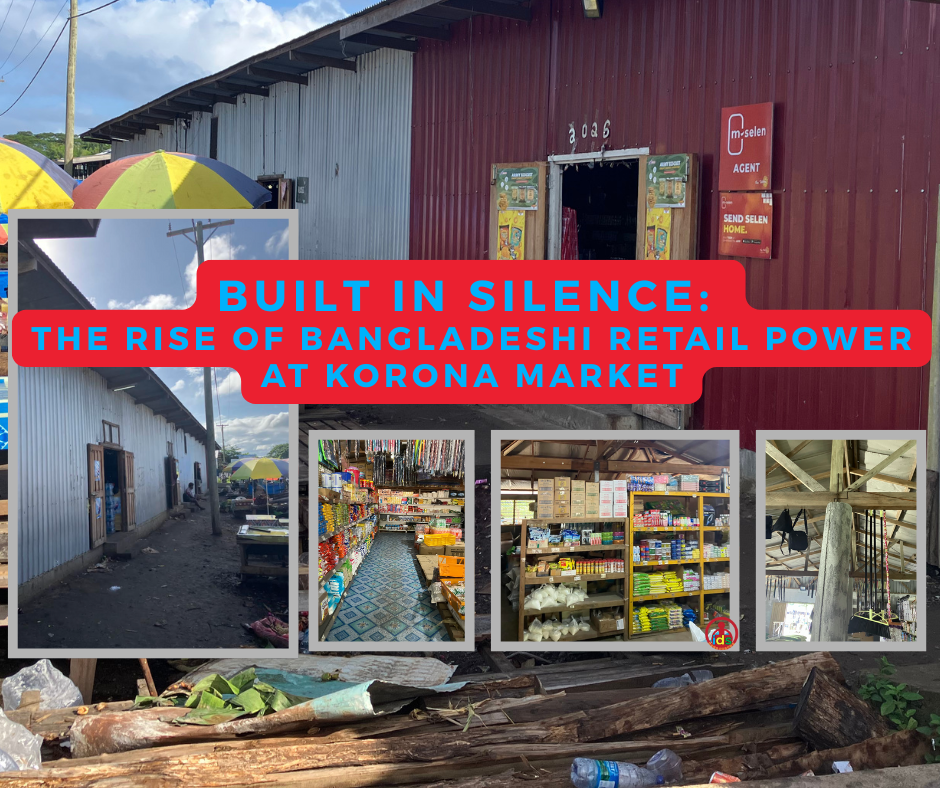
At Korona Market, east of Honiara, controversial Bangladeshi retailers appear to have carved out a niche.
They are doing it quietly and without fanfare.
No promotion, no shop signage — just basic warehouse-style buildings packed with household goods, manned by imported Bangladeshi male workers.
“These are all Bangladeshi stores,” Mary, a betel-nut seller at Korona Market, told In-Depth Solomons, pointing to shops on both sides of the road.
“There are no more locally owned stores here. They’ve all closed because they can no longer compete,” she added.
Located along the main road in the Tenaru area of Central Guadalcanal, Korona began as a makeshift betel-nut and vegetable market established by locals at the height of the COVID-19 pandemic.
It quickly gained popularity and expanded into a mini trading hub, with the addition of canteens, fish stalls and other small businesses.


Operating from various locations across Honiara and rural Guadalcanal, Bangladeshi retailers noticed the commercial potential Korona Market offered.
Quietly, they approached landowners with vacant plots around the market and struck deals.
They then moved in swiftly, erecting a number of warehouse-style buildings — structures that would struggle to meet even basic urban building standards.
Nine years after first setting foot in Solomon Islands under highly controversial circumstances, the Bangladeshi operators appear to have found a place where they could both operate and settle.
How did they come in?
Like the way they conduct their business, the arrival of Bangladeshi nationals was quiet and largely unnoticed by the public.
By the time Solomon Islanders became aware of their presence, they had already established a foothold in the country.
A confidential Solomon Islands Financial Intelligence Unit (SIFIU) report obtained by In-Depth Solomons states that the first Bangladeshi retailer arrived in 2016 from Papua New Guinea.
The report reveals that soon after arrival, the group established a patchwork of interconnected businesses and employed a complex and highly suspicious financial pipeline.
What emerges is a troubling portrait of suspected money laundering, possible human trafficking, and a network of companies that appear to operate less as genuine commercial enterprises and more as financial conduits — moving unexplained funds between Papua New Guinea, Honiara and Bangladesh.
The 29-page document, dated 29 July 2019, was prepared for the Office of the Prime Minister. It has never been made public — until now.
A “Businessman” Arrives
According to the SIFIU report, Bangladeshi national Shahjahan Ali arrived in Solomon Islands in 2016 from Papua New Guinea, where he claimed to have worked in his brother’s business.
He quickly applied for and obtained a work permit from the Labour Division.
Within months, the report states, Ali began receiving steady streams of money through Western Union from at least 10 individuals in Papua New Guinea.
In the first year alone, Ali received “more than SBD$315,000 in multiple Western Union transfers from individuals believed to be his associates in PNG.”
He used the funds to establish Sonar Bangla Enterprises Ltd (SBEL), his first Solomon Islands company, and opened a bank account with Bank South Pacific (BSP).
From there, the network expanded.
Network of Shell Companies
SIFIU investigators uncovered six interconnected companies linked to Ali and other Bangladeshi nationals:
-
Sonar Bangla Enterprises Ltd
-
Sonar Bangla Trading Ltd (PNG)
-
Jononi Enterprise Ltd
-
Friend Forever Trading Ltd
-
Star Life Company Ltd
-
Bismillah Enterprises Ltd
The companies shared striking similarities. Each operated from:
-
The same postal address
-
Directors originating from the same region in Bangladesh
-
In some cases, no legitimate business licences
-
Several had no bank accounts despite operating retail shops
-
Some used different trading names on signage compared with official registration
The web, SIFIU investigators noted, was tight, deliberate and opaque.
The most troubling pattern, however, was financial.
Millions Moving In and Out — With No Clarity
A suspicious pattern quickly emerged.
SBEL recorded:
-
SBD$2.2 million deposited between 2016 and 2019
-
SBD$2.1 million withdrawn almost immediately
A second business, Jononi Enterprise Ltd — owned by an associate — handled far larger sums:
-
SBD$24 million deposited
-
SBD$23.9 million withdrawn within the same period
The SIFIU report notes: “Large deposits followed by immediate withdrawals with no clear commercial explanation.”
Money flowed constantly — into Solomon Islands, through retail outlets, and then out of the country again.
Ali personally remitted more than SBD$80,000 to Bangladesh under the category “family support”.
Investigators, however, believed the funds may not have originated from family sources at all.
The PNG Connection – and the Possibility of a Larger Criminal Network
One of the most concerning findings was SIFIU’s suspicion that funds entering Solomon Islands may themselves have originated from criminal activities in Papua New Guinea.
Investigators wrote: “Dirty money transferred from PNG is being purified through retail shops in Solomon Islands and then remitted to Bangladesh.”
In anti-money-laundering practice, this follows a classic pattern:
-
Inject questionable funds into a small business
-
Pass them through as “sales”
-
Withdraw them as “business expenses”
-
Remit the funds overseas as “family support” or “business payments”
The structure allows illicit funds to appear legitimate.
The fact that multiple individuals in PNG sent money to the same recipients in Honiara raised further red flags — suggesting possible transnational links between Bangladeshi groups operating in both countries.
Published media reports in PNG show authorities there have previously deported Bangladeshi nationals after immigration raids uncovered visa breaches and illegal employment.
These actions followed repeated spot-checks, detentions and deportations involving Bangladeshis operating retail shops and similar businesses.
Forced Labour, Sham Marriages and Exploitation
The SIFIU report goes further, raising concerns largely unknown to the public.
Investigators documented worrying indicators:
-
Almost all workers in Bangladeshi-owned shops were Bangladeshi men
-
Possible use of fake passports
-
Alleged sham marriages to Solomon Islands women to obtain legal status
-
Workers housed in crowded accommodation under employer control
These indicators, the report states, are consistent with human trafficking and labour exploitation.
SIFIU also identified systemic weaknesses across multiple government agencies, including Immigration, Labour, the Business Registry, Inland Revenue, and money-transfer operators such as Western Union.
Investigators found:
-
Multiple workers on expired permits
-
Businesses failing to submit tax records
-
Foreign-owned shops breaching investment laws that reserve retail trade for citizens
-
Widespread use of multiple trading names
-
Poor coordination among enforcement agencies
In one striking finding, SIFIU noted that Bangladeshi operators were running retail shops despite laws restricting this sector to Solomon Islanders.
Government oversight, the report concluded, was simply not functioning.
The scale and coordination of the operations resembled “organised criminal behaviour with potential links to transnational networks.”
Where the Money May Be Going
The report raises a chilling possibility: that some funds leaving Solomon Islands could be supporting extremist activities abroad.
While SIFIU does not claim this is proven, it flags “risk indicators for terrorist financing”.
The concern is not unfounded.
International money-laundering cases involving Bangladeshi networks in Southeast Asia have previously been linked to:
-
Extremist financing
-
Human trafficking syndicates
-
Fraud rings
-
Fake passport networks
Public Concern
Public concern over the growing presence of Bangladeshi-run retail shops has been widespread — a sentiment frequently echoed across social media platforms.
Despite the severity of the 2019 findings, the report appears to have triggered no immediate action from government authorities.
This allowed the network to continue importing Bangladeshi labour, mostly young men.
Only recently have Immigration and other relevant authorities begun to act.

“We have now halted all new Bangladeshi entries,” Director of Immigration Christopher Akosawa told a recent Public Accounts Committee (PAC) hearing.
Akosawa said many Bangladeshi nationals entered the country through irregular migration during a period when his department lacked a functional Border Management System.
“We have now slammed the door on them. No more new entries,” he added.

Director of the Foreign Investment Division, Lynnette DaWheya, told the PAC hearing her division and Guadalcanal Province are working together to control where Bangladeshi operators are allowed to operate.
She said they are now restricted to operating between Korona Market in the east and Kakabona, west of Honiara. Previously, Bangladeshi retailers operated as far as Visale in northwest Guadalcanal and Tetere in the northeast.
DaWheya also said a second inspection of Bangladeshi-run businesses would be conducted soon.

Commissioner of Labour Brown Penuel Pwai said records for the first and second quarters of 2025 show that only three percent of work-permit holders were Bangladeshi — all renewals, not new permits.
“When I took office in 2024, there were no new work-permit applications from Bangladesh,” Pwai told the PAC hearing.
Whether the current enforcement push marks a genuine turning point for Bangladeshi-run businesses remains to be seen.
At the Korona Market, those manning the shops brushed aside requests to be interviewed.
The reality however, is stark: locals have been reduced largely to informal trading, while foreign-owned shops dominate and control the retail space.
* This news feature is produced with funding support from Internews
You must be logged in to post a comment.