
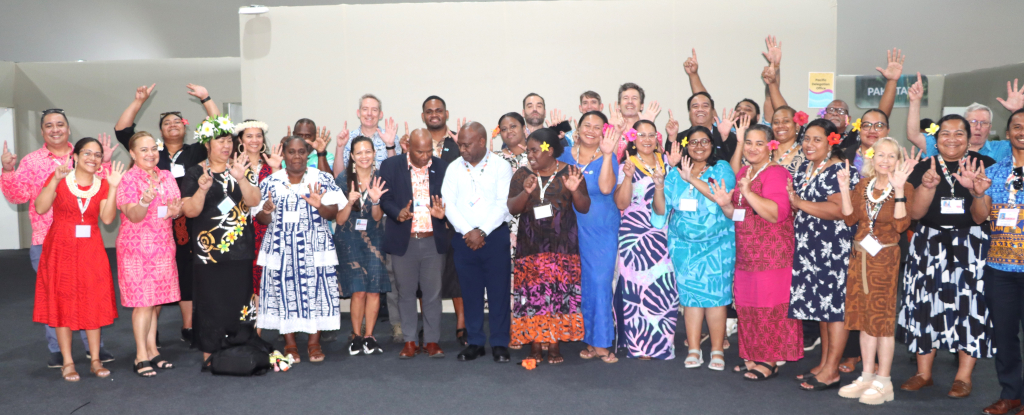
Pacific Island countries are ramping up calls for stronger international action on climate-induced loss and damage as negotiations enter a critical phase at COP30 in Belém, Brazil.
The High-Level Segment (HLS) of COP 30/CMP 20/CMA 7 is scheduled to commence tomorrow.
National or group statements will be delivered by registered and confirmed Parties and representatives.
The Solomon Islands Minister for Environment Polycarp Paea and Pacific Island countries are expected to make a national statement tomorrow.
From Fiji to the Solomon Islands, and communities across the Pacific Islands are already facing irreversible and harshest impacts, forced relocations, loss of land, cultural erasure, and mounting economic strain.
Fiji’s Minister for Environment and Climate Change, Hon. Mosese Bulitavu, described the crisis bluntly, “Families, communities and villages need to relocate now. This is already happening in parts of Fiji. Identities and cultural aspects have been lost due to the impact of climate change.”
With the operationalisation of the Fund for Responding to Loss and Damage (FRLD) underway, Pacific negotiators say COP30 must deliver the next steps needed to make the fund fully effective.
Daniel Lund, Special Adviser to the Fijian Government and one of the Pacific’s lead coordinators on Loss and Damage, said the region is united behind a clear message: “Global financing and governance structures must protect the world’s most vulnerable communities.”
“The Pacific continues to push for arrangements and financing modalities under the UNFCCC that can protect the most vulnerable,” Lund said. “Even with strong adaptation and mitigation, we continue to experience climate-induced loss and damage, and will continue to under all future climate scenarios.”
He said the FRLD stands out because it is specifically designed to support countries facing climate-related destruction, unlike existing funds that lack appropriate frameworks.
“This fund was shaped heavily by Pacific SIDS. Now we must ensure it is operationalised according to that vision,” he said.
Lund said negotiations on the broader Loss and Damage architecture remain complex due to “divergent views between parties.”
A key sticking point is how to scale up finance for the FRLD. “This isn’t a multi-million-dollar issue,” he said. “This is a multi-billion-dollar issue.”
Lund said COP30 must deliver a clear understanding of how global climate finance will be balanced across priorities while expanding what is available.
“It is more cost-effective, globally, regionally, nationally, to respond to loss and damage now than to bear compounding costs over time,” he said. “Our ability to adapt and build resilience will be undermined if we don’t address these trends.”
Looking ahead to the final days of COP30, Lund warned that current national climate commitments are insufficient to limit warming to 1.5°C.
“If we cannot address this fundamental failure, all work across the negotiations is at risk,” he said. “For the Pacific, it comes down to protecting the 1.5-degree goal and designing a response that matches the scale of the crisis.”
With loss and damage already reshaping lives across the Pacific, negotiators say COP30 must deliver outcomes that are not only ambitious, but urgent.
This story was produced as part of the COP30 Climate Change Media Partnership, a journalism fellowship organized by Internews’ Earth Journalism Network and the Stanley Center for Peace and Security.