
by Ednal Palmer and Ofani Eremae
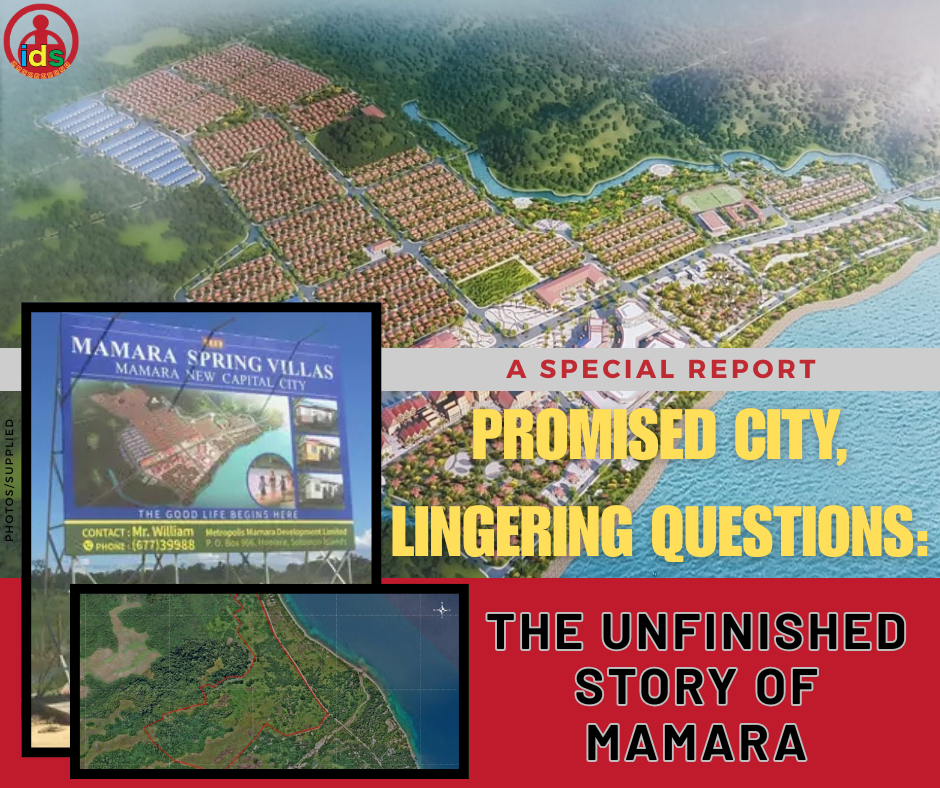
When former Prime Minister Manasseh Sogavare launched the Mamara Township Development Project in May 2021, he invoked hope and national expectation.
After more than 25 years of waiting for a transformative foreign investment, Sogavare told the nation its future city was finally arriving – a sprawling modern township west of Honiara, complete with homes, schools, shops, sports facilities and tourism infrastructure.
He called it a “game-changer”.


Hundreds of jobs were promised. Economic activity would follow. Pressure on the fast-growing capital would ease.
Locally registered Metropolis Mamara Development Ltd – owned by Malaysian logger Yii Ging Hii and Indonesian businessman Jimmy Luhur – was tasked with delivering the project.
But five years on, that promise increasingly appears uncertain.
Aside from about 50 residential houses – purchased by the Solomon Islands Government for $34.3 million – the ambitious township has barely materialised.
Now, In-Depth Solomons can reveal that the Government had been warned by the Central Bank of Solomon Islands’ Financial Intelligence Unit about the significant risks of associating with the project.
That warning, however, appears to have been largely ignored.

A Confidential Warning
Just six months after the project’s launch, the Solomon Islands Financial Intelligence Unit (SIFIU) delivered a stark assessment to senior government officials.
The November 2021 report warned that continuing with the development could expose Solomon Islands to “serious financial and national security risks”.
At the centre of the concern was the project’s purported foreign investor – Metropolis Pacific Pte Ltd, reportedly registered in Singapore and linked to Yii Ging Hii.
SIFIU investigators concluded the company was “highly likely” to be a shell entity.
Even more troubling, investigators said they found no evidence the parent company had injected funds into the project, despite being publicly presented as the principal investor.
Instead, the development appeared to be financed largely through secondary local sources – a pattern investigators said raised potential money-laundering risks and exposure to the domestic financial system.
The report identified several logging companies that made cash deposits into Metropolis Mamara Development Ltd’s bank account, including Solomon Resource Management Ltd, Mega Enterprise Ltd, Maximus International (SI), Mega Pacific Ltd and Blue Bird Company Ltd.
Company Haus records show Mega Enterprise, Mega Pacific and Blue Bird are linked to Yii Ging Hii.
Following the Money
Financial analysis uncovered what SIFIU investigators described as major red flags, including:
-
Large cash deposits into company accounts
-
Funding from unrelated business activities
-
Unclear sources of capital
-
Suspected over-invoicing of imported construction materials
The report states that materials used for the completed houses were imported from China, supported by government-approved tax exemptions.
Between 2020 and 2021 alone, the Government is estimated to have forgone $33.7 million in revenue due to these duty exemptions.
Compounding the risk was a web of interconnected companies operating locally and overseas under the “Metropolis” name.
Individuals linked to the network spanned multiple jurisdictions, including Malaysia, China, Indonesia and Singapore.
Perhaps most sensitive were reported associations between key figures and senior politically exposed persons (PEPs) – relationships investigators warned could create pathways for political influence and corruption.
SIFIU’s conclusion was unusually blunt: if the project proceeds, the Solomon Islands Government would likely be the “biggest loser”.
Investigators strongly advised against signing any sale and purchase agreement with the developer.
Yet the Government went on to purchase the 50 houses.

A 75-Year Lease – For How Much?
Under the Mamara-Tasivarongo-Mavo Development Agreement Act 1997, Metropolis Mamara Development was allocated approximately 100 hectares of alienated land under a 75-year lease.
However, the SIFIU report states that payments made so far total just under SBD$701,000 – covering only the first 26 years, with nearly five decades remaining.
For a development once billed as a landmark foreign investment, the financial return appears modest.
Investigators also reported that authorities were pressured to finalise purchase agreements despite the project lacking insurance coverage – a situation that could potentially expose taxpayers to significant risk.

A City That Barely Functions
Today, Mamara resembles less a future urban hub and more a remote housing enclave struggling with basic services.
The houses are not yet connected to Solomon Power or Solomon Water.
As a result, the developer has been generating electricity and water for residents.
However, residents recently endured overnight power cuts after the developer ran low on fuel – a situation the company described as temporary but necessary.
“Operating utilities alone requires roughly 10,000 litres of fuel each month, costing more than $130,000, while revenue from residents averages about $15,000,” the company said.
The developer claims it has operated at a loss for the past three years.
Unpaid rents have compounded the strain. According to the company, 10 houses carry two years of arrears, many occupied by government officers.
Meanwhile, Solomon Power has reportedly declined to extend electricity lines to the area – a sign the settlement may still lack the infrastructure expected of a modern township.

National Security Risks
Perhaps the most alarming section of the SIFIU report was not financial, but social.
Investigators warned that redirecting government housing schemes toward Mamara could trigger civil unrest or public protests if the project faltered.
They urged authorities to carefully weigh public interest considerations and recommended exploring legal options to terminate or repeal the agreement.
There is no indication those options were pursued.
Developer Pushes Back
Metropolis Mamara Development Ltd – a subsidiary of Metropolis Pacific Pte Ltd and holder of the Fixed Term Estate title – insists the project is progressing, albeit slowly.
A company spokesman said attracting investors to Solomon Islands is difficult without strong government backing.
“This is a government project and without its support nothing will move as everyone anticipated,” the spokesman said.
The developer says new activity is expected in 2026, including:
-
A resort at Turtle Beach
-
A solar power provider
-
A water manufacturing and bottling plant
But such promises echo the optimism heard at the project’s launch – optimism yet to translate into a functioning township.

From “Game-Changer” to Cautionary Tale?
Mamara was meant to symbolise economic confidence – proof that Solomon Islands could attract transformative foreign investment.
Instead, it increasingly risks becoming a lesson in the dangers of ambitious deals that outpace oversight.
For now, the promised city remains largely unbuilt.
And as the gap widens between vision and reality, one uncomfortable question lingers: was the game-changer ever real to begin with?
*This news feature was produced with financial support of Internews
You must be logged in to post a comment.