

Joanna Maru and her children waded carefully into Wagina’s shallow, warm waters, where the morning sun caught the gentle sway of seaweed lines.
These fragile, rippling strands are more than just plants; they are threads of hope, carrying the weight of her family’s survival and her community’s future.
“We make money from seaweed and support our families at the same time, but yields are not what they used to be,” she says. “We don’t know exactly what’s happening.”

Seaweeds destroyed by the rising tide from the Earthquake and Tsunami from of the coast of Russia mid this year\ Credits: Photo supplied.
For years, the sea has been Joana’s workplace and her lifeline. Seaweed once grew thick and steady, providing reliable income for coastal families. Today, rising sea temperatures, unpredictable weather, and sediment pollution from the mines threaten that way of life.
Joanna has been farming seaweed for over a decade now, assisting her husband in this work.

She says scientists from the Pacific Community (SPC), who previously trained local farmers, warned that climate change would eventually affect seaweed farms.
“We are starting to see it now,” she says. “Maybe this is it.”
Joana Maru and her husband Tony Uro at their home, Otin Tai’i, Wagina.
Leading the response to these threats is the KAWAKI Women’s Association, a network of women from Katupika and Wagina in Choiseul Province, and Kia in Isabel Province. Established in the mid-1990s, KAWAKI focuses on conservation, culture, and community development.
“Wagina depends on seaweed farming,” says KAWAKI president Nadariko Dilly. “The currents from Katupika, where mining is happening, flow to Wagina and the Arnavon Islands. That puts our livelihoods at serious risk.”

A young girl from Wagina helping her family to the prepare seaweeds planting materials before planting| Credits Charley Piringi
KAWAKI women have long been involved in protecting the Arnavon Islands, located in the Manning Strait between Choiseul and Isabel provinces. The islands host the largest rookery of critically endangered hawksbill turtles in the Pacific.
In response to decades of overexploitation, the Arnavon Community Marine Conservation Area was established in 1995 through a partnership between the government and the communities of Kia, Katupika, and Wagina.
Covering 40,000 acres of land and sea, it became Solomon Islands’ first nationally protected area in 2017, with support from The Nature Conservancy.
Women play a central role in managing the marine park, from monitoring wildlife to educating younger generations.

Wagina men pulling lines for new seaweed planting| Credits: Charley Piringi/IDS
While women work to conserve marine ecosystems, a growing threat is approaching from the mainland.
Mining operations at Siruka, on the northeastern tip of Choiseul, are stirring sediment and pollution that locals fear could devastate marine life. The operation by a Filipino logger Johnny Sy through Solomon Nickel Mining Company Ltd, following years of logging in the area.
“If mining continues in Siruka, it will destroy our marine resources for sure,” Joana says.
Sediment from mining has already begun clouding the water in parts of East Choiseul. Seaweed lines that once thrived are now thinning, and some farms have slowly experienced low yields in a single season.
Former KAWAKI president Samoa Piripo says the risks are clear.

Former KAWAKI president Samoa Piripo| Credfits: Charley Piringi
“We farm seaweed for survival. Women also dive for sea cucumbers and trochus. Mining threatens everything,” she says. “People talk about development, but development for who? If the sea dies, what do we have left?”
Mining pressures are not new to Wagina. In recent years, residents successfully resisted a proposal to mine bauxite on the island, taking the matter to court and winning.
Despite this, Choiseul Premier Harrison Pitakaka says his office continues to receive expressions of interest from foreign investors.
“That part of Choiseul must be protected at all costs,” he says.

Siruka Mining, North Eastern Choiseul Tip, started in 2023, but already threatening livelihoods: Credits: Charley Piringi
Director of Environment Joseph Hurutarau confirms that mining operations pose serious risks to marine ecosystems.
“We are aware of the mining activities, and they do threaten marine resources,” Hurutarau says. “Recent surveys show breaches of environmental laws, and we have warned the operators.”
Transparency Solomon Islands chief executive Ruth Liloqula, who is from East Choiseul, has called for mining operations to be halted.
“As women, we rely heavily on marine resources to support our families,” she says. “Mining activities must stop until proper procedures, land acquisition, and environmental safeguards are in place.”
Marine scientists say the concerns raised by Wagina’s women are well founded.
Vanuatu-based marine scientist Chloe Molou explains that sediment blocks sunlight essential for seaweed photosynthesis.

A young Marine scientist Chloe Molou of Vanuatu| Credits: Charley Piringi/IDS
“Marine plants like seaweed depend on sunlight for growth,” she says. “Sediment can destroy entire farming areas.”
SPC aquaculture specialist Chinthaka Anushka Hewavitarane adds that climate change is compounding these pressures.
“Rising ocean temperatures, extreme weather, reduced water quality, and sediment from land-based industries all reduce seaweed productivity and biodiversity,” he says.
Hewavitarane says SPC is now working with aquaculture research centres in Thailand and the Philippines to develop climate-resilient seaweed strains that could better withstand warming waters, for Pacific Islanders like Wagina women.
Despite mounting challenges, seaweed remains one of the most important livelihoods in Wagina.

Young People gathered to help out in sea weed farming at the Crocodile Passage, Wagina, Choiseul Province.
A recent SPC survey of 300 farmers found that families involved in seaweed farming earn 52 percent more than those who are not. Women contribute to most stages of production, and 38 percent of respondents said seaweed farming strengthens community networks.
For many women, seaweed is one of the few income sources available in remote island settings.
“Mining on Wagina would be like pulling a trigger on us,” says seaweed farmer Judith Rabaoa. The environment is our lifeline. But we are fighting against all these, we are not remaining silent.”
Youth farmer Norel Frances, from Taora in South Choiseul, agrees.
“This is something that belongs to us,” she says. “Not logging, not mining deals. Seaweed farming is ours. We will stand together to support our famers to grown in the future to come.”

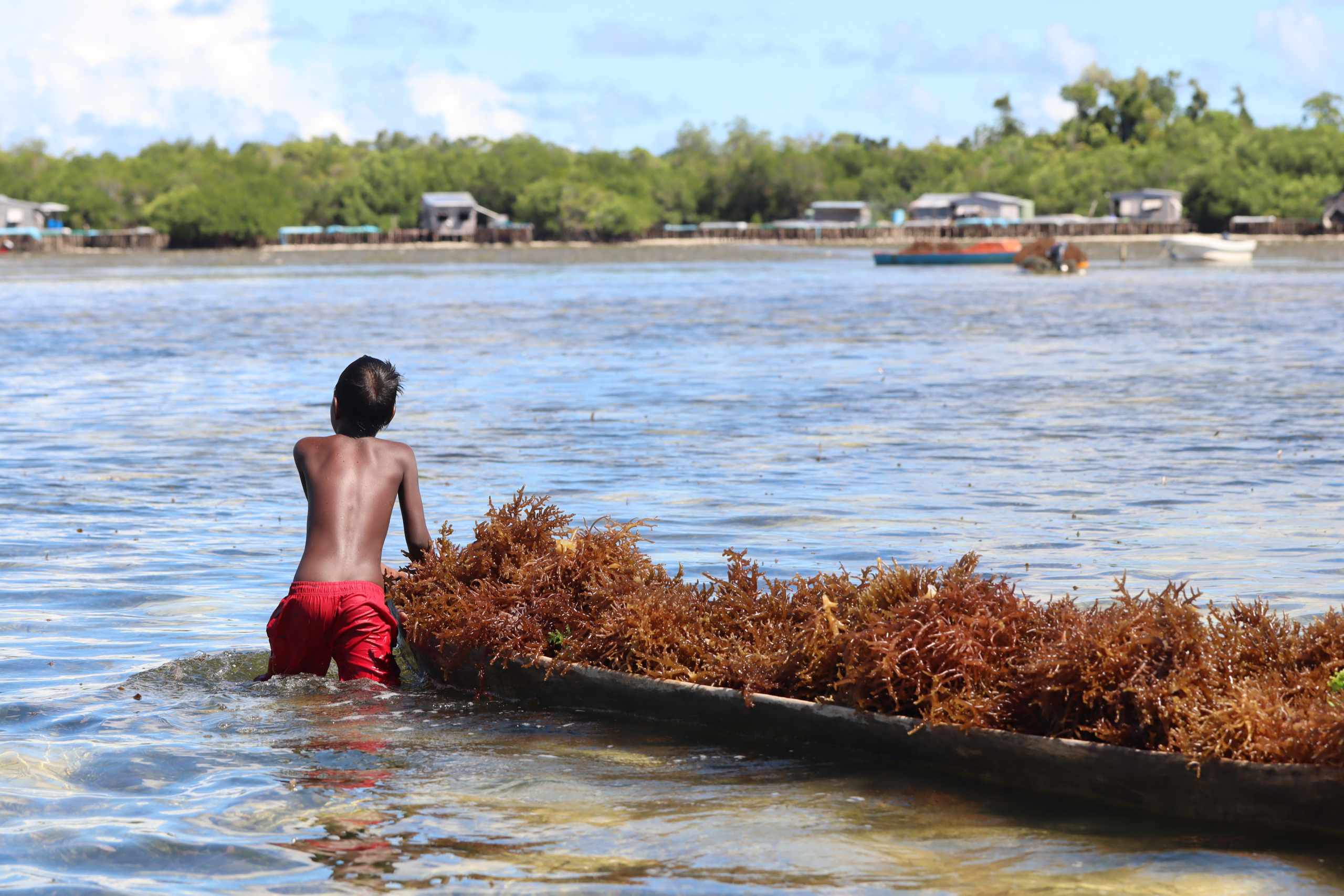
A chile helping in loading of seaweeds in a boat for drying ashore| Credits: Charley Piringi
The impacts of environmental change are already visible. Waters that once shimmered with fish now appear murky. Marine resources that supported families for generations are under strain.
Chief Robertpson Polosokia of South Choiseul admits he regrets allowing mining on his land.
“We can’t dive for fish or collect beche-de-mer anymore,” he says. “All we see now are murky waters.”
Still, the women of Wagina and KAWAKI continue their work, quietly, steadily, and with determination.
Each morning they return to the sea, tying new seedlings, checking water conditions, and passing knowledge to the next generation. They may not lead loud protests, but their actions are rooted in care and survival.
“As long as we wade into the water, with support from responsible authorities, steady and unyielding, we believe the sea, and our future, still has a chance,” says Joana Maru
This article, authored by Charley Piringi, was developed with support from the Earth Journalism Network’s (EJN) Deep Dive Project).
You must be logged in to post a comment.