
Up to 300 Solomon Islanders – including partners and dependent children – can move permanently to Australia each year under Canberra’s Pacific Engagement Visa (PEV) scheme, following confirmation of the doubled quota during bilateral talks this week.
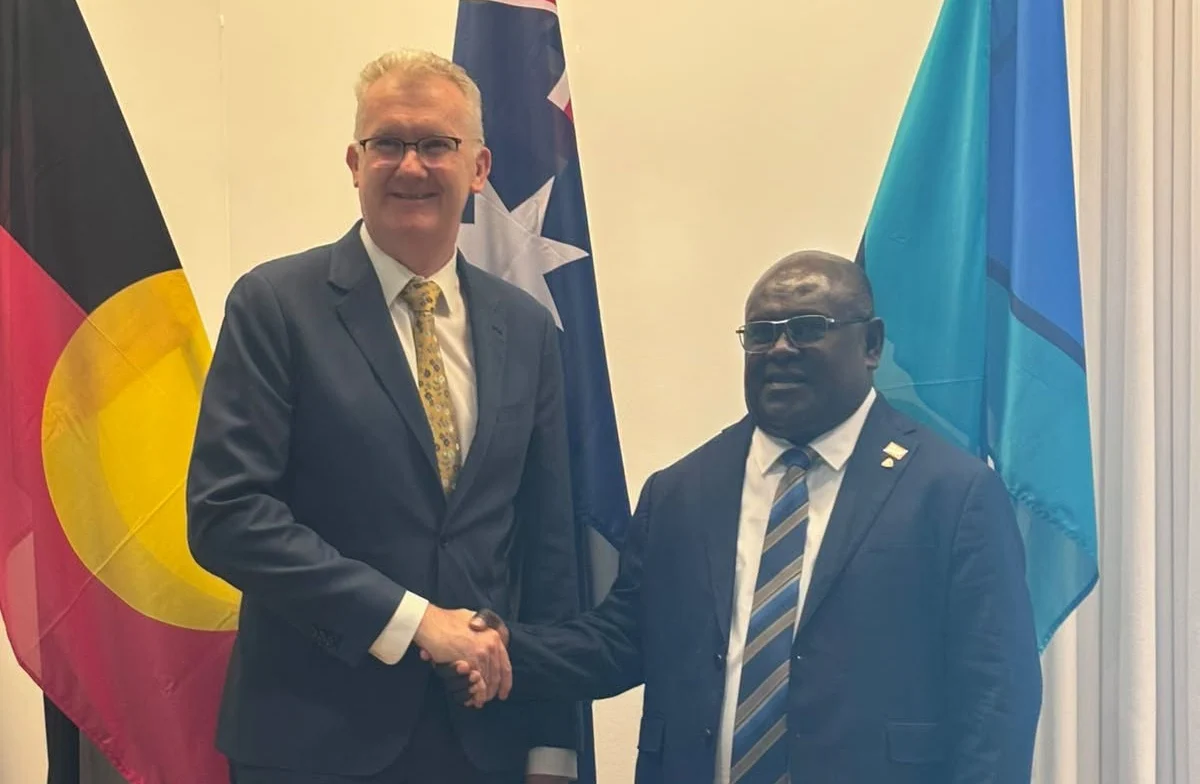
Minister for Commerce, Industry, Labour and Immigration Harry Kuma secured the migration and border commitments during a meeting with Australian Minister for Home Affairs Tony Burke on the sidelines of the Solomon Islands-Australia Treaty signing in Canberra.
Alongside confirming the 300 PEV places – double the 150 allocated when the scheme launched in 2024 – Australia agreed to extend the permitted stay for Solomon Islanders holding multiple-entry visitor visas from three months to four months per visit, making it easier to visit family, conduct business, and take part in church, community, and sporting activities.
“This is a welcome and practical step for our people,” Minister Kuma said in a statement after the meeting.
“Longer stays and more Pacific Engagement Visa places show that Australia values Solomon Islanders,” he added.
“We will continue working towards more flexible labour mobility opportunities.”
Launched in 2024, the Pacific Engagement Visa is a permanent residency ballot open to 12 participating Pacific nations and Timor-Leste.
Unlike standard Australian migration pathways, it carries no points test, no requirement for a university degree or skilled trade, and no formal employer sponsorship – meaning Australian businesses do not have to pay sponsorship fees or levies to hire PEV holders.
Applicants randomly drawn in the annual ballot must still secure an ongoing job offer in Australia – either for themselves or their partner – and meet basic English, health, and character requirements.
The 300-place allocation puts Solomon Islands in a three-way tie with Fiji and Timor-Leste for the second-largest quota in the region, behind only Papua New Guinea on 1,350 places.
Samoa, Tonga, and Vanuatu each receive 150 places, while Kiribati and Tuvalu each hold 100 places under the standard PEV stream – with Tuvalu also receiving a separate allocation under its bilateral Falepili Union treaty.
Palau, the Federated States of Micronesia, and the Republic of the Marshall Islands are each allocated 50 places.
During the Canberra meeting, Kuma and Burke also discussed Australia’s plans to establish visa facilitation services in Honiara, staffed by one Australian officer and two locally engaged staff, to improve access for local applicants.
The ministers further agreed to advance the second phase of Solomon Islands’ Border Management System, building on Australia’s backing for the first phase.
The next phase will introduce additional online services, improved data sharing, and stronger risk assessment as Honiara moves towards a fully automated immigration system.
On border security, both ministers welcomed progress at the Western Border Outpost and discussed establishing a similar facility in Temotu Province to strengthen security and services along the country’s eastern border.
Minister Kuma thanked Australia for its continued partnership and reaffirmed Solomon Islands’ commitment to modernising immigration services while strengthening national border security.
