
by Michael E. Miller (OCCRP) and Carmel N. Pilotti (OCCRP)
A Pacific island’s president bypassed an official selection process when he chose an Indian company to reopen a multi-billion dollar mine. He told OCCRP the firm’s managing director offered to pay for his wife’s kidney transplant but insisted it had “nothing to do” with the deal.
Key Findings
- Ishmael Toroama, the president of Papua New Guinea’s autonomous region of Bougainville, signed a memorandum of understanding (MoU) with Lloyds Metals and Energy Ltd in November 2025, despite warnings from Bougainville’s majority government-owned mining company, Bougainville Copper Ltd (BCL), that Lloyds lacked the technical and financial capacity of rival bidders.
- Toroama told OCCRP that in October 2025 — just before the MoU was signed — he accepted an offer from Lloyds’ managing director Balasubramanian Prabhakaran to arrange for his wife to travel to India and have a life-saving kidney operation at no cost to the president.
- Lloyds paid for the kidney transplant, according to an employee of the clinic where the operation took place. (Lloyds did not respond to multiple requests for comment.)
- Toroama told OCCRP the undisclosed arrangement did not influence his decision to choose Lloyds.
- Lloyds did not appear to follow the normal bidding process: after it signed a nondisclosure agreement with BCL in April 2025 that granted it access to confidential information about Panguna, within days Lloyds stopped communicating with BCL and never sent an official expression of interest.
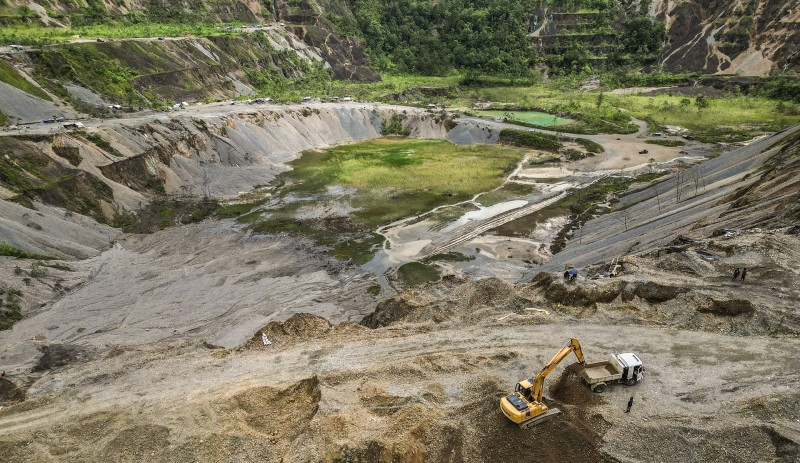
Almost 40 years after it descended into a devastating civil war, the autonomous region of Bougainville is on the cusp of achieving independence from Papua New Guinea. At its heart sits Panguna, a long-shuttered gold and copper mine worth an estimated $160 billion.
To relaunch the Panguna mine and generate the type of economic development that could support the impoverished region’s bid for full sovereignty, Bougainville’s majority state-owned mining company spent around 10 months on a public search for an international partner, speaking to some of the world’s largest and most experienced mining companies.
But last November, Bougainville President Ishmael Toroama made a shock announcement: he had signed a memorandum of understanding (MoU) to redevelop the mine with Lloyds Metals and Energy Ltd, a publicly-traded Indian company with no background in major copper and gold extraction.
The president’s surprise move followed a monthslong campaign by Lloyds and its managing director, Balasubramanian Prabhakaran, that completely bypassed the official process to select a partner on the project, an investigation by OCCRP has found.
This charm offensive included Toroama accepting an extraordinary favor. The president told OCCRP that, last October, Prabhakaran offered to fly his wife to India for a life-saving kidney transplant at no apparent cost, which Toroama accepted. Toroama did not publicly disclose his acceptance of the apparent gift.
Just a few weeks later, the two men inked the MoU putting Lloyds in line for mining rights potentially worth billions of dollars.

An announcement published on the Bougainville government’s website on November 20, 2025 shows Lloyds Managing Director Balasubramanian Prabhakaran (left) shaking hands with Bougainville President Ishmael Toroama (right) during the signing of an MoU that positioned Lloyds to acquire mining rights.
Toroama told OCCRP that his wife’s operation was a “personal arrangement” that he only agreed to after Prabhakaran had offered it three times. Although Toroama said it was his understanding that the cost of the first lady’s treatment was handled by the executive, he said it did not influence his decision to choose Lloyds.
Kabilan Natarajan, an administrator at the kidney center in India that performed the operation, told OCCRP that Lloyds had covered the costs of the transplant, and a follow-up visit months later.

Bougainville President Ishmael Toroama on the veranda of his office in Bougainville’s capital, Buka.
Prabhakaran and Lloyds did not respond to multiple requests for comment.
Documents obtained by OCCRP also show that Toroama — who wields significant power as both president and minister for mineral and energy resources — chose Lloyds despite warnings from the majority Bougainville government-owned company that was tasked with finding an international mining partner, Bougainville Copper Ltd (BCL).
The Indian company lacked the money and expertise to reopen the mine, BCL cautioned.
In a confidential letter sent 10 days before the MoU was signed, BCL’s chairman at the time, Melchior Togolo, told Toroama that signing the agreement with Lloyds would “discredit BCL with all other parties … leaving only Lloyds Metals as the potential future developer of Panguna.”
“Selection of the wrong partner could have lasting detrimental impacts for Bougainville through continued stagnation of the Project or, even worse, the Project could be developed to poor standards with potential environmental and social impacts,” Togolo warned Toroama in the letter obtained by OCCRP.
A chart accompanying his letter compared Lloyds to the five companies BCL was considering. It assessed Lloyds as having a far lower “technical” and “financial” capacity than rival bidders.
In another letter to Toroama in December 2025, BCL recommended the Chinese mining giant CMOC as the best choice to redevelop the mine. But in late January the president ignored the advice and announced Lloyds as his government’s official mining partner for Panguna.
Rather than form a joint venture with BCL and take an ownership stake in the mine, Lloyds would operate Panguna as a contractor without taking equity, according to Prabhakaran’s public statements and Toroama’s recollections.

A small-scale miner uses a homemade sluice box to search for small flecks of gold in the Panguna pit. The mine closed in 1989, but unauthorized miners have continued to mine there ever since.
In June, BCL was cut out completely when the Bougainville parliament amended the mining act to create a “special and exceptional pathway” for the accelerated redevelopment of Panguna. The next day a government-owned company called Bougainville Minerals Ltd was granted a mining license for Panguna, sidelining BCL.
In a speech last month at the mine, Toroama defended the legal maneuver, saying it meant the project could advance while BCL could focus on dealing with “legacy issues” including environmental damage from the old mine. During the same speech, the president said the new licensee, Bougainville Minerals, would be owned by the “government and people,” without providing details. Bougainville Minerals is now working with Lloyds on feasibility studies and preparatory works for the mine.
Controversy over Panguna’s operation comes at a pivotal time for Bougainville. The region voted overwhelmingly for independence in 2019, and Papua New Guinea’s parliament is set to start debating granting that sovereignty at the end of this month.
If independence is granted, Bougainville could become the world’s newest nation by as soon as 2030.

People queue to vote in Buka, Bougainville, during the referendum on independence from Papua New Guinea in November 2019.
Experts warn, however, that this dream hinges on the success of Panguna. The mine is the region’s only potential major money earner. Problems with its reopening could lead to instability.
“The whole thing is fraught with hazard,” said Paul Barker, executive director of the Institute of National Affairs, a think tank in Papua New Guinea, and expert on foreign investment and transparency. While Lloyds is “not a shrimp,” he said the company’s relatively smaller size and lower level of experience compared to competitors heighten the chance that things could go wrong. “Suddenly you’ve got a new player on the board that doesn’t really have a copper and gold background, it does add to the risks.”
Toroama’s decision to go with Lloyds has already been opposed by some locals, including prominent members of the community.
“The president does not own Bougainville,” said John Momis, a former president who has publicly questioned Betty Toroama’s medical treatment. “He wants to save his wife … but he should not then use it as an excuse to sell Bougainville.”
‘Outside of the Strategic Partnering Process’
Toroama told OCCRP he and Prabhakaran discussed Lloyds reopening Panguna during a helicopter trip to the mine in June 2025. As the chopper crested the Crown Prince mountain range, the mine’s mile-wide pit appeared in the jungle below. At its center stood a pool stained a brilliant turquoise by leached copper.

A boy plays in the Panguna pit in Bougainville, near a pond of water stained turquoise by copper.
Once one of the world’s biggest mines, Panguna had funded Papua New Guinea’s split from Australian colonial rule in 1975 by providing around 44 percent of export revenue until civil war forced its closure over a decade later.
The license to the mine was held at the time of the helicopter visit by BCL, a former subsidiary of British-Australian miner Rio Tinto that has since become majority-owned by Bougainville’s autonomous government.
BCL’s official search for an international partner to help reopen the mine had drawn expressions of interest from some of the world’s biggest mining companies, including CMOC and fellow Chinese firm Zijin Mining, both of which have experience mining gold or copper.
Lloyds was a fraction of the size of the Chinese firms and lacked experience in mining either precious metal, having been primarily an iron ore miner.
It initially participated in BCL’s official search process, signing a nondisclosure agreement in April 2025 that granted it access to confidential information about Panguna, according to letters between BCL, Lloyds, and Toroama obtained by reporters. But within days, Lloyds stopped communicating and never sent an official expression of interest, the letters show.
When Prabhakaran and Toroama visited the pit in June last year, they did not have the required permission from BCL to land the helicopter, according to two people with direct knowledge of the event who spoke on condition of anonymity for fear of a backlash from the government.
None of Lloyds, Prabhakaran, Toroama, or BCL responded to requests for comment.
On October 7, 2025, the day after Toroama was sworn in to a second presidential term, BCL wrote to Lloyds to complain about the company’s direct contact with officials, visits to Bougainville — including Panguna — and an offer from Lloyds to build a high-tech hospital in Arawa, the town near Panguna. Lloyds “appears to be operating outside of the strategic partnering process” agreed to by Toroama’s government, BCL warned.

Construction workers at the site of the high-tech hospital being built by Lloyds Metals and Energy in Arawa, Bougainville.
According to Toroama, it was around this time that Prabhakaran offered to take his wife to India for her kidney transplant operation.
Betty Toroama had been suffering from kidney disease for some time. Toroama told OCCRP that, by last October, he believed she only had a month to live.
Fearing that her mother wouldn’t live to see Bougainville become independent, Toroama’s daughter offered to donate a kidney, the president recalled.
Toroama said he “struggled” for two weeks over how to save his wife before accepting Prabhakaran’s third offer to help her.
“He said, ‘Can I take Betty?’” the president recalled. “I said, ‘Is it a generous offer? Because I don’t like you charging me.’”
The president recalled telling Prabhakaran his acceptance of the offer had “nothing to do with the [MoU] agreement…It has nothing to do with Panguna. It is totally nothing.”
Within a few weeks of agreeing, Toroama traveled to India to visit Lloyds facilities, he told OCCRP. A video that appears to be from that trip shows him being welcomed by a procession of musicians and dancers wearing headdresses with peacock feathers.

A still from a video of a welcoming procession for Bougainville President Ishmael Toroama at a Lloyds Metals and Energy steel plant in Konsari, India, in November 2025.
Shortly afterwards, Lloyds organized for around a half-dozen Bougainvilleans — many of them officials or people close to the president — to go on an all-expenses-paid trip to India, according to interviews with three people who went on the trip as well as photos, videos, and itineraries from their journey.
Back in Bougainville’s capital Buka, Toroama signed the MoU with Prabhakaran on November 20, before the delegation had even returned from India. The publicized ceremony was likely the first time most Bougainvilleans had heard of the company.
In the document, Toroama’s government agreed to “partner” with Lloyds for the mine’s redevelopment. Lloyds, meanwhile, said in the MoU it would like “to immediately construct, develop and commission” the hospital in Arawa as “a goodwill gesture.” The company also agreed to help with other projects including tourism, a technical college, a special economic zone, a bank, a new office for the president and a “pilot training club.”
The MoU was drafted in advance by Lloyds and provided to Toroama’s office, the president told OCCRP.
About two weeks after the MoU was signed, Betty Toroama underwent her surgery in the southern Indian city of Coimbatore. Natarajan, the administrator at the Coimbatore Kidney Centre, confirmed the operation took place on December 5, 2025, and said it was “paid by Prabhakaran’s company…Lloyds.” Reporters also obtained photos of Toroama and his daughter, who he said donated the kidney, in the city during the same period.

Toroama (far left) sits next to his daughter, wearing a medical mask, in Coimbatore, India, between late 2025 and early 2026, around the time his wife received a kidney transplant in the city. Toroama’s daughter was the donor.
On January 29, Toroama confirmed he was choosing Lloyds as his government’s official mining partner for Panguna, rejecting BCL’s choice of CMOC and putting the Indian company firmly in line to reopen the mine.
The next day, he and Prabhakaran led a groundbreaking ceremony in Arawa for the hospital, which will be named after the Indian businessman’s grandmother.

Prabhakaran and Toroama (circled in red) at a ceremony for the hospital in Arawa.
The Indian miner’s apparent role in the kidney operation arrangement is an open secret in Bougainville, an island of about 300,000 people who are divided over Lloyds’ arrival.
For some locals, the first lady’s operation is, along with the new hospital, a sign of the Indian miner’s goodwill. Francis Nasia, a local government official and landowner who was taken to India by Lloyds, said her recovery was proof of the company’s ability to help Bougainville.
“She was very sick,” Nasia said of the first lady, who has returned to Buka and no longer needs dialysis, according to the president. “People who have been dying because of no hospital, they will know that when this hospital is here, we will survive.”
‘Toxic Issue’
Panguna was a key catalyst of Bougainville’s civil war, with local anger over profit-sharing and environmental damage in the 1980s leading rebels including Toroama to launch an uprising in late 1988.

Buildings near the Panguna mine pit that once housed foreign workers are now home to local residents.
The decade-long conflict that followed forced the closure of the mine in 1989, led to as many as 15,000 deaths, and left the island deeply scarred. Years of tense negotiations concluded in a peace process, a degree of autonomy, and laws that required indigenous landowners to consent to mining projects.
Barker from Papua New Guinea’s Institute of National Affairs described the community tensions over the mine in the 1980s as a “toxic issue that…tore the island apart,” and warned that the situation could again “turn sour reasonably quickly” if the new project did not deliver tangible benefits for the local population.
Toroama said he chose Lloyds partly due to its claims to have delivered jobs and infrastructure to formerly conflict-ridden communities in India.
OCCRP found that Prabhakaran and the Indian company he founded, Thriveni Earthmovers Pvt Ltd, have a history of taking on difficult projects in India.
And while Prabhakaran has had success turning around troubled ventures, he also attracted scrutiny from regulators in the years before he started working with Lloyds in 2018. Thriveni and Lloyds have since been intertwined in a complex series of shareholding deals, with Prabhakaran holding top positions in both.
A government inquiry into “illegal” iron ore and manganese mining in the state of Odisha found in 2013 that Prabhakaran’s main company at the time, Thriveni, had improperly controlled mines where it was supposed to be just a contractor. It had also allegedly profited off of unusual contracts pegged to prevailing ore prices rather than fixed terms. The inquiry’s findings on Thriveni’s control over mines were later reversed.
Prabhakaran did not respond to a request for comment, but in the past has denied the claims made in the government inquiry, saying “all Thriveni does is mining.”
Prabhakaran himself was charged in Odisha by the state’s anti-corruption agency in 2010 along with several others for allegedly mining more than 300,000 metric tons of iron ore without paying royalties or sales tax, according to court records cited in the inquiry report and a Thriveni filing with India’s market regulator. In a motion to overturn the charges, Prabhakaran’s lawyers described the investigation as “illegal” and flawed. The charges were later dropped, according to the filing.
In Jharkhand state, Thriveni was hired in 2015 as an operator to jump-start a long-stalled nationally-owned coal mine. Before Thriveni was brought in, there had been a long-standing conflict between the state government and local population over land, employment, and displacement related to the mine. In 2016, farmers protested and police reportedly opened fire, killing at least four people.
And in the state of Maharashtra, Thriveni was hired in 2018 by Lloyds — which at the time was a separate, struggling company — to resurrect a massive iron mine that had been long blocked by Maoist rebels known as Naxals. Lloyds’ attempts to negotiate had been disastrous, with the company’s vice president reportedly slain by the rebels in 2013 and 50 trucks torched three years later.
Prabhakaran turned the troubled project around, overseeing the hiring of dozens of former militants at the same time as a brutal, government-led crackdown reduced the insurgents’ ranks.
Thriveni and Lloyds also invested in local infrastructure. In the village of Hedri, near its large Surjagarh iron mine, for example, Lloyds built a 300-student primary school and a 30-bed hospital — also named after Prabhakaran’s grandmother.
Thriveni and Lloyds then entered into a partnership. Thriveni became Lloyds’ largest single shareholder and Prabhakaran Lloyds’ managing director, while Lloyds acquired a majority stake in a unit of Thriveni last year. Lloyds — which is listed on Indian stock exchanges — has thrived since. The company’s revenue has soared from less than $27 million in the fiscal year 2020-2021 to more than $1 billion in the fiscal year 2025-2026.
Prabhakaran, Thriveni, and Lloyds did not respond to questions.
Lloyds has rapidly grown its operations in Arawa, the town near Panguna, since January. When reporters visited in late May, they saw scores of employees from Lloyds preparing to do sample drilling.

A Lloyds Metals and Energy bulldozer operator takes a break while renovating a disused airstrip in Arawa, one of several civic projects undertaken by the company.
The company had by then already spent more than $11 million on civic projects including the new hospital that is under construction, according to Toroama.
While some Panguna landowners support the president’s plan for the mine and independence, others oppose the way the deal with Lloyds has been pushed through.
Moses Pipiro, one of the most vocal Panguna landowners opposed to the president’s plan, said he physically blocked Lloyds from bringing a drill into the mine pit in May.
Tensions have sparked protests by some traditional landowners and fears of renewed violence. To secure the site, Toroama told OCCRP the company had hired former rebels who fought alongside Toroama in the civil war to guard the mine, in line with a proposal by the Bougainville ministry of veteran affairs.
Pipiro, who is himself a former rebel commander, said he warned Toroama that discontent could flare into violence.
“I don’t want bloodshed,” Pipiro recalled saying.
Beverly Ittamari, another indigenous landowner from the Panguna pit area, criticized Toroama for signing the MoU with Lloyds without proper consultation. She said she was stunned when Toroama signed the agreement in November 2025.
“It did not go right when the president and some of the landowners went to India and then they signed this MoU with Lloyds Metals … without the knowledge of the [other] landowners,” she said.

Beverly Ittamari, an indigenous landowner from the Panguna pit area, fears that the mine’s reopening will destroy more of her family’s land and sacred places.
Her concerns were underscored by Toroama’s speech at the mine pit in early July, when he appeared to suggest that those opposed to mining would not receive the benefits.
“You have to come and work with us on this,” the president said. He had previously told OCCRP that all indigenous landowners would be given a combined 20 percent of the government’s stake in the mine.
Ittamari also expressed concerns over the potential impact of relaunching the mine. Two mountains had been destroyed to create the original mine, she said, and now she worries more of her traditional land and sacred places will be dynamited without her consent — and without compensation.
“When they know the gold is here, nothing is going to stop them,” she said.
Additional reporting by Aubrey Belford and Allan Gioni.
Fact-checking was provided by the OCCRP Fact-Checking Desk. Research and data expertise was provided by OCCRP’s Research & Data Team.

You must be logged in to post a comment.