
By John Tom
Honiara
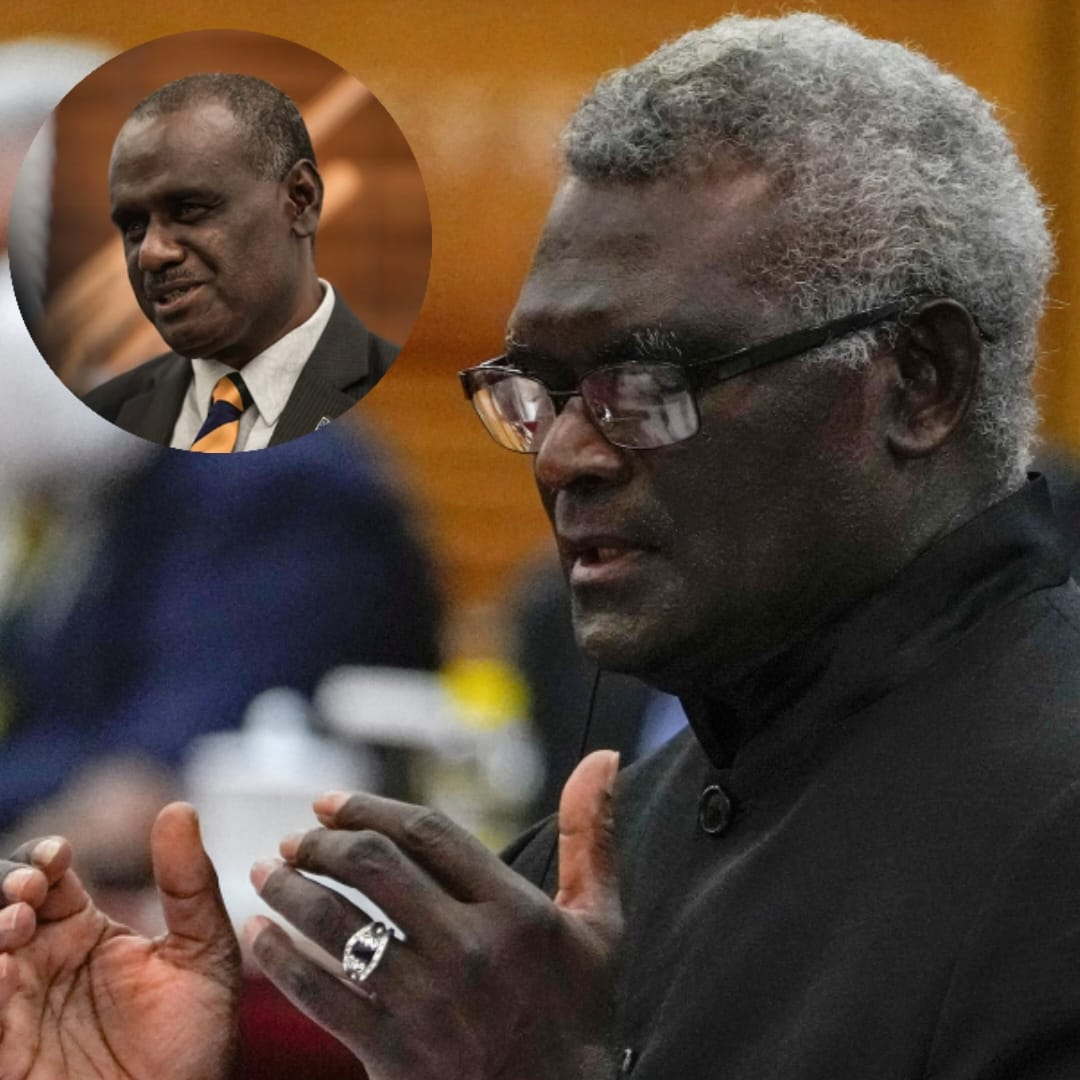
The return of former Prime Minister Hon. Manasseh Sogavare into the GNUT government as Deputy Prime Minister is not a sign of unity but a reflection of a political system under pressure.
Let’s take a look back at the events of April 2025 when Sogavare led a group of ministers and MPs and walked out from GNUT in a failed attempt to destabilize the same government he now serves.
Sogavare’s reasons back then was that Prime Minister Jeremiah Manele was a ‘weak leader’ and was indecisive, let alone Sogavare accused the Prime Minister of being subjective by the 3T’s (Hon Bradley Tovosia, Hon Jimson Tanangada and Hon Namson Tran).
It was a direct challenge to the Prime Minister’s authority. That makes Sogavare’s sudden return less about reconciliation and more about political expediency.
Unsurprisingly, the return of Sogavare to GNUT comes at a time when the government is facing a Motion of No Confidence and have now slipped into minority.
Sogavare knows well that his return to GNUT is not about realignment but access to power.
The pondering question is why did Sogavare return under the leadership of Prime Minister Manele who he deemed a ‘weak’ leader?
More critically, Sogavare’s return may not be about salvaging GNUT at all.
Political pundits assumed he might be positioning himself for what comes next.
With the Prime Minister facing a likely defeat in a Motion of No Confidence, the political landscape is already shifting toward ‘who’ emerges within GNUT after GNUT falls.
In this context, Sogavare’s move places him at the centre of GNUT at the most strategic moment.
By returning as DPM, he strengthens his prominence, rebuilds alliances, and positions himself as a ready-made candidate for Prime Minister should GNUT collapse.
The question of whether majority of GNUT members will favour this likely scenario is a matter for debate.
The Sogavare factor is actually not new. It reflects a familiar strategy, a pattern in Sogavare’s political history.
His rise to Prime Ministership in the past has often come not from stable, long-term mandates, but from moments of political transition when governments weaken, fracture, or collapse.
Sogavare has a great political mindset; a seasoned politician that strategically calculates his positioning, timing, and control of numbers become decisive.
His latest move aligns with a strategic approach and that is, enter at a point of instability, consolidate influence, and emerge as the compromise or consensus candidate when leadership changes.
This historical pattern strengthens the argument that his intention is not to stabilize GNUT, but to be strategically placed to inherit power.
But the most striking feature of this situation is the contradiction placed as the leader who only 11 months ago in April 2025, attempted to dethrone Manele and GNUT, and publicly questioned its leadership, and now entrusted as the second in command under a leadership he previously threatened to overthrow.
So the fundamental question is;
If the leadership was weak then, what makes it legitimate now? What has changed?
The absence of a clear answer weakens public trust and reinforces the perception that political loyalty is fluid and transactional.
While political elites may reposition themselves quickly, public grievances remain unresolved and we citizens must be reminded.
And one thing for sure is GNUT is DCGA in disguise.
Have we forgotten issues such as:
- The controversial tax exemptions
- Governance concerns around “sufferance wharves”
- The reported 33 mining shipments from Renbel
- The perception of influence by the “3Ts” over Cabinet decision-making
These are not isolated concerns but they reinforce a larger narrative of a government that lacks transparency and accountability.
But at the centre of the political uncertainty, we have ill informed leadership that is attempting to manage power outside of Parliament at a time when legitimacy is in question.
This nation is held at ransom intentionally. A noble and respected like Prime Minister Manele is well aware that in a parliamentary democracy, numbers are not negotiated in private but they are tested on the floor of Parliament.
The Motion of No Confidence is the constitutional mechanism to determine whether his government still commands support.
By deliberately delaying that process only deepens uncertainty and raises further doubts about the government’s legitimacy to govern with a minority.
There is only one place that this can be decided and resolved and that is at the floor of Parliament.
————————–
Disclaimer: The views and opinions expressed are solely those of the author and do not reflect the views of In-depth Solomons. We provide a platform for the author to publish his work, trusting that he has conducted his own research and fact-checking prior to publication, in the interest of informing the public.
