
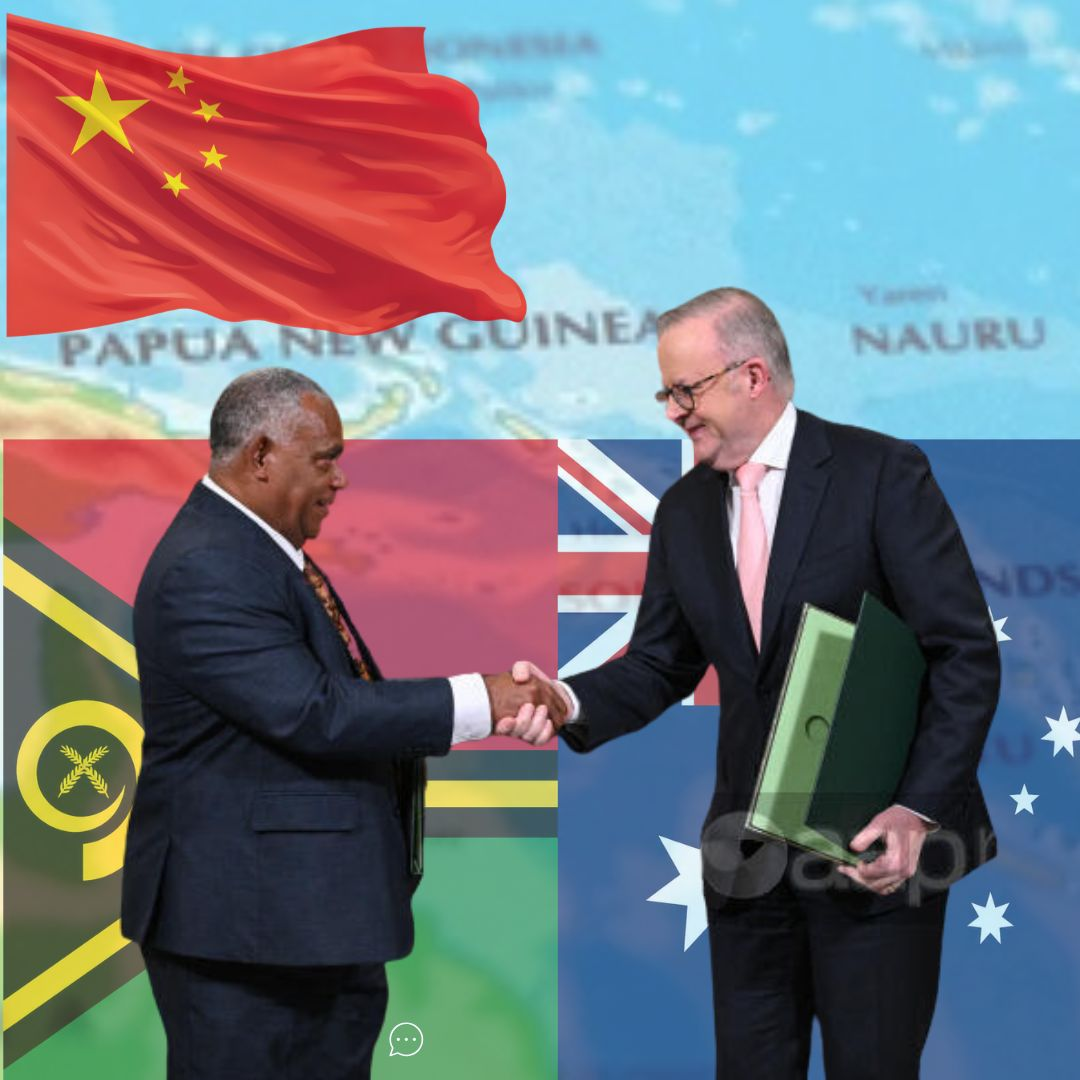
China hit back at Australia’s new security treaty with Vanuatu, warning that bilateral agreements should not target third countries, as Beijing pursued its own pact with Port Vila and declined to say whether it would release the text once it was signed.
Prime Minister Anthony Albanese and Vanuatu’s leader Jotham Napat signed the long-awaited Nakamal agreement in Canberra on Monday, almost a year after a planned signing ceremony in Port Vila collapsed over concerns Vanuatu would surrender too much sovereignty to Australia, particularly over foreign investment decisions.
Under the finalised Nakamal deal, Vanuatu has committed not to permit its territory to be used for any foreign military base and has recognised Australia as its primary policing partner, pushing back on China’s efforts to bolster its influence across the Pacific by training local police forces.
While Vanuatu will still be free to pursue Chinese investment in its critical infrastructure network, it has committed to consulting Australia, which will provide Port Vila with technical support to ensure safety and security on any future projects.
Asked about the Nakamal agreement on Monday, China’s foreign ministry spokesman Guo Jiakun said, “the co-operation should not target any third party, still less be used as an excuse for geopolitical contest”.
“We hope that the co-operation between relevant countries and Pacific nations will be truly conducive to the development and stability of the Pacific Islands region,” Guo said.
China is now in discussions with the Vanuatu government to sign its own agreement – the Namele agreement – though Napat has forcefully denied to local media that it would amount to a security deal. Vanuatu has a foreign policy of non-alignment.
Napat on Monday committed to sharing a copy of the Namele agreement once it had been signed with Beijing.
But Guo would not commit China to releasing the deal text, instead saying that “China always handles the documents on bilateral co-operation with Pacific island nations on the basis of friendly consultation”.
“China’s co-operation with Pacific island nations is fair and square. Our co-operation is not imposed on anyone, nor targets any third party, and has been sincerely received by the people in the region,” Guo said.
The Albanese government has tried to strengthen Australia’s ties with the Pacific after the Solomon Islands stunned the region in 2022 by striking a secretive defence pact with Beijing.
Solomon Islands’ new Prime Minister Matthew Wale said this month that he could not release details of his country’s security pact with China because of a non-disclosure clause in the agreement, even as he committed to negotiating a new strategic partnership with Australia.
To counter China’s influence, Canberra has signed far-reaching security agreements with Tuvalu and Nauru, giving it a final say over any other security deals the two nations might want to strike with other countries.
It has also inked a military alliance with Papua New Guinea and is finalising a security pact with Fiji, which Albanese is expected to sign in Suva next week. – Source: Financial Review
