
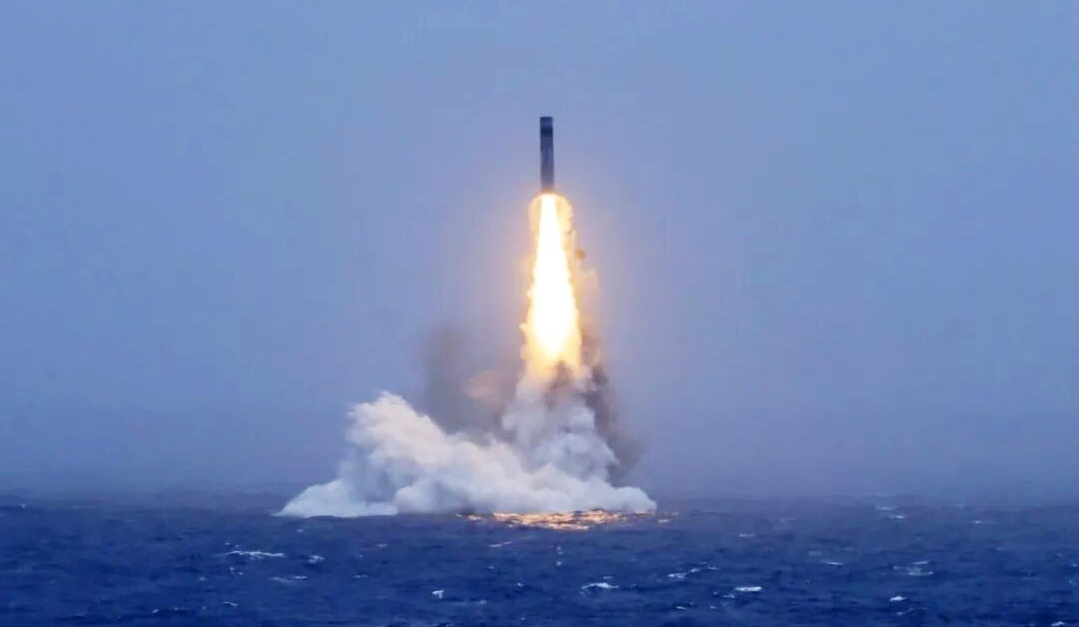
Pacific island nations are facing a security challenge in responding to China’s recent missile launch near Tuvalu and keeping their vision of a region as an “ocean of peace”, as analysts say the diverse nature of their ties with Beijing is complicating efforts towards a united response.
On July 6, China said one of its navy’s nuclear submarines launched a “strategic missile” carrying a dummy warhead towards “relevant high seas of the Pacific Ocean”, describing the test as routine annual military training that complied with international law and was “not directed at any specific country or target”.
Beijing said it had notified relevant countries in advance. Still, the move did little to ease the concerns of Pacific governments and partners, with some criticising the short warning period.
The missile appeared to have landed near the exclusive economic zones of Tuvalu and Kiribati, 1,000km (621 miles) northeast of the Solomon Islands.
The Pacific region has for decades been cautious of missile tests as a result of the hundreds of nuclear tests carried out by the US, UK and France in the second half of the 20th century.
While leaders from Tuvalu, Palau and the Solomon Islands have strongly criticised the Chinese missile test, the 18-member Pacific Islands Forum (PIF) held in Suva, Fiji, on Wednesday failed to draft a united statement against it.
Member states are expected to reconsider the issue during a meeting of the bloc’s foreign ministers in Suva and a meeting of its leaders in Palau from August 30 to September 4.
Bernard Singu Yegiora, an international relations lecturer at Divine Word University in Papua New Guinea, said many PIF countries maintained strong bilateral ties with China.
Papua New Guinea initially criticised China’s missile test but later closed the Taiwan Economic and Cultural Office in Port Moresby, reaffirming its adherence to the one-China principle.
“Although there is no direct evidence linking these two developments, the timing may indicate the influence that China’s bilateral relationships can exert on the policy calculations of Papua New Guinea and other member states,” Yegiora said.
“These differing national interests will make it difficult for the PIF to reach a common position.”
Beijing strictly requires countries establishing diplomatic relations with it to recognise the one-China principle stating that Taiwan is part of China and forbid them from having any formal ties with the island.
Previous US missile tests in the Pacific had also not drawn a collective response from the PIF, said Yegiora, who noted that Washington and Beijing were aware of the long-standing opposition of Pacific island nations to nuclear weapons testing in the region.
Between 1946 and 1996, the US, UK and France conducted over 300 nuclear tests in the Pacific, particularly in French Polynesia and the Marshall Islands, resulting in radioactive contamination, mass displacement, high cancer rates and a generational trauma among the region’s residents.
Created in response to these tests, the 1985 Treaty of Rarotonga prohibits nuclear testing, dumping of radioactive waste and toxic matter at sea and commits member nations to non-proliferation and encourages nuclear powers to respect the region as a nuclear-free zone.
Comprising mostly South Pacific nations, the treaty includes five
nuclear-power signatories – France, the UK, the US, China and Russia.
Oliver Nobetau, director of the Pacific Islands Programme at the Sydney-based Lowy Institute, said the absence of a statement by the PIF over Beijing’s missile test arose from the region’s diversity, with consensus limited to issues such as climate change and fisheries.
These nations do not have a common position on regional security, according to Nobetau. As such, there were doubts about whether a regional security treaty proposed by the Solomon Islands could succeed, he added.
Last month, Solomon Islands Prime Minister Matthew Wale, who took over from pro-China Jeremiah Manele in May, proposed a Pacific-wide security agreement centred on a “Pacific-led security architecture”.
The treaty aims to ensure that regional security challenges are primarily addressed by Pacific island nations and is seen as a plan to curb China’s security role in the region.
These nations had a different experience from past nuclear tests among themselves, and their diverse economic partnerships with China were a factor to consider, Nobetau said.
For instance, French Polynesia suffered the most detonations and was still dealing with generational health effects, while Papua New Guinea was not as significantly affected, Nobetau said.
“It is difficult to reach consensus when not all parties share the same historical reality,” he added.
Hideyuki Shiozawa, director of the island nations’ division at the Sasakawa Peace Foundation, said Chinese embassies in Pacific countries had likely detailed explanations on the launch despite giving short notice.
“The incident did not appear to pose a problem under international law, as the missile landed in international waters,” Shiozawa said.
Although the missile was capable of carrying a nuclear warhead, it did not contain nuclear materials and was not a violation of the Treaty of Rarotonga, Shiozawa said.
Some Pacific island countries chose not to issue a strong statement to avoid provoking China even though the launch had fuelled their perception that they could become “targets within China’s strategic calculations”, Shiozawa said.
The test was a warning by Beijing against the growing security ties between Pacific island nations and Western powers, according to analysts.
It occurred just hours after Australia and Fiji signed a landmark mutual defence agreement called the Ocean of Peace Alliance.
“For some Pacific island countries, this event likely served as a wake-up call, highlighting the direct security implications of intensifying great-power competition in the region,” Shiozawa said.
China has strengthened military and security ties with Pacific island countries in recent years, including signing a security agreement with the Solomon Islands and expanding law enforcement cooperation with Fiji and Kiribati.
On the economic front, China trades with Pacific island countries primarily in resources, such as seafood, timber, and minerals.
It has also invested in the region’s infrastructure, ranging from ports to hydropower stations, and provided financial support, including grants and concessional loans. – Source: South China Morning Post
c