
by Charley Piringi
The Solomon Islands is losing an estimated US$79 million every year to climate-related loss and damage, equivalent to nearly nine percent of its annual GDP, according to new government data revealed during the Solomon Islands National Loss and Damage Media Training.
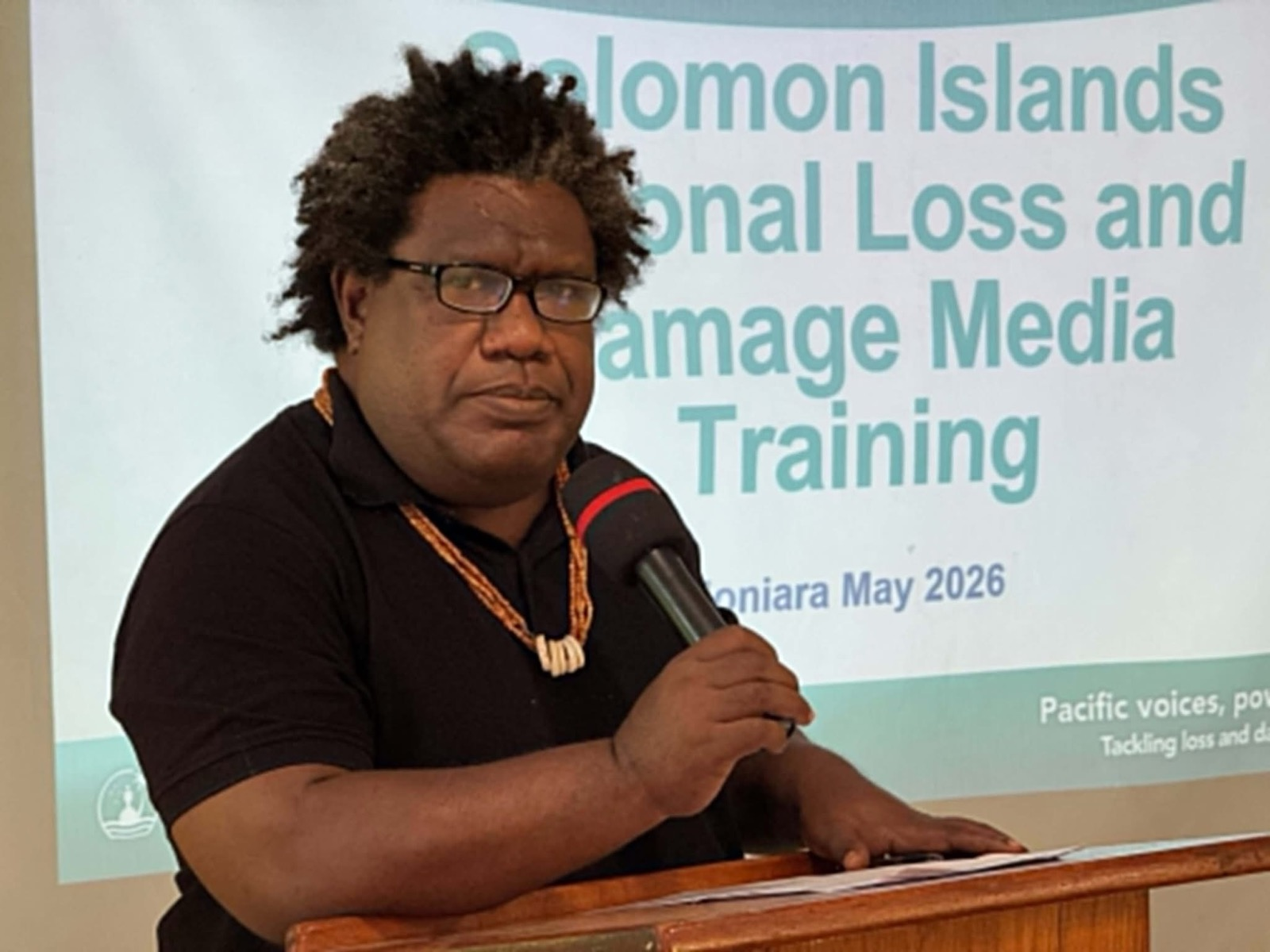
David Hiriasia, Permanent Secretary of the Ministry of Environment, Climate Change, Disaster Management and Meteorology (MECDM), addressed local media.
He characterized the country’s intensifying climate crisis as a profound human and economic ordeal rather than a simple environmental concern.
“Today is not just another workshop, but it is a call to action,” Mr. Hiriasia told journalists.
“For us in the Solomon Islands, and across the Pacific, climate change is not a theory, it is our lived reality.”
The training highlighted alarming figures from the draft Solomon Islands Climate Loss and Damage Evidence Base Report (MECDM, 2026), which quantifies the ongoing economic toll on the nation.
A core focus of the summit was educating the media on “Loss and Damage” (L&D), an emerging issue in the global climate agenda that is treated distinctly from mitigation and adaptation efforts and carries its own separate funding modalities.
The Pacific region has long championed this cause, with Vanuatu first raising the issue on behalf of Small Island States in 1991. These decades of advocacy culminated in the recent establishment of the Santiago Network in 2019 and the global Fund for Responding to Loss and Damage in 2022.
However, PS Hiriasia said that accessing these critical international mechanisms requires the Pacific’s voice to be heard loudly on the global stage, a responsibility that falls heavily on local journalists.
“The media has the power to transform statistics into human narratives, to amplify the voices of those on the frontline,” Hiriasia stated.
“Radio, television, newspapers, and digital platforms are not just channels of communication, they are instruments of change.”

The media training workshop is part of a broader effort to unify Pacific climate reporting. It was organized through a partnership between the Media Association of Solomon Islands (MASI) and the Secretariat of the Pacific Regional Environment Programme (SPREP), with financial backing from the Government of New Zealand under the Loss and Damage Capability and Capacity project.
Mr. Hiriasia said, equipping broadcasters and storytellers with the facts and frameworks surrounding climate loss and damage, the government hopes to mobilize action and hold major global emitters accountable.
“You are not just reporting,” the Permanent Secretary reminded the local media.
“You are shaping the global narrative of climate justice.”
[ENDS]

You must be logged in to post a comment.