
Global climate cooperation “is alive and kicking,” UN Climate Change Executive Secretary Simon Stiell declared at the close of COP30, a statement closely followed across the Pacific, where communities face some of the world’s most urgent climate threats.
On Saturday, a compromise climate deal was brokered by Brazil’s COP30 presidency. While the agreement commits to increasing financial aid for poorer nations like the Pacific Islands in tackling global warming, it notably failed to address the fossil fuels primarily responsible for climate change.
Brazil aimed to showcase global solidarity in tackling climate change impacts by securing the accord, despite the United States, the world’s largest historic emitter, choosing not to send an official delegation.
In his final press briefing in Belém, Stiell acknowledged the “roaring political headwinds” facing climate diplomacy, saying that 194 countries stood firm in solidarity, even as one major emitter, stepped back.
Despite the frustrations surrounding the agreement, the head of the U.N. climate secretariat (UNFCCC) commended the delegates for reaching a consensus in a year marked by denial and division.
“I’m not saying we’re winning the climate fight. But we are undeniably still in it, and we are fighting back,” UNFCCC Executive Secretary Simon Stiell said in a statement.
Stiell’s message provided both reassurance and a sobering assessment for Pacific Island nations. These nations are heavily reliant on international collaboration to address the dangers posed by rising sea levels and escalating natural disasters.

UN Climate Change Executive Secretary Simon Stiell| Credits: COP30
“For the Pacific… global solidarity is a matter of survival,” he said. “And that solidarity remains rock-solid.”
The global shift away from fossil fuels is now “unstoppable,” Stiell said.
This is a matter of critical significance for Pacific Island states, which have been advocating for a fossil fuel phaseout for over ten years.
“With or without navigation aids, the direction of travel is clear,” he told reporters.
Achievements under the COP30 Action Agenda include:
- US$1 trillion pledged to build clean energy grids
- Hundreds of millions of hectares of forests, land, and oceans protected or restored
- Over 400 million people gaining climate resilience
For Pacific governments investing heavily in renewables and coastal protection, from Kiribati’s seawalls to Fiji’s and Solomon Islands relocation programs, these global shifts carry immediate, practical significance.
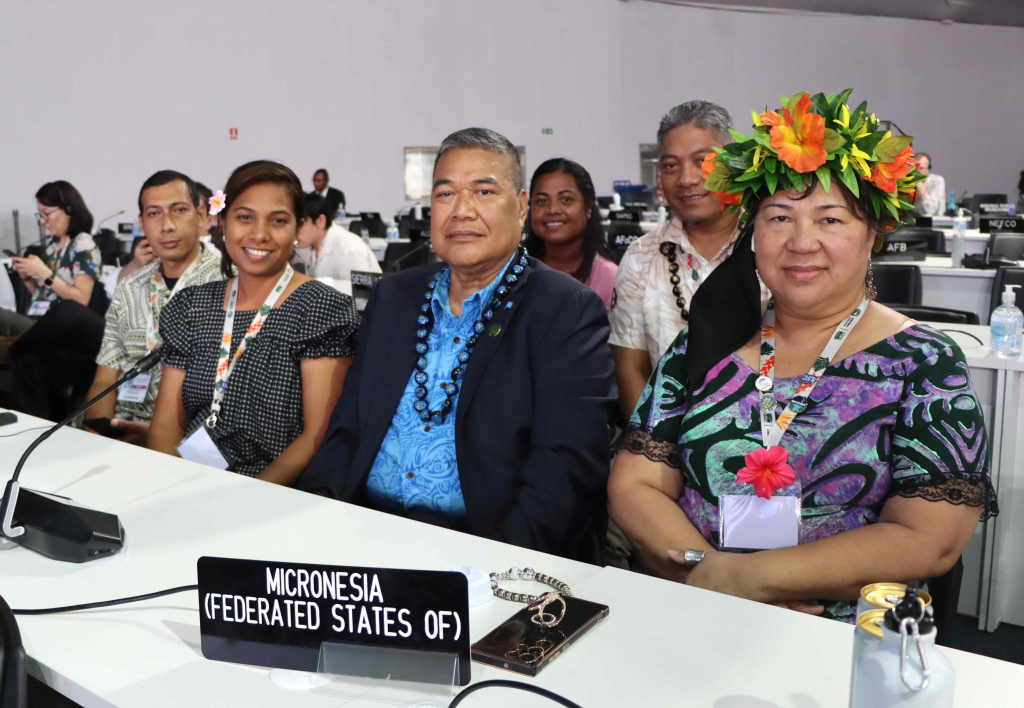
Micronesia’s Permanent Representative to the United Nations, Ambassador Jeem Lippwe told COP30.
“Across our islands and across the world, we are united in grief, and in purpose,” he said. “We must act with the same sense of collective purpose that we have seen in moments of great challenge, recognising that only together can we safeguard our future.”
Three Key Negotiation Outcomes
Stiell broke down the complex negotiated text into three major wins:
- Unanimous Agreement on Just Transition, Gender, and Adaptation Finance
All countries agreed to advance:
- Just transition frameworks
- Gender-responsive climate action
- A tripling of global adaptation finance
Pacific negotiators have repeatedly highlighted the need for climate policies that support frontline workers, women, children, and atoll communities. Stiell stressed that these commitments “aim to make lives better… particularly in vulnerable developing countries.”
- Powerful Political Signals in the Mutirão Text
The Belém outcome text includes unprecedented clarity:
- Paragraph 11: 194 countries affirm the Paris Agreement is working, and must accelerate.
- Paragraph 10: The global shift to low-emission, climate-resilient development is irreversible.
- The 1.5°C limit is reaffirmed, a long-standing red line for Pacific states.
Leaders are ramping up climate action, Stiell noted, “because it’s in their national interest… and creates economic growth.”
- A Clear Path Forward for All Countries
The Mutirão Text consolidates earlier decisions, from Dubai’s energy transition deal to Baku’s finance commitments, and sets new expectations:
- Paragraph 29: All actors must “significantly accelerate and scale up” climate action.
- Paragraph 33: Countries must strengthen national climate plans (NDCs) and strive to do better collectively.
- Paragraph 52: The new global climate finance goal must now be implemented.
The slow pace remains a concern for Pacific Island nations, where the emphasis on operationalizing climate finance is crucial due to delays hindering adaptation and relocation efforts.
Stiell openly acknowledged the frustrations of vulnerable nations, many of which pushed for stronger commitments on phasing out fossil fuels, scaling up finance, and responding to climate-fueled disasters.
He said “The world is moving in the right direction. The shift from fossil fuels to renewables and resilience is unstoppable.”
He closed with a message that resonates deeply from Tuvalu to Solomon Islands to the Marshalls, “We’re building, day by day, step by step, COP by COP for a better world. For billions more people, in every part of the world.”
As Pacific delegations return home, the region is left weighing COP30’s progress against a narrowing window of survival.
For communities already relocating, for coasts already disappearing, and for youth who have never known a stable climate, the question remains: Can global momentum accelerate fast enough to match the pace of rising seas?
Ms. Josephine Moote, Deputy Permanent Representative of Kiribati to the United Nations, lamented that although the COP30 marks a decade since the Paris Agreement.
“For Kiribati, climate change is not an abstract concern; it is a lived reality,” she said. “Each encroaching wave erodes our heritage, our livelihoods, and disrupts our basic human right to access clean and quality drinking water and food.”
Pacific leaders’ voices throughout the COP30, the message is clear, “The world cannot afford to find out too late, because in the islands, every fraction of a degree, and every delayed dollar, comes with a human cost.”
This story was produced as part of the COP30 Climate Change Media Partnership, a journalism fellowship organized by Internews’ Earth Journalism Network and the Stanley Center for Peace and Security.
You must be logged in to post a comment.