
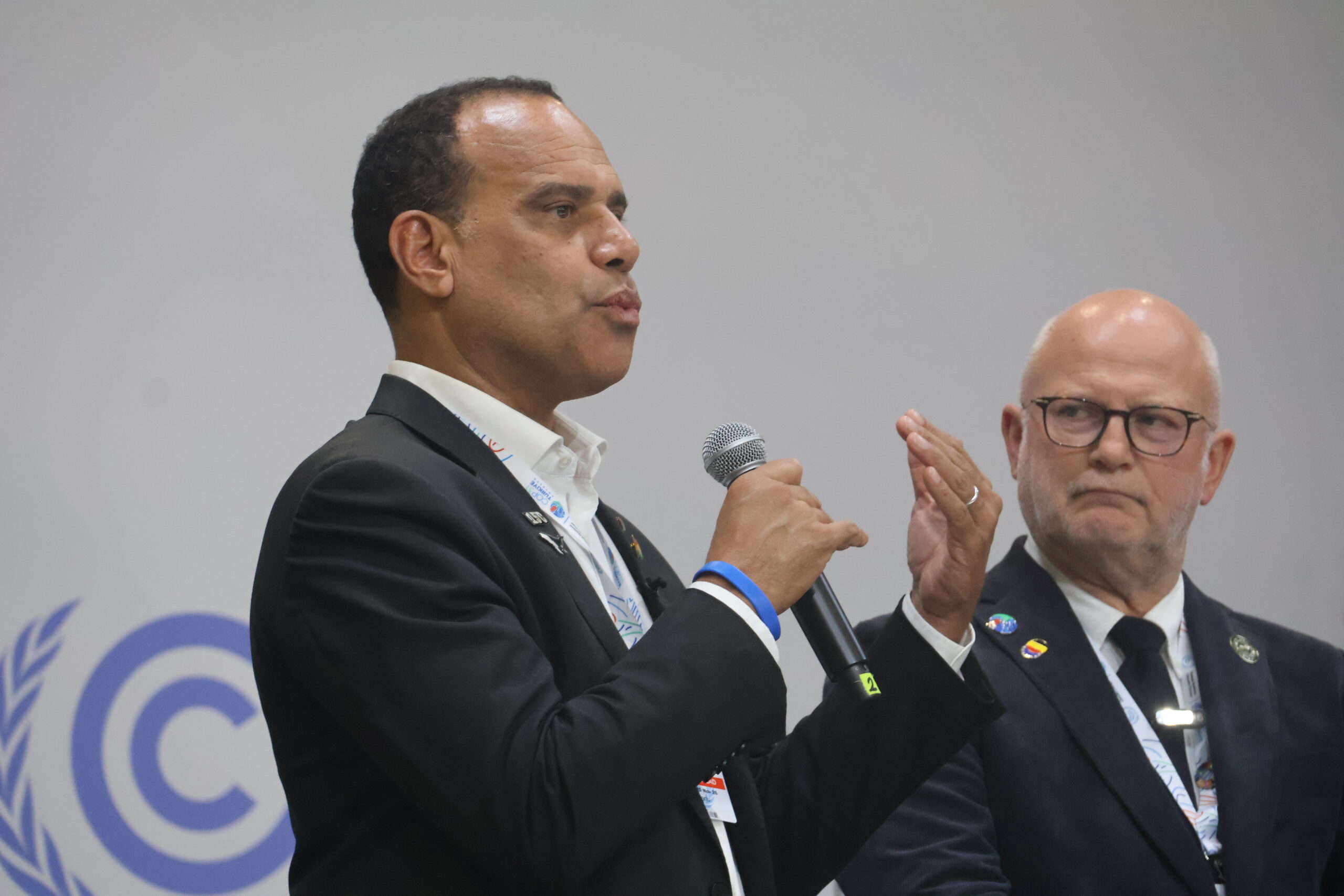
by Charley Piringi in Antalya, Turkiye
The Solomon Islands and Vanuatu have joined a broad international coalition alongside France, Spain, Panama, and several other nations in response to key regional priorities being omitted or diluted in the draft decision released yesterday.
Following the release of the second draft of the COP31 Presidency decision text, Pacific Island countries and Small Island Developing States (SIDS) have expressed strong disappointment
The alliance is calling for urgent, concrete outcomes on critical climate measures before the summit concludes.
Speaking to international media during a joint press conference, Panama’s Minister of Environment Juan Carlos Navarro emphasized the need for decisive action.
“We will not solve climate crises by more papers or more beautiful speeches,” Navarro said.

Outlining six core demands that must be reflected in the final document, Navarro stressed that climate science must remain the foundation of all decisions, alongside an explicit commitment to transition away from fossil fuels.
“Also, fair contributions to climate finance must come from those with greatest responsibility, you pollute, you pay,” he added.
Speaking exclusively to In-depth Solomons, expressing his disappointment, Vanuatu Minister for Climate Change Adaptation, Energy, Environment and Natural Disaster Ralph Regenvanu reiterated calls for the presidency to revise the text before the final text is released.
“We are disappointed with the text. We’ve identified the particular issues and paragraphs that we want to strengthen, and we’ve met the presidency and communicated that to them. And we’ve also sent the presidency our suggestions, and so we are now waiting to see whether they will be taken on board,” Regenvanu said.
Regenvanu noted that securing an unequivocal commitment to phase out fossil fuels remains a non-negotiable priority for the Pacific delegation.
“We are not happy with all the mentions of carbon capture utilization as a solution. We don’t think it is a solution. We need it taken out. We want the overshoot recognition strengthened,” he explained.
He further urged world leaders to acknowledge the risks of exceeding the 1.5°C global warming threshold, stressing that immediate actions are required to bring temperatures back down as rapidly as possible.
“We also want the advisory committee of the ICJ mentioned in the common decision, and the mention now is not strong at all, but it’s strengthened,” Regenvanu added, referring to the landmark International Court of Justice legal advisory opinion on climate change championed by Pacific nations.
The final COP31 Presidency decision text is expected to be released later today.
This story was produced as part of the COP31 Climate Change Media Partnership, a journalism fellowship organized by Internews’ Earth Journalism Network and the Stanley Center for Peace and Security.
