
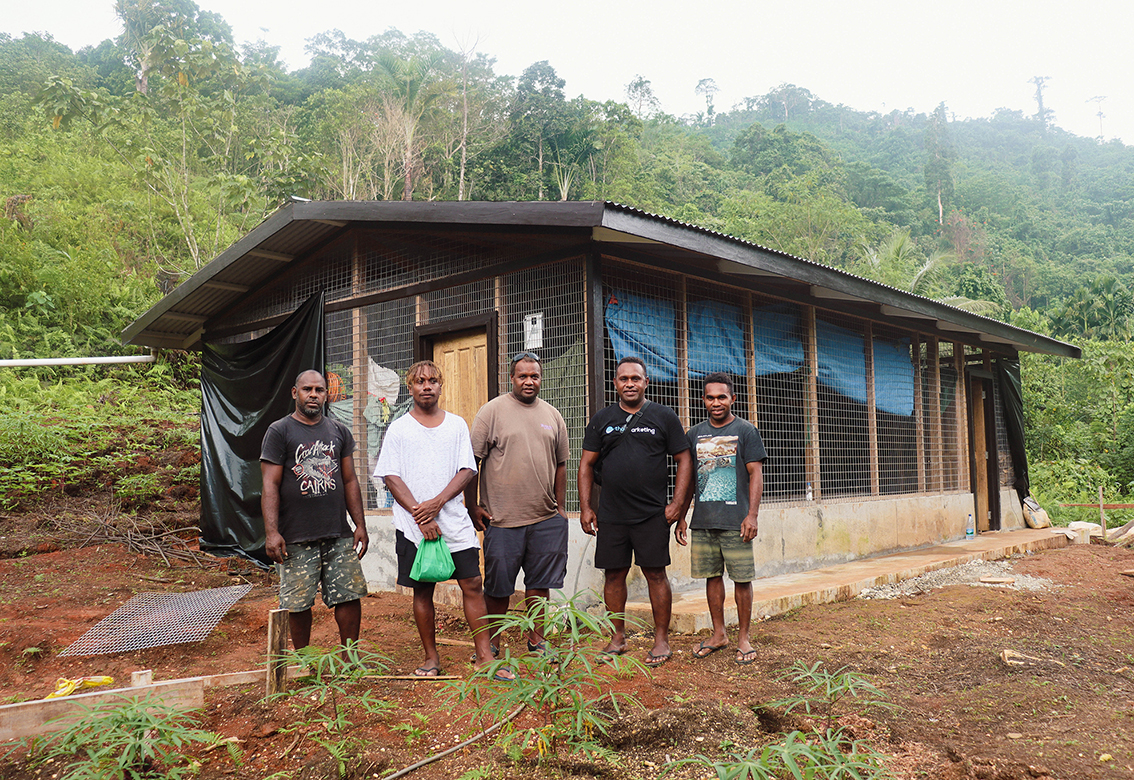
For high school teacher Alexander Dite’e, agriculture is more than a way of life – it is an opportunity to build a better future for his village.
A teacher at Aligegeo Provincial Secondary School in Malaita Province, Dite’e lives with his family in provincial capital Auki.
Before leaving Solomon Islands to pursue a degree in Fiji, he developed a keen interest in agriculture and gained experience in poultry farming.
He returned home determined to turn that interest into an opportunity for his community.
“The livelihoods of our people in the village depend heavily on agriculture to support our families,” he said.

With this in mind, Dite’e formed the ADA Alliance and Farmers Association, one of 45 Agribusiness Producer Organisations (ABPOs) in Malaita Province supported by the Solomon Islands Agriculture Rural Transformation (SIART) Project, a World Bank-funded initiative implemented by the Ministry of Agriculture and Livestock (MAL).
The association brings together 20 households from an extended family in Analolo Village, in the mountainous Central Kwara’ae region. Women and children are also part of the farming group.
As chairman, Dite’e and the association’s members will receive 1,000 day-old chicks through the SIART Project.
The project has also provided a poultry house, equipment, starter feed and a revolving fund to help the group establish and manage its agribusiness.
“Thank you to the SIART Project for this opportunity and for assisting our struggling farmers in rural communities,” Dite’e said.
“This support has put us in a position where we have the opportunity to start our village poultry farm and establish an organised agribusiness as a group,” he added.
The first batch of 500 chicks arrived in Analolo in late August 2026, with a second batch of 500 expected soon.
After about six weeks of feeding, the farmers plan to sell the birds at around SBD$120 each, potentially generating up to SBD$120,000 from the first 1,000 birds.
A central hub for the farmers
Every fortnight, Dite’e travels from Auki to Analolo to meet with members and oversee the association’s activities.
The farmers have agreed on a system to operate their agribusiness in its early stages while building a foundation for long-term growth and self-sufficiency.

Photo Credits: SIART Media
“The facility or poultry house constructed as part of the support from SIART will be our central hub where all the birds will be raised,” Dite’e said.
“When the birds are strong enough, we can distribute them to our farmers, who also have their own poultry houses that can cater for 50 to 100 birds,” he said.
The association’s initial goal is to build its cash base over the first two years by using the central poultry house to raise birds.
The farmers will then gradually increase their capacity to raise poultry at their individual farms.
SIART has also provided the association with a generator, solar set and freezer. However, the farmers’ longer-term goal is to build a storage facility in the village.
“This will allow us to store our birds after slaughter before transporting them to our buyers,” Dite’e said.
“As our cash base grows, we will use the money earned to build our storage facility, which is very important for us,” he added.
Building benefits and overcoming challenges
The farmers at Analolo are grateful to SIART for giving them the opportunity to establish their poultry business.
“The funding support from SIART is already a benefit for us,” Dite’e said.
“It has provided us with the opportunity to raise 1,000 birds and access feed without spending our own money.
“For us, this is a big help, which we really value. That is why we will ensure the project is implemented properly so that everyone and all our farmers benefit,” he added.
The association has also benefited from capacity-building training delivered through SIART, including training in farm management and financial literacy.
But operating an agribusiness in a remote mountainous community comes with challenges.
For the ADA Alliance and Farmers Association, geography is one of the biggest obstacles.
Getting to Analolo requires travelling by truck from Auki before walking from the main road crossing near the head of the Fiu River.
Dite’e says the farmers understand that overcoming such challenges will require commitment and teamwork.
“To ensure we successfully implement our project, we have to work together to mitigate the challenges,” he said.
“Farmers must have a sense of ownership of this project so that everyone contributes. We are not expecting immediate benefits, but over time we will reap the rewards of our hard work,” he added.
Because the association is made up largely of closely related family members, Dite’e said they are also well placed to resolve issues and challenges collectively.
Planning for life after SIART
With the SIART Project scheduled to end in late 2026, the ADA Alliance and Farmers Association are already planning for the future.
The association intends to use the SIART-funded poultry house as its central feeding hub for the next two years or so while building its cash base.
During this period, members will gradually develop their capacity to raise between 50 and 100 birds in their own poultry houses.
Once the farmers are ready, they will raise birds independently and sell them to the association, which will then market them.
“The association is currently working on securing markets for our birds in Auki and also in Honiara,” Dite’e said.
SIART has also provided ABPOs with revolving funds to support the establishment and operation of their agribusinesses.
Dite’e said the training provided through the project has been particularly valuable.
“The financial literacy training is an important aspect to ensure our farmers are capable of properly keeping and managing their records,” he said.
While building the poultry business, the farmers will continue their other village activities to generate income for their immediate needs.
“Most of our members were piggery farmers before we started this association,” Dite’e said.
“So, as our poultry agribusiness grows in the future, the association can also support our members to enhance their piggery farms if they wish.”
For now, with the first 500 chicks already settled into their central poultry house and another 500 on the way, the farmers of Analolo are taking their first steps towards building a sustainable village agribusiness.
For Dite’e and his fellow farmers, the goal is simple: start small, work together and build something that can continue long after SIART ends.
You must be logged in to post a comment.