
by Ofani Eremae
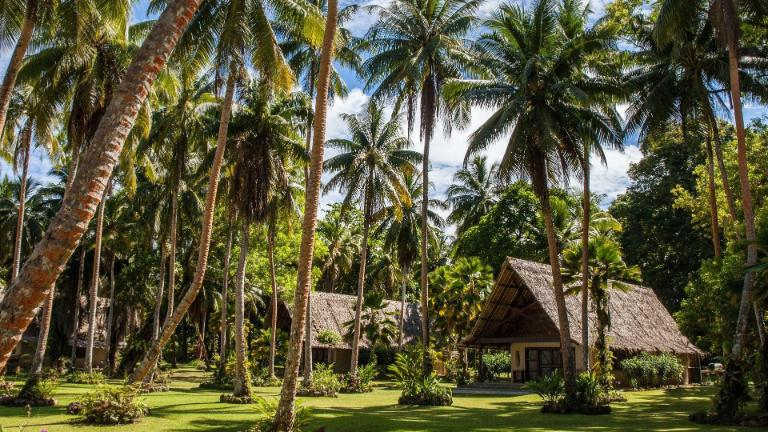
The Solomon Islands National Provident Fund (SINPF) is selling Tavanipupu Island Resort, one of its most high-profile tourism assets in East Guadalcanal.
Dr Philip Tagini, the recently appointed chairman of the SINPF Board, said the decision was made because Tavanipupu had become a liability rather than a profitable investment for members.

“It’s a serious decision to sell off properties,” Tagini told reporters as SINPF marked its 50th anniversary in Honiara this week.
“But we have no option but to sell because Tavanipupu is now more of a liability than an asset,” he said.
“The resort is not generating anything for us at this time.”
Located in the picturesque Marau Sound, Tavanipupu is one of Solomon Islands’ oldest resorts. It was first developed by Norwegian traders in the early 1900s.
The property changed hands several times before becoming Tavanipupu Island Resort Limited (TIRL).
By 2012, company records showed Pamela Kimberly and John Sullivan as shareholders of TIRL.
SINPF became involved with the resort in 2012 when it lent TIRL SBD15 million.
The loan later defaulted, leading to a court-sanctioned settlement under which SINPF took control of the resort and obtained title to the mortgaged property.
The Fund eventually became the resort’s owner around 2015 after the former shareholders failed to exercise their option to buy it back.
The SBD15 million loan has attracted public scrutiny over the years, with critics questioning the decision by the then NPF Board and management to finance the resort.
At the time, Austin Holmes was chairman of the Fund, while Tony Makabo was general manager.
The Numbers Don’t Support it
Tagini, who holds a PhD in Law and Policy from Monash University in Australia, said the resort’s poor financial performance was a key factor behind the decision to sell.
“The resort was making a loss,” he said.
“So our decision is purely based on numbers.
“Lots of people want us to keep the resort. It might be a good idea to keep it. But the numbers don’t support maintaining the property in our portfolios.”
Tagini said the prolonged closure of the nearby Marau airfield, due to a land dispute, had also made it difficult to operate the resort profitably.
“Marau airfield is critical to Tavanipupu’s viability,” he said.

“The airfield has been closed for many years. Right now, we don’t see it reopening anytime soon.
“So the possibility of making losses from the property remains in the foreseeable future.
“This is why we decided to liquidate the asset, bring the cash back in and look at future opportunities.”
SINPF chief executive officer and general manager Mike Wate was deputy general manager when the Fund provided the SBD15 million loan to TIRL in 2012.
Wate agreed SINPF was no longer generating revenue from Tavanipupu because of difficulties accessing the resort by land, sea and air.
But he said the Fund had recovered the original loan through acquiring the island after the borrower defaulted.
“When the borrower failed to repay, we recovered the loan through acquisition of the island,” Wate said.
“That’s how we recovered the loan.”
Neither Tagini nor Wate disclosed the property’s selling price.
Instead, they said SINPF would allow the market to help determine its value.
“We have a reserve price, but we let the market decide first,” Tagini said.
Story Behind The Loan
SINPF’s involvement with Tavanipupu began in February 2012, when it provided SBD15 million to Tavanipupu Island Resort Limited.
The loan was structured as a five-year facility, maturing on 22 February 2017, with interest payable at 12.5 per cent.
SINPF’s 2012 annual report recorded the transaction as a secured convertible bond.
The resort’s shareholders at the time included businesswoman Pamela Kimberly and Australian lawyer John Sullivan QC.
Recent reporting identified Kimberly as holding 90 per cent of the beneficial ownership and Sullivan 10 per cent.
The financing was intended to upgrade and develop the resort.

This included improvements ahead of the planned visit by Britain’s Duke and Duchess of Cambridge, Prince William and Catherine.
William and Kate visited Solomon Islands in September 2012 as part of their Diamond Jubilee tour.
They travelled to Marau and then by traditional canoe to Tavanipupu, where they spent the night before leaving the country the following day.
The royal visit brought international attention to the resort and reinforced its reputation as one of Solomon Islands’ premier private island resorts.
But the investment did not develop as SINPF had expected.
Less than two years after receiving the loan, Tavanipupu Island Resort Limited failed to make its third scheduled interest payment.
According to SINPF’s 2015 annual report, the Fund called up the loan before its February 2017 maturity date and applied to the courts for default judgment.
The parties eventually reached a court-sanctioned settlement on 14 October 2014.
Under the settlement, SINPF took management control of Tavanipupu Island Resort and obtained title to the mortgaged property.
The resort’s shareholders were given an option to buy it back from SINPF by 30 September 2016.
They did not exercise the option.
SINPF subsequently retained ownership of the resort.
Rather than immediately selling it, the Fund made Tavanipupu part of its property portfolio.
By 2017, SINPF valued Tavanipupu at SBD31.274 million.
The same value was carried in its 2018 financial statements.
That valuation was more than twice the original SBD15 million loan principal.
But the resort remained a difficult investment.
In 2018, SINPF publicly acknowledged Tavanipupu as one of its low-performing property investments, alongside its slipway investment in Tulagi.
The Fund said it was working to turn around the resort and other underperforming assets.
Five-Year Lease
SINPF later sought outside management for the resort.

In 2021, it leased Tavanipupu to Private Islands Investments Limited for five years. This company is owned by David Leong Yee, a local Chinese businessman.
SINPF said the successful bidder had been selected from companies that had expressed interest in leasing or managing the resort.
But the resort continued to face challenges.
In its 2021 financial performance statement, SINPF said its tourism investments were performing below pre-COVID levels because the domestic market was limited.
The Fund listed Tavanipupu among its tourism investments and confirmed that it had been leased to Private Islands Investments Limited for five years.
The resort’s problems now extend beyond its operating performance.
