
by Ednal Palmer
When I was a teenager leafing through old books in my high school library, I stumbled upon what I thought were descriptions of ancient biblical cities protected by towering stone walls.
As I kept reading, I realized these weren’t stories from Jerusalem or Jericho—these walls belonged to a distant land I had never seen, never touched, but somehow already admired: China. The Great Wall.
That moment sparked something in me. As I closed the book, the seed of a dream was planted.
I began to obsess over it. I watched documentaries, read history, traced maps with my fingers, imagining how such a feat could have been built centuries ago—over mountains, across alleys, winding like a dragon through the landscape.
It wasn’t just a wall; it was a wonder. And I vowed to myself that one day, I would stand on it. I wrote it down, right there in my notebook: “Visit the Great Wall of China.”

Years passed. Life happened. That line in my notebook faded beneath other goals, responsibilities, and distractions—but it never disappeared.
Then came April 2025.
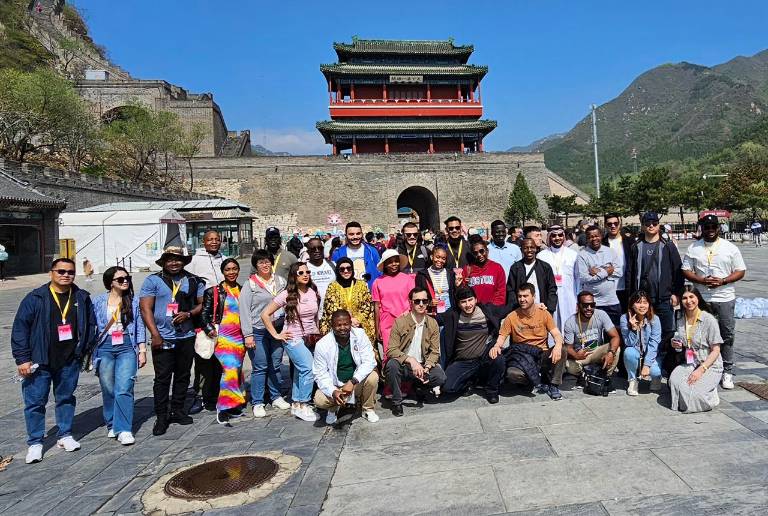
I was invited to join a cross-continental group of journalists on a tour and seminar in Beijing, China.
Among our scheduled destinations was the very place I had dreamed of for so long. As our bus drove through the countryside, winding up through rocky terrain, someone shouted from the front: “There it is!”
And there it was.
From the window, I saw it: the Wall, stretched high along the spine of the mountains, snaking across peaks like a silent sentinel.
It looked both ancient and alive, hugging the horizon with pride. My heart pounded as we pulled up at the base.
The day was young, tourists flocked to the base from all over the world. I stepped off the bus, and for a moment, I stood still—eyes fixed upward, breath caught somewhere between disbelief and reverence.
It was real.
The air was brisk, but sunlight warmed the chill, painting golden shadows across the stone. Around me, my fellow journalists chatted, laughed, took photos—but I could barely hear them. I was in a trance, alone with my dream.
Then came the climb.
No book had prepared me for the steep, very even stairs. Each step felt like a small battle. My legs burned, and my breath shortened.
I stopped often—pretending to take pictures, but really just trying to gather strength. Locals passed me with ease. Tourists, too. But I wasn’t racing anyone. I was climbing for that teenager who once sat in a quiet library, dreaming across pages.
And then, finally, I reached the first watchtower.
They were handing out small medals there—simple tokens for those who made it up. When they placed one in my hand, I smiled. Not because of the climb. Not even because of the medal. But because I had made it. I had stood on history. I had lived my dream.
The Great Wall was everything I imagined—and so much more. It was strength. It was silence. It was history echoing beneath my feet.
I stood at the summit, seeing the whole world from all corners. Clean chilly breeze combed through my hair, I was unmoved.
And for me, it was proof that dreams written down in youth, no matter how far-fetched, can one day become footsteps in stone.

About the Great Wall
The Great Wall of China is a series of fortifications in China. They were built across the historical northern borders of ancient Chinese states and Imperial China as protection against various nomadic groups from the Eurasian Steppe.
The first walls date to the 7th century BC; these were joined together in the Qin dynasty. Successive dynasties expanded the wall system; the best-known sections were built by the Ming dynasty (1368–1644).
To aid in defense, the Great Wall utilized watchtowers, troop barracks, garrison stations, signaling capabilities through the means of smoke or fire, and its status as a transportation corridor.
Other purposes of the Great Wall have included border controls (allowing control of immigration and emigration, and the imposition of duties on goods transported along the Silk Road) and the regulation of trade.
The collective fortifications constituting the Great Wall stretch from Liaodong in the east to Lop Lake in the west, and from the present-day Sino–Russian border in the north to Tao River in the south: an arc that roughly delineates the edge of the Mongolian steppe, spanning over 21 km.
It is a UNESCO World Heritage Site, and was voted one of the New 7 Wonders of the World in 2007.
Today, the defensive system of the Great Wall is recognized as one of the most impressive architectural feats in history.

You must be logged in to post a comment.