
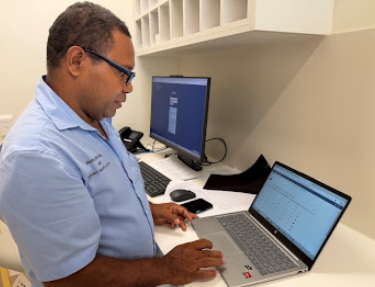
At the busy Naha Birthing and Urban Health Center in Honiara, where staff see more than a hundred patients a day, stacks of paper records once shaped every aspect of patient care.
Nurses spend valuable time searching through books, compiling reports by hand, and tracking patient information across multiple registers.
That picture is changing.
At the center of this change is head nurse Ataban Teimana, who has become a champion of District Health Information Software 2 (DHIS2), a digital system that allows clinics to store and access patient information electronically to improve health services.
For Ataban, the shift to digital health was more than a new system.
It was the realization of a long-held vision.
“It was always my dream to see us move from manual records to digital information,” he says.
“Whenever people visited the facility, I would ask if there was a platform that could help digitize our information.”
A Long Wait For Change
Before DHIS2, managing health information was labor-intensive.
Health workers recorded patient data manually, forcing them to search multiple books and registers for information. Reports often took time to compile and could be delayed before reaching decision-makers.
“There was a lot of paperwork,” Ataban recalls.
“Sometimes one patient could have information in several different books. If you needed to find something, you had to spend a lot of time looking for it.”

The challenges went beyond convenience. Paper records could be misplaced, damaged, or become difficult to retrieve over time.
When Naha opened its new facility, equipped with computers and improved infrastructure, Ataban saw an opportunity to introduce a different way of working.
In collaboration with the Ministry of Health and Medical Services, the World Health Organization (WHO) developed the health information system within DHIS2 and provided training to healthcare workers, supported by the Australian Department of Foreign Affairs and Trade.
Learning a New Way
Transitioning to a digital system was not without its challenges. For many nurses, using computers as part of routine clinical work was unheard of.
During the early days of implementation, some nurses were frustrated by the additional learning required while managing busy patient workloads.
“At first it was difficult,” Ataban says.

“We were used to doing everything manually. Some staff were unsure about the change because it was new.”
Data quality was another challenge. Health workers needed to learn to enter information correctly and consistently while getting familiar with the software.
But with continued support and practice, their confidence grew quickly.
Within weeks, nurses who were initially hesitant began to recognize the benefits.
“Now they’re excited,” says Ataban. “They take responsibility for entering good quality data and using the system.”
Seeing Patients More Clearly
One of the most significant changes DHIS2 brings is the ability to access information quickly and comprehensively.
Ataban says nurses can now find a patient’s history in seconds rather than searching through multiple record books.
More importantly, the system helps staff develop a fuller understanding of the communities they serve.
“We can see much more information about our patients,” Ataban explains. “We know which communities they come from and their background.

“It helps us relate to them better and build trust.”
That deeper understanding helps health workers strengthen relationships with patients and provide care that better responds to individual and community needs.
Turning Data Into Action
For facility leaders, access to timely information has transformed decision-making. Rather than waiting for monthly reports, managers and supervisors can now view health information more quickly and respond faster to emerging issues.
The system also helps identify communities experiencing higher levels of illness or potential outbreaks.
“The data lets us see which communities are experiencing more sickness,” says Ataban.
“This in turn helps us prioritize our activities and focus on the places that need attention most.”
Using information to focus efforts where they’re needed most supports more effective outreach, resource planning, and public health responses.
Whether managing patient services, medicines, or community activities, reliable, readily available information helps ensure actions are based on real needs rather than assumptions.
For Ataban, digital health’s value extends beyond technology. At its core, it ensures the right information reaches the right people at the right time.
“Quality data must be timely, accurate, and complete,” he says.
“When decision-makers have good information, they can respond more quickly.”
A Digital Health Champion
The DHIS2 training has also transformed Ataban’s own professional journey.
Despite having no formal information technology background, he has become a key advocate for digital health within the facility.
“People look at me now as an IT person as well,” he says with a smile.
“But I’m still a nurse.”
He credits the training team’s encouragement for helping him embrace the role, particularly Vasco Nuno Carvalho, WHO Solomon Islands Health Information Systems Officer.
“Vasco, through WHO, opens the way for DHIS2 to be established in this facility.
“Together with the Ministry and partners like the Health Information Systems unit, Vasco is pushing a lot to give them the power to improve data quality for patients and the nation overall.
“Vasco’s message is clear: we want you to be a champion for digital health,” says Ataban.
“Digital health should make care better for people,” says Vasco.
“Ataban is helping his team use patient information to understand people’s needs, respond faster, and provide more connected care,” he added.
“That means patients spend less time waiting, health workers can follow their care more easily, and communities receive support where it is needed most.”
As Solomon Islands advances its digital health journey, the experience at Naha Birthing and Urban Health Centre will help guide the rollout of digital health systems in other facilities across the country.
