
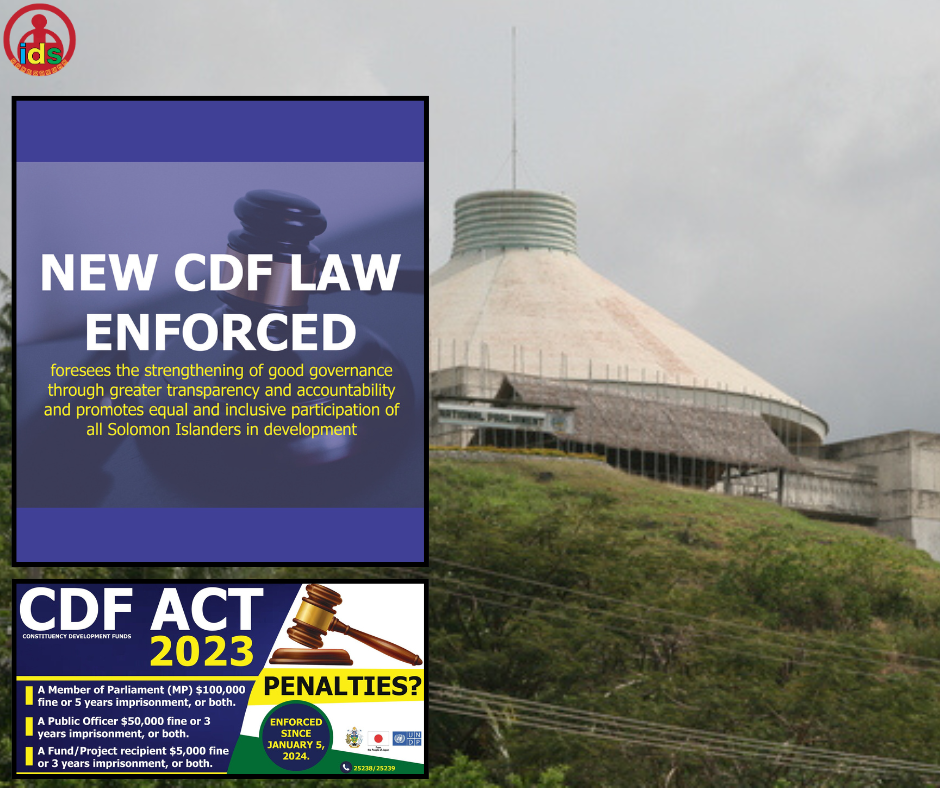
With the passing of the much Bill Boarded CDF Act 2023 now going onto two years since the Joint National General Election of 17 April 2024, most constituencies continue to question why few visible development programs have been implemented in their areas.
Transparency Solomon Islands (TSI) have carried out extensive community awareness sessions on the Constituency Development Funds (CDF) and is continued to be approached by citizens seeking information on CDF.
One thing that stands out is the lack of information about CDF, citizens want to know how their tax money is used, how much of tax-payers funds allocated to their constituencies, beneficiary lists, constituency expenditure reports only to name a few.
These are important information inaccessible to the tax payers, limiting citizens’ ability to monitor public spending and hold decision-makers accountable.
Constituency Development Funds (CDFs) is the largest stream of public funding allocated to the development of constituencies in the Solomon Islands.
CDF is designed and it is argued to bring development directly to the people and to develop all 50 constituencies across the entire country.
It is larger than the funds allocated to Provincial Governments who are responsible for the whole province.
The CDF funds are intended to finance social and economic infrastructure, assist vulnerable families, strengthen local livelihoods.
In principle, CDF is argued as a practical solution to the country’s geographic challenges.
In practice, however, it has become one of the most corrupt, wasteful funding used for political financing purposes and political gain (monetization of elections), maintaining sitting members of Parliament.
For years, citizens, researchers, and civil society organisations, including Transparency Solomon Islands (TSI), have raised concerns with regards the lack of transparency, inconsistent reporting, and questionable use and much secrecy surrounding CDF.
Communities frequently question why allocations and beneficiary lists are not routinely published, why their constituency development plan is not made public, why some projects fail to produce lasting results.
Some constituencies appear to benefit more from CDF funded development initiatives than others fueling public frustration and raising broader questions about integrity, transparency, accountability, fairness, and oversight of CDF.
Prior to having a CDF legislation (2013 and later 2023), this public fund operated without a comprehensive legislative framework clearly defining permissible spending, reporting standards, or enforceable penalties for misuse.
Although funds were drawn from the national budget, its expenditure failed to comply with Government Financial Instruction, nor the Public Finance Management Regulations, Oversight mechanisms were either absent, unclear or inconsistently applied.
This regulatory gap created conditions in which allegations of corruption, favouritism, politically influenced distribution, or misuse and abuse arise, whether substantiated or perceived, contributing to declining public trust in members of Parliament and those who handled this public funds.
Ongoing public reporting reflects the depth of concern.
The 2019 national census indicated that approximately 35 percent of households reported negative experiences related to CDF allocations, citing unfair or politically biased distribution.
Election observers raised concerns about the use of Constituency Development Fund in ways that garners political support.
Media reports (2023) suggested that more than 30 percent of households were calling for stronger governance and clearer accountability mechanisms.
Amid sustained public debate, Parliament enacted the CDF Act 2023 however this Act failed to adequately address higher issues associated with CDF, nor improve the mechanisms to ensure the performance of the CDF is monitored, transparent, and accountable.
It continues to perpetuate these issues and legalise corrupt practices.
Whilst the Act introduced rules on allocation, management, and reporting, along with penalties for misappropriation or the personal conversion of project assets.
There are still gaps that must be addressed to strengthen financial discipline, enhance oversight, and promote fairer distribution of public resources.
Whilst a number of MPs are making an effort to comply with the provision of the CDF Act 2023, nothing much changed in the control and management of the CDF.
As raised by TSI when the CDF Act 2023 went through the Parliamentary Process, legislation alone does not guarantee accountability.
The effectiveness of the CDF Act 2023 depends on consistent enforcement, transparent reporting, and meaningful community participation.
Governance gaps have tangible consequences for development: Inadequate planning and weak oversight can undermine the sustainability of existing critical social infrastructure and community-based economic initiatives.
When projects are short-term or poorly coordinated, they often fail to deliver lasting and meaningful benefits to communities.
TSI therefore calls for practical and enforceable reforms. Constituency allocations, expenditures, and beneficiary lists should be published annually and accessible to constituencies.
Independent audits conducted by the Auditor-General should be regular and publicly available.
Clear spending guidelines must be consistently applied, enforced with a firm separation between development funding and political campaigning.
Structured community consultation mechanisms are essential to ensure projects reflect collective priorities rather than individual discretion.
CDFs represent a significant portion of the taxpayer’s money which should be invested in the development of Solomon Islands, both economic and human resources.
When managed transparently and accountably, the fund can strengthen health services, education, infrastructure, and livelihoods across the country.
Without robust safeguards, however, they risk undermining public trust, confidence in democratic institutions, and the integrity of political leadership.
Transparency Solomon Islands urges the National Parliament, government agencies, members of Parliament, to collectively provide enforcement mechanisms that will truly ensure CDF serve the public interest.
Accountability strengthens democracy, and transparency protects public trust.
Public funds must serve the public interest above all else. Bill Boards most certainly will not be able to enforce the CDF Act. – Transparency Solomon Islands
