

by Terence Wood
Look at the Australians, they’ve tried every approach to giving aid here, and nothing’s worked.
She worked for a small organisation and was new to Papua New Guinea. She was being hyperbolic — some Australian aid to PNG has worked well enough and a few projects have been very successful — but her broad point was right. Giving good aid in PNG isn’t easy. The Australian government has learnt this the hard way.
Australia has built infrastructure, only to watch it crumble when PNG’s government failed to maintain it. Australia has worked with the civil service, only to become mired in inertia. Australia has tried to improve governance, only to be thwarted by PNG’s political economy. Australia has funded civil society, a good idea in a poorly governed country, but — while there have been successes — working outside of the state has proven difficult too.
More recently, Australia has returned to its post-independence practice of budget support, which used to be given as grants but now comes mostly in the form of loans.
Budget support helped stave off a debt crisis during COVID, but the government of PNG hasn’t used the fiscal space well.
Instead, it has pumped more and more money into District Service Improvement Program funds — which are spent inefficiently, unaccountably and largely as a form of patronage.
Australia’s not alone in its travails. The Chinese have had to watch potholes sprout from their newly-constructed roads.
Their once grand plans of criss-crossing the country with highways have been shelved. Multilateral organisations have had successes, but failures too. They haven’t found any silver bullets.
Aid won’t determine the fate of PNG — much will depend on domestic factors. However, effective aid can help.
The trouble is that — thanks to a dysfunctional government, and a topography that includes mountains, jungles, miasmic swamps and atolls — giving aid in PNG is difficult. But Australian aid doesn’t have to fail. The re-elected Labor government could make aid to PNG more successful if it wanted to.
First, the politicians in charge of the aid program need to be honest with themselves: Australian aid could be much better, and if the new government wants success it needs to drive change.
Part of this change should involve the creation of a specialised entity within DFAT focused on aid in PNG.
You can find people in DFAT who understand PNG well, but they are transient: they will be of limited use next year when stationed in Geneva.
Consolidating and stabilising country expertise will maintain ties and trust with counterparts in PNG. It will also allow DFAT to systematically build its institutional knowledge base rather than relying on hasty handovers.
Understanding aid also matters. No one confuses neurologists with orthopaedic surgeons and we don’t ask engineers to perform liposuction.
All these people are experts, but they’re experts in very different things. Being an aid worker in a government aid program and being a diplomat both require expertise, but the knowledge needed is different.
If you want to give aid well in a place where that’s difficult, you need the right type of experts. There are genuine Australian aid experts working on PNG, but their presence is often part accident, part design. Expertise shouldn’t be a matter of happenstance; it needs to be baked into the system.
It may seem unlikely that many DFAT staff would want to spend their lives focusing on aid in PNG.
Yet if Australia was genuinely committed to giving better aid there, aid specialists would find it more appealing. And people working in the new aid entity wouldn’t have to focus on PNG forever, just longer than at present. Long enough for a coherent body of expertise to be maintained.
The new government should also free up funding to allow people working on the aid projects it funds to take time.
“We are”, an exhausted Port Moresby aid worker once told me, “always running from task to task. We never get time to stop, think and learn.”
This makes it hard to give aid well. It also makes it harder to meaningfully promote the participation of people from PNG in the aid process.
Participatory development and localisation are easy to talk about, but difficult to do well. They take time. Increasing labour costs to pay for more aid workers would be money well spent if it gave people enough time to actually do their jobs.
Finally the new government should require honest, high-quality evaluations of the work it funds. Evalutions are often afterthoughts that struggle to extract findings from scant evidence.
They are often expected to unearth good news and bury bad. It shouldn’t be this way. Spend more on evaluations, design them early, run them throughout, let evaluators be honest and act on what they tell you. With good evaluations you can learn from your mistakes. Without good evaluations, you’ll just keep repeating them.
The secret to giving aid well in PNG doesn’t involve lurching between different approaches and objectives; it involves time, understanding and learning. Learn what works and then stick with it. Learn what isn’t working and abandon it or at least change it substantially.
If setting up an entity in DFAT focused on aid in PNG, employing more staff and spending more money on evaluations sounds excessive too you, remember Australia spends nearly $650 million on aid each year in PNG. PNG is by far the largest recipient of Australian aid. It’s also a country where poverty and malnutrition are high, the economy is barely growing and governance is getting worse.
Making aid work in PNG is the right thing to do — the country’s people deserve better. It would also be in Australia’s interests. PNG is struggling. And it’s right next door. If its problems become overwhelming, they won’t stop at the border. Australia would also be helping itself if it gave better aid to PNG.
Aid to PNG must get better. The new government has political capital aplenty. The need for change is obvious. All that is needed now is political will.
*This article appeared first on Devpolicy Blog (devpolicy.org), from the Development Policy Centre at The Australian National University. Terence Wood is a Fellow at the Development Policy Centre. His research focuses on political governance in Western Melanesia, and Australian and New Zealand aid.
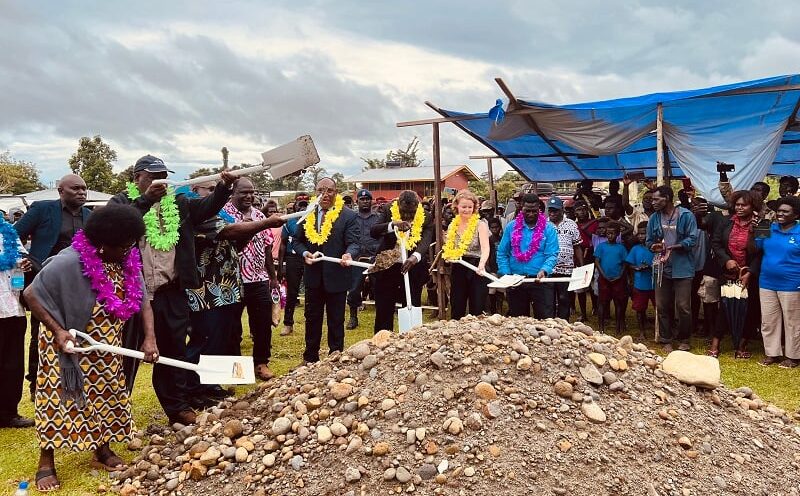
Caption: A groundbreaking ceremony held in February 2025 for the new Buin District Hospital in Bougainville which will benefit from a PGK76 million grant from Australia. (DFAT)

You must be logged in to post a comment.