
by Ednal Palmer
The Government is preparing to begin the reconstruction of homes destroyed by Cyclone Maila in Western and Choiseul provinces, with about 1,300 houses expected to be rebuilt under a national shelter-recovery programme.
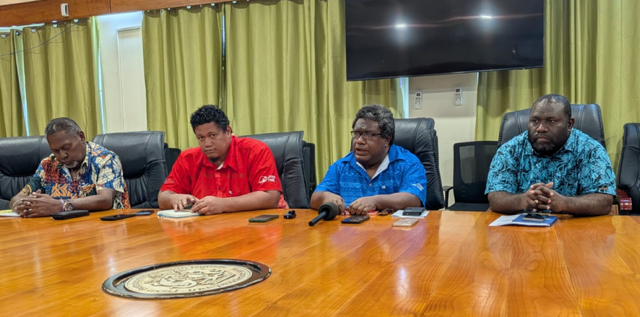
Chairman of the National Disaster Council and Permanent Secretary of the Ministry of Environment, Climate Change, Disaster Management and Meteorology (MECDM), David Hiba, confirmed the plans during a press conference today.
Hiba said the Government has allocated SBD $75 million in the 2026 Supplementary Budget specifically for Cyclone Maila recovery and rehabilitation, with the funds expected to soon be used to procure building materials for affected communities.
“Based on initial assessment, around 1,300 homes will be built under the shelter-recovery plan,” Hiba said.
According to the Permanent Secretary, the proposed houses will follow a standard two-bedroom design, with the estimated cost of building materials ranging between SBD$30,000 and $40,000 per house.
The reconstruction programme is expected to target communities in Western and Choiseul provinces that suffered extensive damage from Cyclone Maila in April this year.
Funds to be Managed
Through NDC and NDMO
Director of the National Disaster Management Office (NDMO), Jonathan Tafiariki, and a representative from the Ministry of Finance confirmed that the recovery funds will soon be made available through a special funding arrangement.
They said the National Disaster Council and NDMO will strictly manage implementation.
Hiba stressed that the funds would not be channelled through a third-party organisation.
“No third party will be involved in expending the funds,” he said.
The Government says the arrangement is intended to ensure that the money allocated for shelter recovery is used directly for the rebuilding programme.
However, questions have been raised by provincial leaders about how the recovery programme will be implemented and whether the reconstruction of homes alone will adequately address the needs of communities affected by the cyclone.
Western Province Premier Billy Veo has questioned whether a private contractor will be engaged to carry out the construction work.
Provincial leaders have also stressed that cyclone recovery should extend beyond houses to include the restoration of food gardens, livelihoods and damaged public infrastructure, which are critical to the long-term recovery of affected communities.
The concerns highlight the broader challenges facing communities after a major disaster, where the loss of homes is often accompanied by damage to agricultural gardens, water systems, roads, schools, health facilities and other essential infrastructure.
Gov’t Says $75M is Specifically for Shelter
Responding to questions over the broader use of the recovery allocation, Hiba clarified that the SBD$75 million was specifically provided for shelter recovery.
This means the funding will primarily support the reconstruction of homes rather than the wider restoration of livelihoods and public infrastructure.
The Government’s immediate priority is therefore to provide permanent shelter for families whose homes were destroyed or severely damaged by Cyclone Maila.
With approximately 1,300 houses identified in the initial assessment, the programme represents one of the Government’s major post-cyclone reconstruction efforts.
The next stage will involve the procurement of building materials and the development of implementation arrangements for construction in the affected communities.
The Government is yet to provide further details on the final locations of the houses, construction timeline, procurement process, eligibility criteria for affected households, and whether local builders or contractors will be engaged.
Those details are expected to become clearer as the National Disaster Council and NDMO move into the implementation phase of the shelter-recovery programme.
