
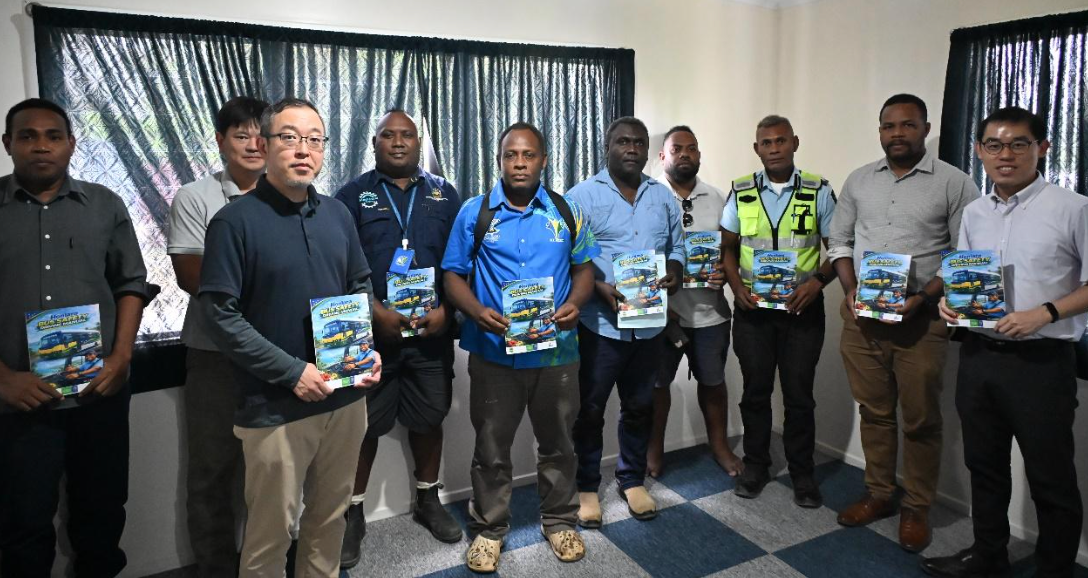
In a significant move toward urban modernization, the Solomon Islands government has unveiled a comprehensive draft driver manual as part of a broader strategy to reform the often-chaotic public transport system in the capital.
The initiative is a collaborative effort between the Ministry of Infrastructure Development (MID), the Honiara City Council (HCC), and experts from the Japan International Cooperation Agency (JICA). The project aims to transition the city’s bus services from an informal, driver-led model to a regulated, safe, and sustainable public utility.
For years, Honiara’s public transport has been plagued by inconsistency. Bus operations have largely relied on the individual whims of drivers, leading to:
-
“Short-routing”: The practice of drivers ending trips prematurely to maximize turnover.
-
Traffic Congestion: Unregulated stopping and erratic driving patterns.
-
Safety Gaps: A lack of standardized passenger handling and safety protocols.

The newly drafted Driver Manual serves as a regulatory cornerstone, establishing professional benchmarks for safe driving, passenger etiquette, and strict compliance with operational rules.
During the 9th Stakeholder Meeting held on March 26, 2026, officials outlined an aggressive action plan for the coming year. Beyond individual driver behavior, the reform seeks to address systemic issues through:
-
Route-Based Management: Moving away from “free-for-all” roaming to assigned, monitored routes to ensure city-wide coverage.
-
Monitoring Systems: Establishing government-led oversight to track bus performance and service reliability.
-
Agency Coordination: Clarifying the legal and operational roles of the MID and HCC to eliminate regulatory overlap.
The JICA-led team brings over 20 years of global urban transport experience to Honiara. This partnership ensures that the local transport network is built on international best practices while remaining adapted to the unique geography and social context of the Solomon Islands.

Mike Qaqara, MID’s Deputy Secretary for Technical Affairs, noted that while systemic change is a gradual process, the commitment to reform is absolute.
“Although reforming systems takes time, this project will continue working collaboratively toward a public transport system that citizens can use with confidence,” Qaqara emphasized.
The project is set to continue through the remainder of 2026. The next phase involves pilot programs for route-based management and formalizing the manual into the licensing requirements for all public service vehicle (PSV) operators. For Honiara’s residents, these reforms promise a future where public transport is no longer a daily frustration, but a reliable pillar of urban life.
[ENDS]

You must be logged in to post a comment.