
by Ednal Palmer
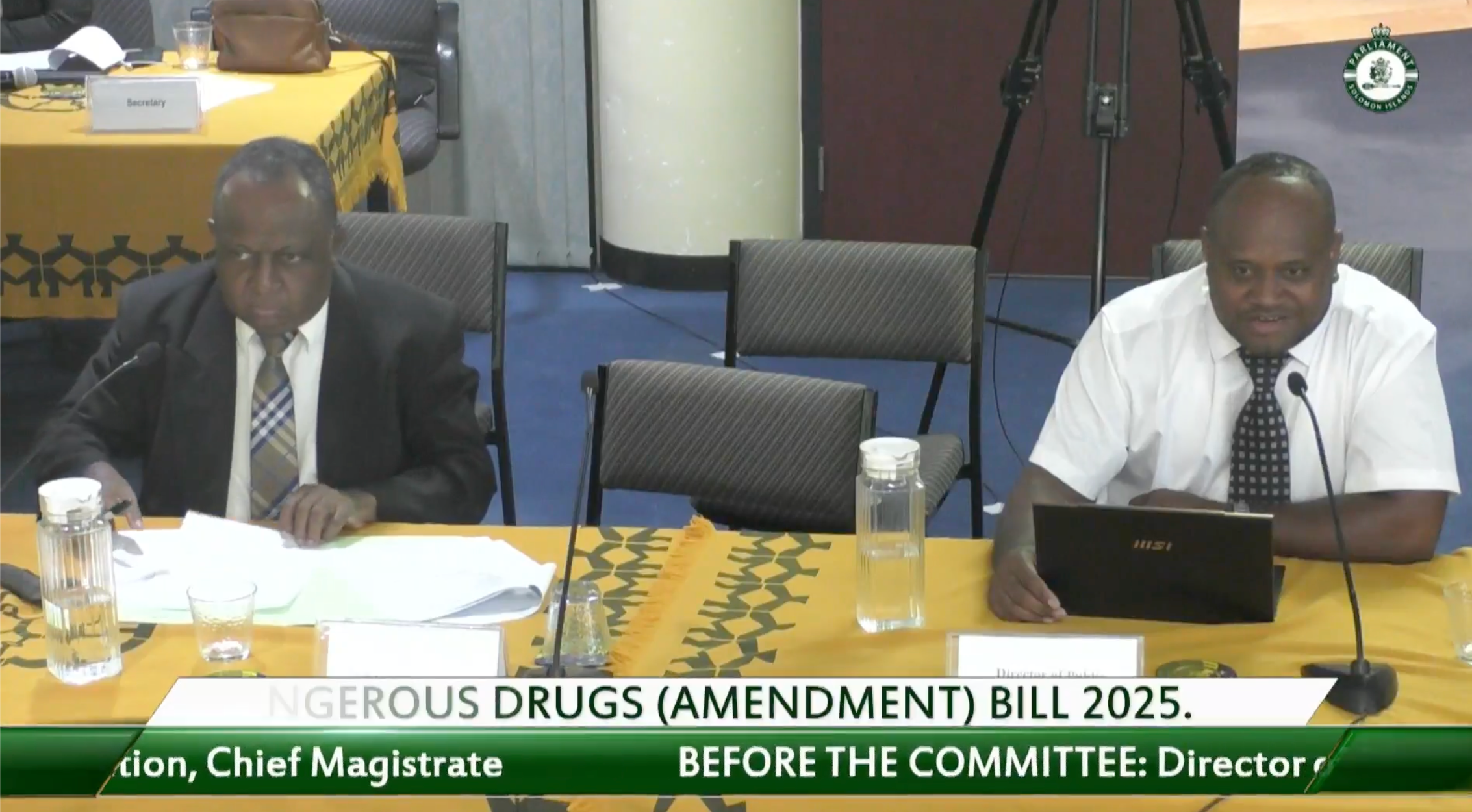
The Bills and Legislation Committee has begun its inquiry into the Dangerous Drugs (Amendment) Bill 2025, a proposed law that would dramatically increase penalties for drug-related offences and close long-standing legal loopholes in Solomon Islands’ drug laws.
Appearing before the committee today were the Chief Magistrate, Ricky Iomea, and Director of Public Prosecution (DPP) Andrew Kelesi.
What the Bill Does
The Bill amends the Dangerous Drugs Act (Cap. 98), specifically Section 39, to impose far harsher penalties where no specific punishment is already prescribed.
Under the proposed amendment, an offender could face:
-
A fine of up to 15,000,000 penalty units, or
-
Life imprisonment, or
-
Both.
This represents a significant increase from the current penalty framework.
Why Government Is Moving Fast
The push for reform follows revelations earlier this year that existing drug laws are deeply flawed.
In October last year, Prime Minister Jeremiah Manele confirmed the Government was acting urgently after it emerged that the law criminalises only the importation, exportation, and transportation of dangerous drugs.
Critically, the law does not explicitly criminalise possession, supply and manufacturing or production
This meant that, under current legislation, it was technically not illegal to possess or manufacture methamphetamine in Solomon Islands—an issue raised publicly by DPP Andrew Kelesi following the arrest of a foreign national allegedly found with the drug.
The disclosure sparked public alarm and prompted Cabinet to fast-track legislative reform.
DPP: Harsher Penalties Are Timely
DPP Kelesi told the committee the amendment contains two major changes.
First, it removes the use of court assessors – individuals who provide opinions to judges during proceedings. While not opposed, Kelesi said the DPP would prefer assessors to remain in the law in case they are needed in future, avoiding the need for another amendment.
Second, and more importantly, he strongly supported the increase in penalties.
“We do not have any issues with the increase,” Kelesi said. “It is in line with other Pacific island countries, except Tonga. The penalty units reflect what is happening in the country.”
He warned of a steady rise in methamphetamine use, linking it to domestic violence and other serious crimes.
“It’s timely that we have harsher penalties,” he said, thanking the committee for what he described as its “wisdom” in considering the amendment.
Chief Magistrate: Courts Ready to Apply the Law
Chief Magistrate Ricky Iomea stressed that the judiciary does not make policy but stands ready to apply whatever Parliament enacts.
He said the amendment would harmonise the law by clearly criminalising possession, supply, distribution, and manufacturing – conduct that was not comprehensively addressed under previous legislation.
Iomea said the severe penalties reflect Parliament’s denunciation of large-scale drug offending and give courts flexibility to properly sentence serious cases.
In determining sentences, courts would consider the type and quantity of drugs, the offender’s role (user, distributor, or manufacturer), harm to individuals and society, and the prevalence of offending.
Where drug crimes are widespread, he said, courts often emphasise general deterrence to protect the community.
Concerns Over ‘One-Size-Fits-All’ Penalties
Committee member John Dean Kuku raised concerns that the amendment applies the same maximum penalty across all categories of offenders – users, manufacturers, and traffickers alike.
In response, DPP Kelesi said the wide penalty range is intentional.
“It gives the court discretion to penalise accordingly,” he said, noting that offenders fall into different categories.
He added that prosecutors can seek to have serious cases referred from the Magistrates’ Court to the High Court, where heavier penalties are warranted.
What’s Next
With the amendment now before the committee, the Dangerous Drugs (Amendment) Bill 2025 is expected to be finalised and tabled in Parliament soon.
As drug crime becomes more organised and sophisticated, both the prosecution and judiciary agree the law must respond decisively – while remaining consistent with constitutional safeguards and the rule of law.
The hearing continues next week.
