
by Ofani Eremae
After three weeks of intense legal arguments, the nation now waits for May 1, when the Court of Appeal will deliver a ruling that could shape not only this case but future relations between the executive and Parliament.
More than that, next Friday’s decision will determine the immediate political fate of Prime Minister Jeremiah Manele’s government and clarify the constitutional boundaries between executive power and parliamentary accountability.
Final submissions were concluded this afternoon before a three-member bench comprising Justice Howard Lawry, Justice Gina Nott and Justice Gibbs Salika.
The current standoff began when 19 government MPs – including 12 Cabinet ministers – dramatically defected from Manele’s coalition and joined the Opposition.
The shift instantly altered the balance of power in the 50-member Parliament, giving the Opposition-aligned New Coalition a commanding 28–22 majority.
With the numbers on their side, the New Coalition moved swiftly to test the government’s legitimacy by filing a motion of no confidence against Prime Minister Manele.
Under the law, such a motion requires a minimum notice period before it can be debated. That period has since expired, meaning the motion is now ready to be tabled and voted on in Parliament.
However, Parliament has not been convened.
At the heart of the dispute is a fundamental constitutional question: can a prime minister delay calling Parliament after a no-confidence motion has matured?
Prime Minister Manele has maintained that he retains the authority to convene Parliament at a time of his choosing, insisting it will be done when “government business is ready”.
But the New Coalition argues that this position effectively blocks Parliament from performing its constitutional role.
This disagreement triggered legal action by the New Coalition, setting the stage for a high-stakes constitutional showdown in the High Court over the past three weeks.
Landmark Ruling
In a landmark ruling last week, Chief Justice Sir Albert Palmer rejected the government’s position, declaring that delaying Parliament in such circumstances is unconstitutional.
Palmer that once a motion of no confidence has matured, the Prime Minister has a clear constitutional duty to ensure Parliament meets “at the earliest opportunity”.
Any delay, the Chief Justice ruled, is unlawful because it frustrates the constitutional mechanism designed to test majority support.
In blunt terms, the ruling reduced the Prime Minister’s options to two: resign or face Parliament.
The judgment also warned that continued inaction could trigger the Governor-General’s reserve powers as a last resort to restore parliamentary process.
Appeal
The government, through Attorney-General John Muria Jnr, quickly moved to challenge the ruling in the Court of Appeal.
Muria argued that the High Court had overstepped its authority.
His central claim was that the judiciary cannot direct the Prime Minister to convene Parliament without breaching the doctrine of separation of powers.
“The court has no duty to order the prime minister to convene Parliament,” Muria told the bench, describing the High Court’s orders as legally flawed.
Supporting that position, lawyer Wilson Rano argued that the Prime Minister had not refused to call Parliament, but was merely waiting for government business to be ready.
Lawyers for the New Coalition pushed back strongly, framing the issue not as political discretion but as a constitutional obligation.
Gabriel Suri told the court that a motion of no confidence is not “government business” but a constitutional process that takes priority over all else.
He argued that allowing the Prime Minister to delay Parliament under the guise of scheduling would effectively enable him to avoid accountability.
“The prime minister cannot use ‘government business’ to stifle Parliament,” Suri said.
In one of the more striking metaphors of the hearing, Suri warned against treating constitutional authority as something to be idly relied upon.
“Constitutional power cannot be treated like a soft pillow… it must be exercised lawfully,” he said.
With hearings now concluded, the Court of Appeal faces a defining constitutional question: does the Prime Minister have discretion over when to convene Parliament, or is he legally bound to act once a no-confidence motion has matured?
A nation watching
Public interest in the case has been intense, with widespread debate across social and mainstream media since the defections in March.
For many Solomon Islanders, the outcome will determine not just who governs, but how the country’s democratic institutions operate under pressure.
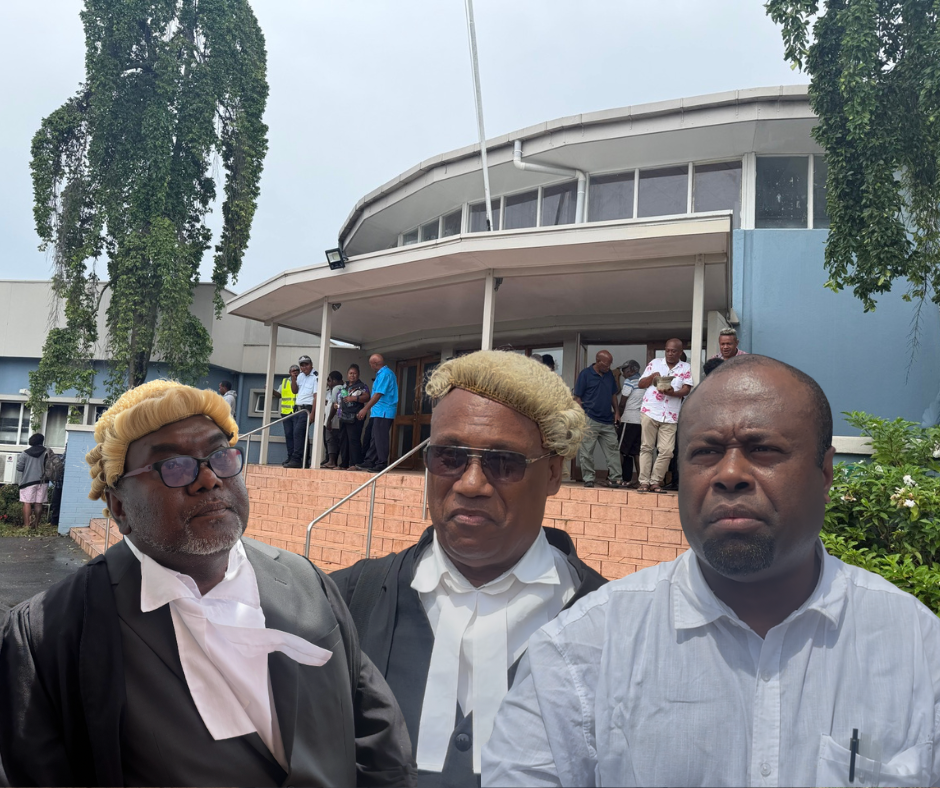
Outside the High Court today, lawyers from both sides expressed relief that the hearing is over, and like the public, look forward to next Friday’s ruling.
