
When the new Malu’u market opens its doors, it will be more than a place to buy and sell. It will be proof of what a community can build when it builds together.
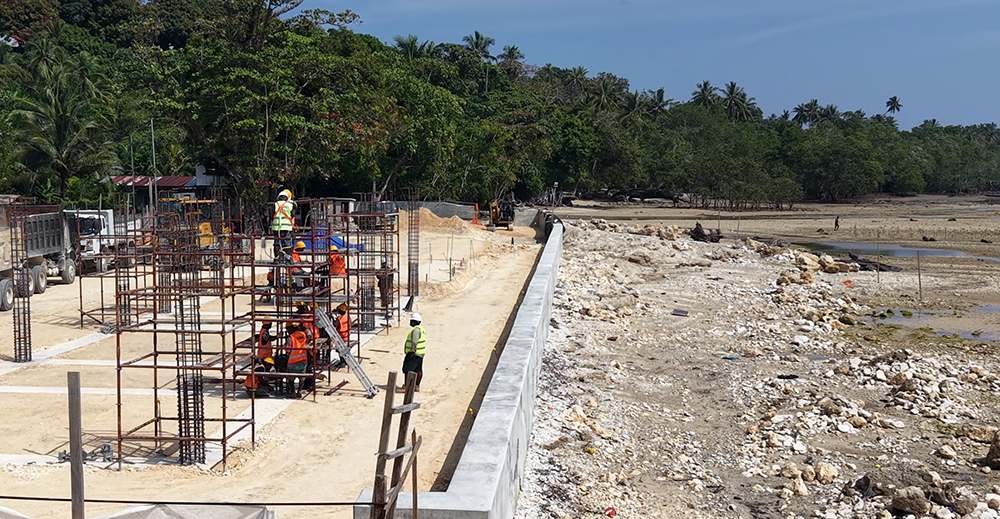
The Australia-funded project has reached a key milestone, with its 120-metre seawall now complete and groundworks well underway for the next stage of construction. But behind the headlines is a story of local hands, community heart and a market designed to outlast the rising seas.
The project has employed 44 workers to date — 32 of them from the local community. For many, it’s more than a pay cheque; it’s a chance to shape a facility their own families will use for generations.
Australian High Commissioner Jeff Roach said the project shows the power of locally-built infrastructure.
“It’s really positive for Solomon Islands to see Solomon Islanders leading the construction of an important community facility like the new Malu’u Market,” he said. “Together we’re building a safe, comfortable and accessible place for social and economic activity in North Malaita for years to come.”
The 120-metre seawall is just one layer of protection against climate change. Workers and community members have also planted thousands of mangroves in front of the barrier nature and engineering working side by side.
Site Engineer Linken Filiteku said completing the seawall gives the team a strong foundation for what’s next.
“We’re now focused on building the market house and facilities, and look forward to delivering something that will serve the community for many years to come,” he said.
For Exodus Project Director Jeremiah Fonoota, the project’s greatest achievement may be the relationships it has built. Daily “toolbox sessions” inspire the team about their contribution to nation-building, while on-site mentoring helps upskill local workers.
The community’s needs have shaped the work at every turn. When local landowners asked for help, the contractor responded evelling the playing field, supplying gravel for the community market, clearing an access road to a local cemetery, and even using project vehicles to haul water to Malu’u Hospital during recent shortages.
“We’ve also used our vehicles to help transport water from the nearby river to the Malu’u Hospital during recent water shortages,” Mr Fonoota said.
When complete, the market will host up to 140 vendors, with separate toilets and showers for men, women and people with disabilities. It will store 43,000 litres of rainwater, run on solar lighting, and feature improved waste management and sanitation.
For High Commissioner Roach, the collaboration is the real success story.
“Australia is committed to locally-built, community-owned infrastructure, and this project demonstrates the benefit of building trust and reducing disputes around the project,” he said.
For the people of North Malaita, it means something simpler: a safe, worthy place for families to trade, gather and thrive — built by their own hands, for their own future.
