
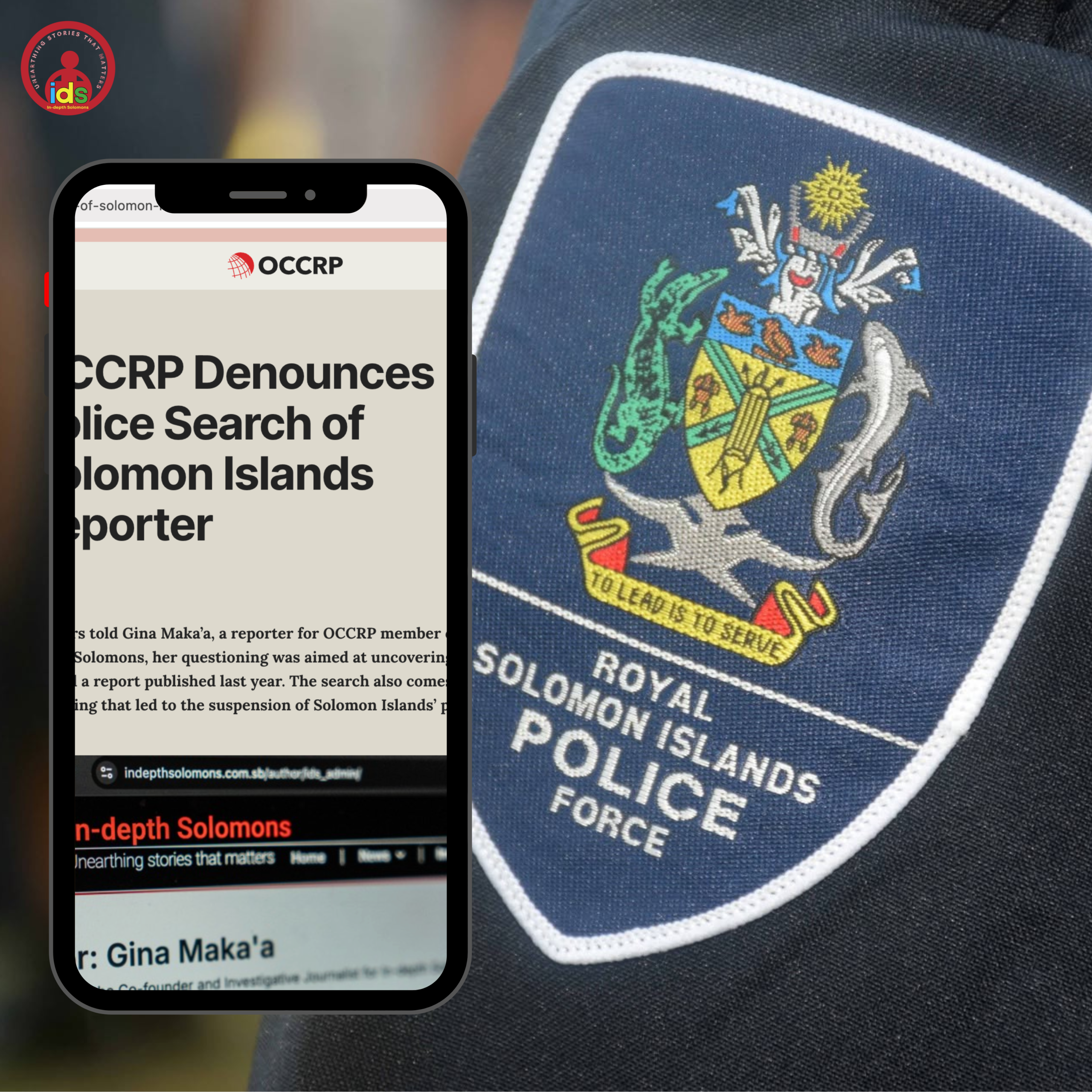
Officers told Gina Maka’a, a reporter for OCCRP member center In-depth Solomons, her questioning was aimed at uncovering the source behind a report published last year. The search also comes after IDS reporting that led to the suspension of Solomon Islands’ police chief.
by OCCRP
OCCRP has strongly condemned the Solomon Island police for questioning one of the network’s member center journalists and searching her office in an effort to identify her government whistleblower.
Officers questioned the reporter and searched her office for a confidential document used in an investigation last year. The story revealed that auditors had raised concerns over a $10 billion tax discrepancy involving the Solomon Islands Tobacco Company, a subsidiary of British American Tobacco.
Gina Maka’a, an investigative reporter for In-depth Solomons, told OCCRP that she initially spoke by phone on Tuesday morning with an officer of the Royal Solomon Islands Police Force (RSIPF), who told her that she needed to hand over a document they believed was in her possession. Then the officer showed up at her workplace in the capital, Honiara.
She was asked to hand over the original paper copy of the document used in the report. Maka’a told the officer the document was no longer in her possession. When asked to name the person who gave it to her, she refused.
She was then shown a search warrant bearing the name of another person, the former head of the local press association, Georgina Kekea.
Maka’a pointed out the wrong name, organization and address on the search warrant but officers searched her office anyway and did not find the paper. She had to go with them to the police headquarters to give a statement but she refused a subsequent attempt by police to take her phone and laptop.
The incident comes roughly two months after reporting by In-depth Solomons (IDS) helped trigger the suspension of Police Chief Ian Vaevaso.
Maka’a covered Vaevaso’s suspension as well as conflict of interest concerns that led to the withdrawal of a member of a tribunal appointed to investigate the suspended police chief.
“Questioning a journalist over her reporting, asking her to reveal her source, and attempting to take documents and electronic devices, is an unacceptable assault on press freedom and independent media in Solomon Islands,” Miranda Patručić, the editor in chief of OCCRP, said in a statement. “The fact that it was done despite officers admitting that their warrant was in someone else’s name makes this incident even more appalling.”
The editor of In-depth Solomons Ofani Eremae, told OCCRP that “demanding that journalists disclose their sources amounts to an attack on press freedom and risks suppressing legitimate investigative journalism.”
“We acknowledge that police have a responsibility to investigate alleged offences,” he said. “However, that responsibility must be exercised with respect for the constitutional protections afforded to the media and the legitimate role of journalists in a democratic society.”
Maka’a said she felt “scared” and “confused” at first speaking to police, but she never considered naming the whistleblower.
“I made a promise to the source that I will never reveal their identity, so that’s what made me stand my ground that I will never reveal the person, even if I go to court,” she said.
Police did not respond to a list of questions.
Desmond Rave, an RSIPF spokesman, said that a search warrant had been conducted “as part of an ongoing investigation, while the case file is now with the director of public prosecution for legal advice.”
Meanwhile, former Media Association of Solomon Islands President, Georgina Kekea described this mix-up as “Showing a troubling lack of basic due diligence before taking serious legal steps against media workers. Rushing to question journalists based on mistaken identities exposes how reactionary this investigation has been.”
“It is unfortunate to see police resources directed toward chasing whistleblowers and raiding media bodies when the focus should be on public accountability surrounding the billions of dollars involved in this tax controversy.”
“Currently, the Whistleblowers Protection Act 2018 only recognizes disclosures made directly to specific state agencies (such as SIICAC or the Ombudsman), leaving the media and public interest reporting completely unprotected. When whistleblowers have nowhere safe to turn, reporting to the press is often the last line of defense for public transparency.”
“My hope is that the Media Association of Solomon Islands (MASI) will actively advocate for legislative amendments to expand the Whistleblowers Protection Act, ensuring that journalists and public interest disclosures to the press are explicitly protected under Solomon Islands law.”
Transparency Solomon Islands CEO Ruth Liloqula also denounced the recent law enforcement maneuvers, saying such conduct “severely erodes the professional integrity of the press while striking at the heart of the public’s fundamental right to free expression.”
