
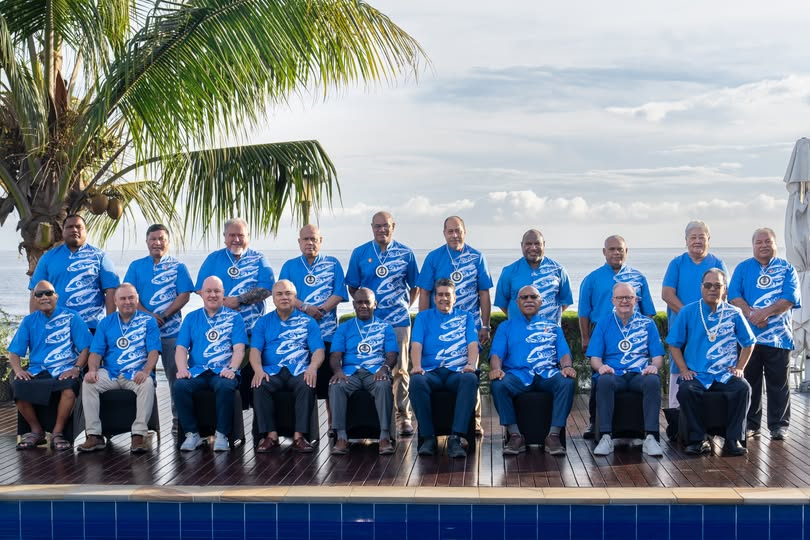
The Fifty-Fourth Pacific Islands Forum (PIF) concluded in Honiara on Friday 12 September, with Pacific leaders reaffirming their shared vision for a stronger, more united Blue Pacific Continent.
Meeting under the theme “Iumi Tugeda: Act Now for an Integrated Blue Pacific Continent”, leaders acknowledged the pressing challenges of climate change, geopolitical competition, and economic fragility, while charting new pathways to deepen regional integration and cooperation.
The meeting was attended by the Heads of State and Government of Australia, Cook Islands, Federated States of Micronesia, the Republic of Fiji, French Polynesia, the Republic of Kiribati, the Republic of the Marshall Islands, New Caledonia, New Zealand, Niue, the Republic of Palau, the Independent State of Papua New Guinea, Solomon Islands, Tonga, Tuvalu and the Republic of Vanuatu.
The Republic of Nauru was represented at Ministerial level, and Samoa at Senior Government Official level.
The Forum retreat was hosted in Noro, Western Province, reflecting Solomon Islands’ cultural heritage and commitment to regional unity.
Leaders expressed gratitude to host Prime Minister Jeremiah Manele for the hospitality and the spirit of “Iumi Tugeda,” which framed discussions throughout the week.
In his closing remarks as Forum Chair, Prime Minister Manele said:
“Over the course of our week-long deliberations, we have reflected deeply on our shared priorities, reaffirmed our unity as a region, and agreed on clear actions that will help guide the Blue Pacific Continent through an increasingly complex and challenging strategic environment.”
Key Outcomes and Highlights
Pacific Resilience Facility (PRF):
Leaders celebrated the signing of the Agreement to Establish the PRF, describing it as “a financing facility for the Pacific, by the Pacific.”
With pledges of more than US$165 million already committed, Manele stressed that the PRF would be a crucial advocacy tool for capitalisation and long-term resilience building.
Blue Pacific Ocean of Peace Declaration:
Another milestone was the endorsement of the Ocean of Peace Declaration.
Citing Fiji’s Prime Minister Sitiveni Rabuka, Manele explained that it represents “a region in which strategic competition is managed; where stability is the touchstone of regional relationships; and where coercion is eschewed.”
He added that the declaration underscores the Pacific’s commitment to peacebuilding, reconciliation, and addressing enduring legacies such as unexploded ordnance.
Partnerships and International Engagement:
Leaders adopted a new Policy on Partnerships, giving the Forum greater control over how it engages with dialogue partners and observers.
Manele stressed the importance of partnerships built on Pacific values, noting that “our CROP agencies stood in solidarity in driving our collective actions to achieve the goals and vision for 2050.”
On external relations, leaders reaffirmed efforts to revitalize engagement with the United States on nuclear legacy issues and ensure continuation of the U.S. Tuna Treaty payments.
They also agreed to strengthen Pacific voices in international platforms through a new mechanism for nominating regional candidates to international positions.
Deepening Regional Integration:
Economic priorities featured heavily, with leaders agreeing to move beyond sectoral approaches to fisheries and tourism toward coordinated regional integration.
Manele highlighted the endorsement of the Pacific Regional Labour Mobility Principles, calling freer movement of people central to equitable development:
“Deepening regional integration is our commitment to leaving no one behind.”
He noted that air and sea transport, particularly for Smaller Island States, remains a priority to boost intra-regional trade and sustainable growth.
Climate Change and COP31:
With climate change at the heart of discussions, leaders endorsed Australia’s bid to host COP31 as a Pacific COP in 2026.
Manele stressed the symbolism of this moment.
“We contribute so little to global warming but we face the brunt of its impacts. Having a Pacific COP will be an opportunity to share with the world that we are not defined by our vulnerabilities but by the strength of our resilience.”
He also praised Pacific youth and Vanuatu for leading the campaign that resulted in the landmark International Court of Justice Advisory Opinion on climate obligations.
Ocean Priorities and Deep-Sea Minerals:
The Forum also addressed the health of the Pacific Ocean, advancing negotiations on plastics, fisheries, and the controversial issue of deep-sea minerals.
Leaders agreed to develop a regional approach to deep-sea mining to ensure it aligns with Pacific values and priorities.
People-Centered Development
Forum leaders recommitted to people-focused action, advancing gender equality, early childhood development, and stronger regional health systems.
Manele said placing people at the heart of regionalism remains non-negotiable:
“Our discussions this week reaffirmed our commitment to placing people at the heart of our collective action, recognising its criticality to the wellbeing, equity and inclusion of Pacific peoples.”
What’s Next for the Forum
Forum leaders agreed New Zealand will host the 56th PIF in 2027, while French Polynesia will take on the 60th anniversary gathering in 2031.
As he closed the meeting, Manele summed up the Pacific’s determination to act decisively.
“We achieved a mammoth task this week and I thank my fellow Forum Leaders for their commitment, endurance and more importantly, standing in solidarity as we wrap up this week’s discussions.
“But many more lies ahead… Iumi tugeda, ACT now for an integrated Blue Pacific Continent.”
