
by Ednal Palmer
Prime Minister Jeremiah Manele has reaffirmed that the recent Cabinet reshuffle was guided by one central objective — stability.
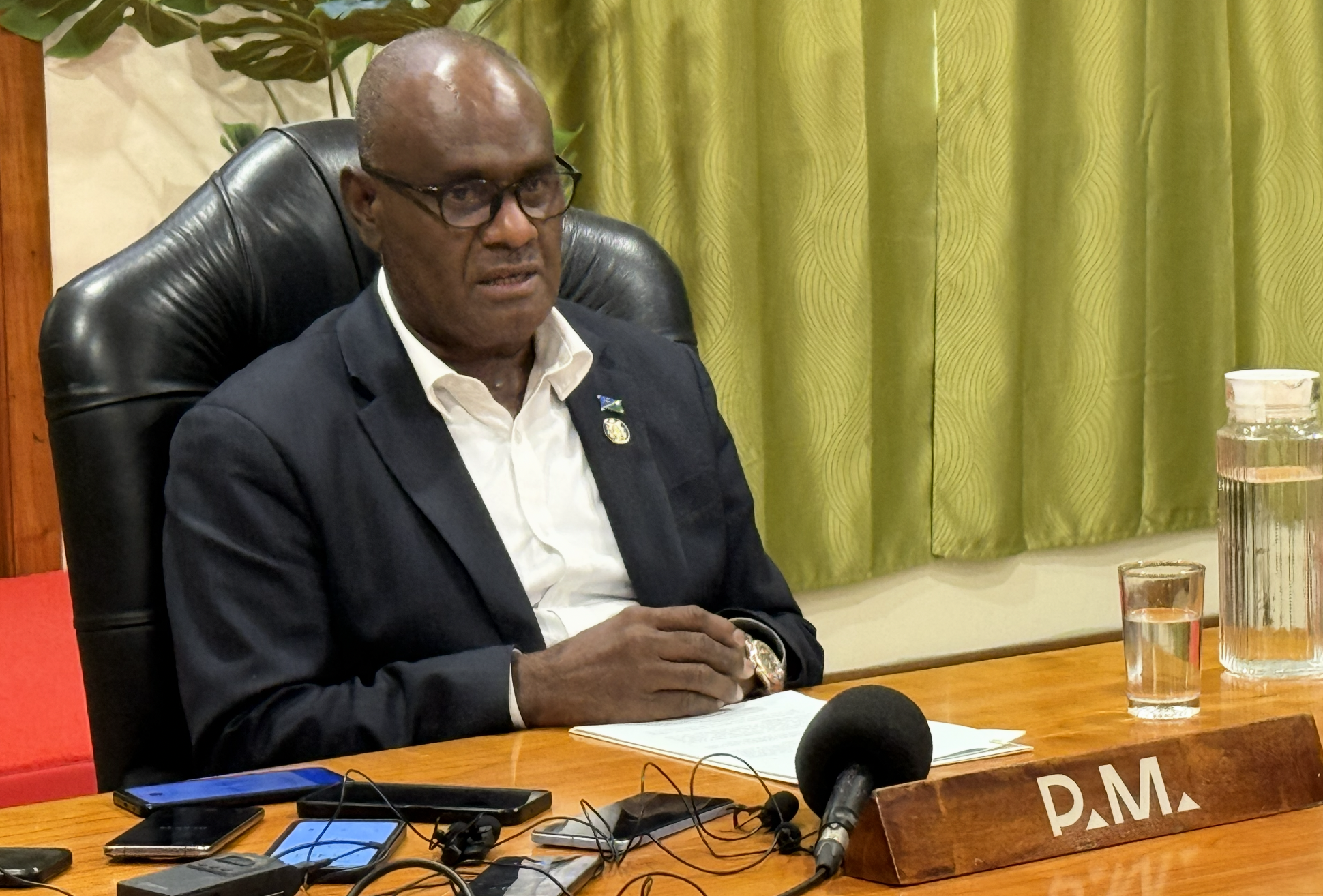
Speaking to journalists yesterday, the Prime Minister said the changes were designed to strengthen the government’s delivery capacity and ensure that key ministries remain aligned with national priorities.
“These changes were made to strengthen our delivery capacity and to keep our ministries aligned with our national priorities,” the Prime Minister said.
“Let me be clear — the reshuffle was guided by one central objective, and that is stability — political and operational stability for the long term.”
A motion of No Confidence is reportedly in the making, which prompted GNUT to make reshuffles in recent weeks.
Under the reshuffle, Honourable Trevor Hedley Manemahaga, MP for Gao/Bugotu, has been reassigned to the Ministry of National Planning and Development Coordination, while Honourable Rexon Ramofafia, MP for Fataleka, now serves as Minister for Finance and Treasury.
Manele emphasized that frequent changes in government disrupt policy continuity and progress, adding that his duty as Prime Minister is to safeguard stability so that the GNUT government can complete its mandate and deliver tangible results for the people.
“Cabinet reshuffles are not a sign of weakness but a normal part of governance,” he said. “Even as ministers change, ministries continue to function fully, and all programs and services remain uninterrupted.”
The Prime Minister dismissed speculation that external influences played a role in the decision-making process, stressing that all changes were made purely in the national interest.
“There is no foreign influence on the decisions taken by GNUT — it’s solely for the stability of the government,” he stated.
Addressing ongoing political speculation about parliamentary numbers, the Prime Minister expressed confidence in his government’s support within the House.
“Everybody is claiming numbers, but I am confident I have the numbers,” he said. “The MNC is always like that — rumours of numbers everywhere. But repeated motions do not send a good signal about stability.”
While acknowledging that motions of no confidence are part of the democratic process, the Prime Minister cautioned against their misuse, warning that such actions can hold back national progress.
“Motions are part of democracy, but without a strong basis, we are only moving the country backward,” he said. “Each time there’s a motion, the country is kept in suspense for a month or so. But I am prepared to face any motion of no confidence.”
The Prime Minister admitted that not all decisions would please everyone but maintained that stability remains the government’s overriding priority.
“It’s difficult to satisfy everyone in the decisions we make — of course, there will be fallouts,” he said. “But stability is the main factor behind these reshuffles. The two ministers concerned are qualified, and the decision was made with stability at the centre.”
