
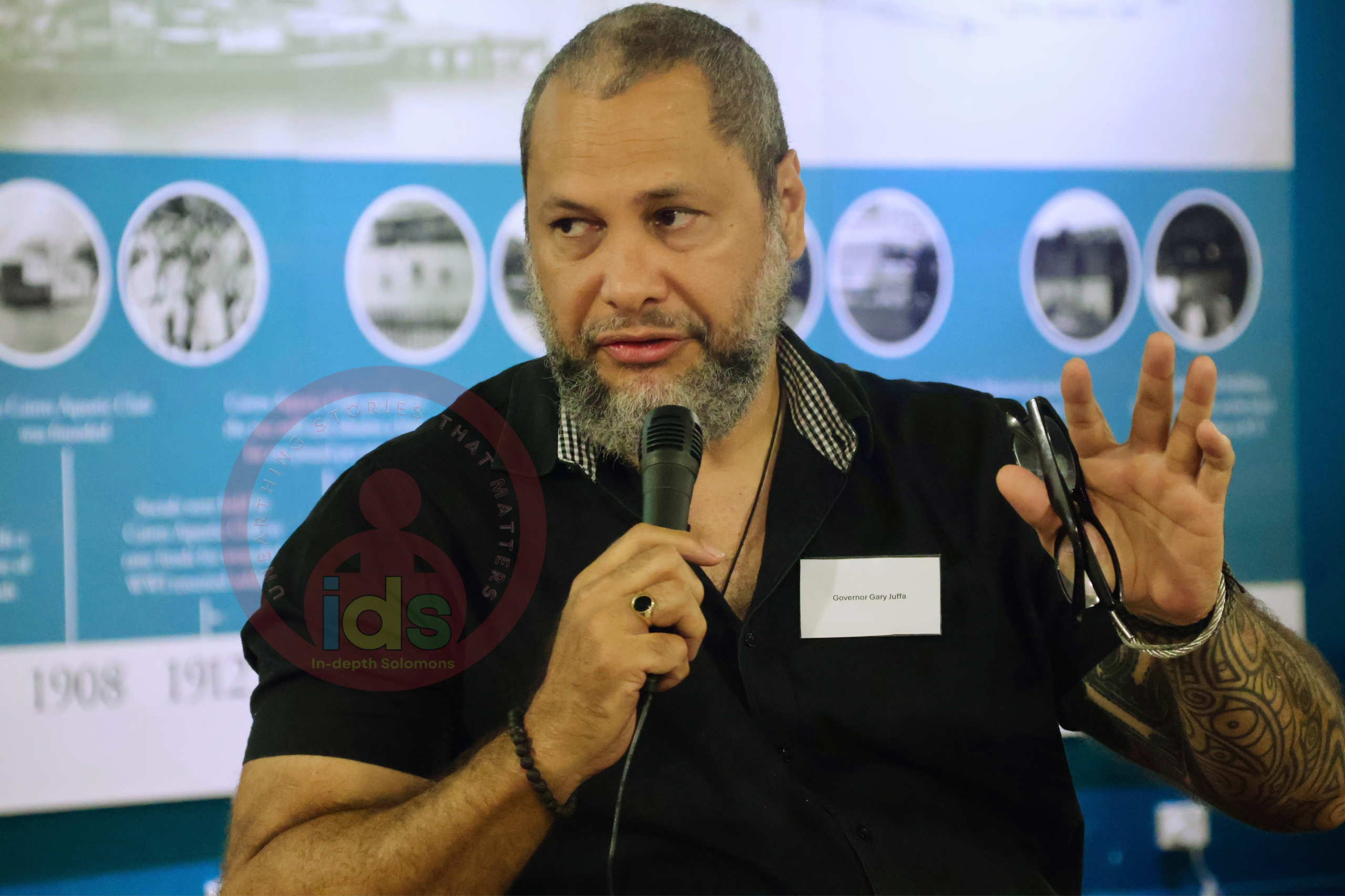
by Charley Piringi in Cairns, Australia
A senior Papua New Guinea leader warned PNG and the Solomon Islands that failing to reform colonial resource laws risks losing people’s resources to foreign “criminal cartels.“
Speaking exclusively to In-depth Solomons at the third Asia Pacific Forest Crime Network meeting in Cairns, outspoken Oro Governor Garry Juffa said that both nations remain bound by resource frameworks designed to serve foreign interests rather than empowering native titleholders.
“Many of these laws are outdated colonial laws. They are not our laws; they are their laws,” Juffa said “We have attained political independence, but to attain economic independence, we must have our own laws, especially for resource development.”
Juffa pointed to changes made to PNG’s mining legislation around 2009–2010 as a critical failure. He argued these amendments were passed without genuine public consultation, effectively reducing customary landowners to mere “surface landowners” while vesting everything beneath the ground to the State.
“For PNG most landowners don’t realise that they are merely surface landowners,” he explained. “Everything under the land belongs to the State, and the State can then negotiate with developers. And I guess Solomon Islands must be having the same issues too.”
He cautioned that both the Solomon Islands and PNG must urgently re-examine their resources laws to prevent foreign firms and state entities from controlling underground wealth while leaving local communities with minimal benefits.
Juffa did not mince words when describing the actors currently dominating the logging and mining sectors across Melanesia. He alleged that many companies active in PNG—and increasingly visible in the Solomon Islands—are “not genuine investors but criminal organizations.”
“They will manipulate and threaten anyone in anyway just to get what they want,” Juffa said. “They will entice, they will intimidate, they will bribe, they will induce. That is what they do, and only criminal organizations do that.”
He said “Genuine investors follow the law, pay taxes, and prioritize the welfare of the host nation’s people. The organizations currently exploiting the region, he argued, will compromise state agencies, politicians, and public servants without hesitation to maximize their profits.”
The governor warned that Melanesian countries face “State Capture” by powerful forces that target not only natural resources but the very institutions meant to defend the public interest. By funding political parties and infiltrating parliaments, these groups ensure favorable laws are passed.
He urged the Solomon Islands to learn from PNG’s experience, where many state agencies have already been compromised. To fight back, Juffa called for strong, courageous leadership at every level of governance and continuous reform of the public sector so it can act as a true gatekeeper against predatory interests.
“People have to invest in leadership rather than being bought,” Juffa urged voters. “We need leaders who are willing to fight like warriors to protect the interests of our country, to protect the interests of our people, current and going into the future.”
Without these urgent reforms, Juffa warned, the real wealth of Melanesia will continue to be decided in foreign boardrooms, far from the village communities that rightfully own the land.
