
By Tom Tom
In politics, the line between leadership, theatrical performance, and cultism is thin – very thin.
Politics is about appealing to people’s hopes and aspirations and convincing them that, if they elect a candidate or his or her political party, their lives will become better.
Consequently, there are usually many promises. In order to convince citizens, politicians deploy rhetoric – persuasive language coated with sweet-sounding sound bites – that exploits people’s vulnerabilities and ignorance and appeals to their most basic needs.
When people are struggling, vulnerable, and relatively uninformed, a well-crafted slogan, even if devoid of substance, can be convincing.
A skillful politician can make proclamations that may be superficial but carry the outward appearance of progress and the promise of a better future. These can include both broad ideas and specific promises.
For centuries, politicians have used slogans to hook and reel in support.
Contemporary examples from around the world include the Bolsheviks’ WWI promise of “Peace, Land, and Bread,” Indira Gandhi’s 1971 slogan, “Garibi Hatao” (“Abolish Poverty”), in India, and Donald Trump’s “Make America Great Again.”
Poverty in India was never abolished under Gandhi’s leadership, and America arguably became less great under Trump. Yet, these politicians won elections.
Here in Solomon Islands, Prime Minister Matthew Wale promised, “Change is Coming.”
That is the broad idea. Specific promises include free education, reforms to the forestry and mining sectors, addressing the sufferance wharves issue, tackling state and elite capture, and addressing other concerns.
Many of the GREAT Coalition’s policies make sense, are needed, and are accepted by many Solomon Islanders who have long suffered the consequences of bad governance, a poor economy, and substandard social services, and who have seen their natural resources squandered to enrich foreigners.
This government’s policies are therefore music to their ears.
It is worth noting that Wale is not unique in deploying slogans and making promises.
Successive Solomon Islands prime ministers, governments and individual politicians have done the same.
That is what politics requires. Politicians, therefore, ply the tools of the trade.
Many people believe Wale’s promises. They never pause to ask: What kind of change? How will that change occur? Is it possible to achieve it in two years? Can the government afford it? If not, who will pay for it? How do you get rid of state and elite capture?
For many people, there is no need to ask such questions. The promise of change is sufficient.
And because many Solomon Islanders have struggled socio-economically for a long time and have lost trust in previous governments, they may have accepted almost any promise of change – even if Wale had promised them the moon.
Now that the Wale-led GREAT Coalition is in power, people are watching, anticipating, and waiting for the promised “cargo of change.”
In politics, promises are often matched with performative rituals, including repetitive political theatre.
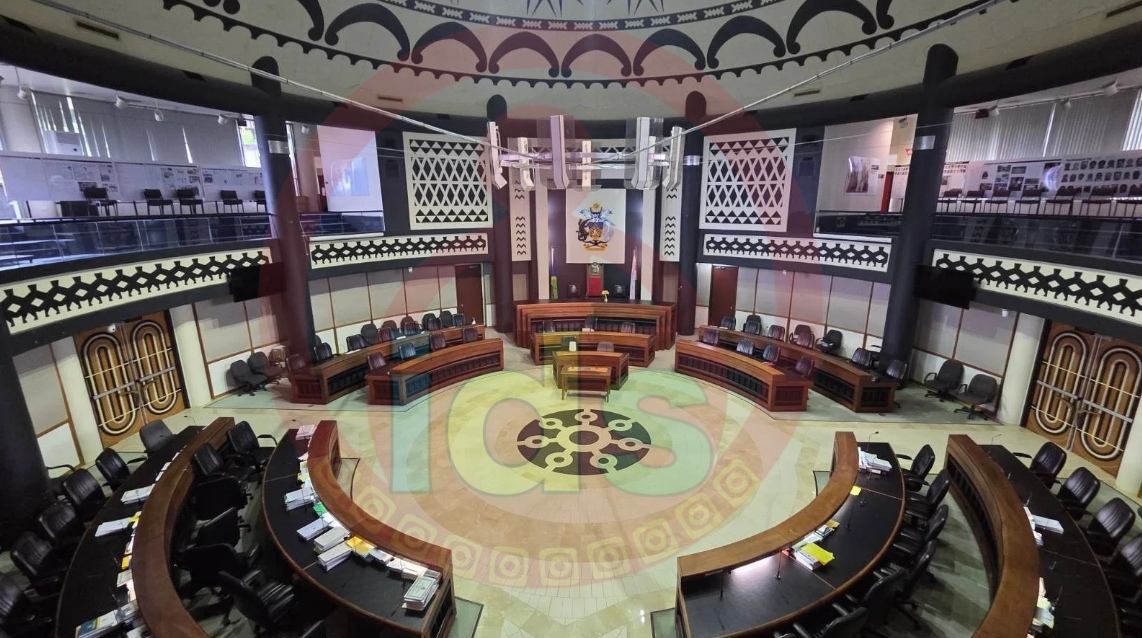
We have seen these performances in Parliament over the past two weeks.
Politicians, like characters in a play, perform for their electorates, whether by quoting Bible verses, raising their voices, switching between English and Pijin, or whipping the chair.
Anyone with basic training in theatre knows that two of the most important rules for stage performers are: “The show must go on” and “Stay in character,” even when you make a mistake.
Politicians are theatre performers who have, perhaps inadvertently, adopted those same rules.
Apart from physical stages such as the floor of Parliament, politicians, their minders, and their supporters now perform on the digital stage.
Since the GREAT Coalition government assumed office, for example, comments critical of the government have been met with a barrage of social media warriors defending it.
To them, any criticism of the GREAT Coalition, particularly Prime Minister Wale, is almost sacrilegious – Wale cannot be wrong. This attitude is also reflected in the mainstream media.
This, if left unchecked, could contribute to the building of a cult of personality.
Such a situation can arise when dissenting voices are bullied out of public spaces while only voices that favour a particular leader and his political party are privileged.
Backed by the exploitation of media and propaganda, such an environment could potentially lead to mass psychological manipulation that elevates an individual to a position of unquestionable authority.
That is not where Solomon Islands currently stands. However, an unchecked and uncritical acceptance of every promise made by Wale and his GREAT Coalition could contribute to the creation of a cult of personality.
Maybe not to the same extent as in other places, but enough to influence the nature and dynamics of politics in Solomon Islands.
This leads to the issue of promises – the promise that “Change is Coming.”
In Parliament, Prime Minister Wale quoted from the Bible – the Book of Nehemiah – to counter those who doubt his and his government’s ability to deliver change.
The invocation of the Bible can be interpreted as a way of suggesting to doubters that doubt itself reflects a lack of belief in the Holy Book and, by extension, in the prime minister.
That can be a powerful way of silencing critics. It is also dangerous.
In politics, the line between promise and cult is thin. When people unquestioningly accept a promise, they can become uncritical and simply wait for an expected cargo that might never be delivered.
This is not a criticism of the Prime Minister and the GREAT Coalition. It is a caution about the thin line between politics, theatre, and cargo cult.
Most Solomon Islanders want to believe and hope that the Wale-led GREAT Coalition will deliver on its promises.
If it does, that would be great for Solomon Islands. If it does not, this may become just another episode of political theatre – and another political cargo cult.
As an audience in this political drama, I can only wait and see.
After all, the show must go on!
