
by Georgina Maka’a
The Premier of Central Islands Province has appealed to the National Government and international partners to support his vision of transforming Tulagi into the heritage capital of Solomon Islands – a place where the nation’s history, culture, faith and tourism converge.
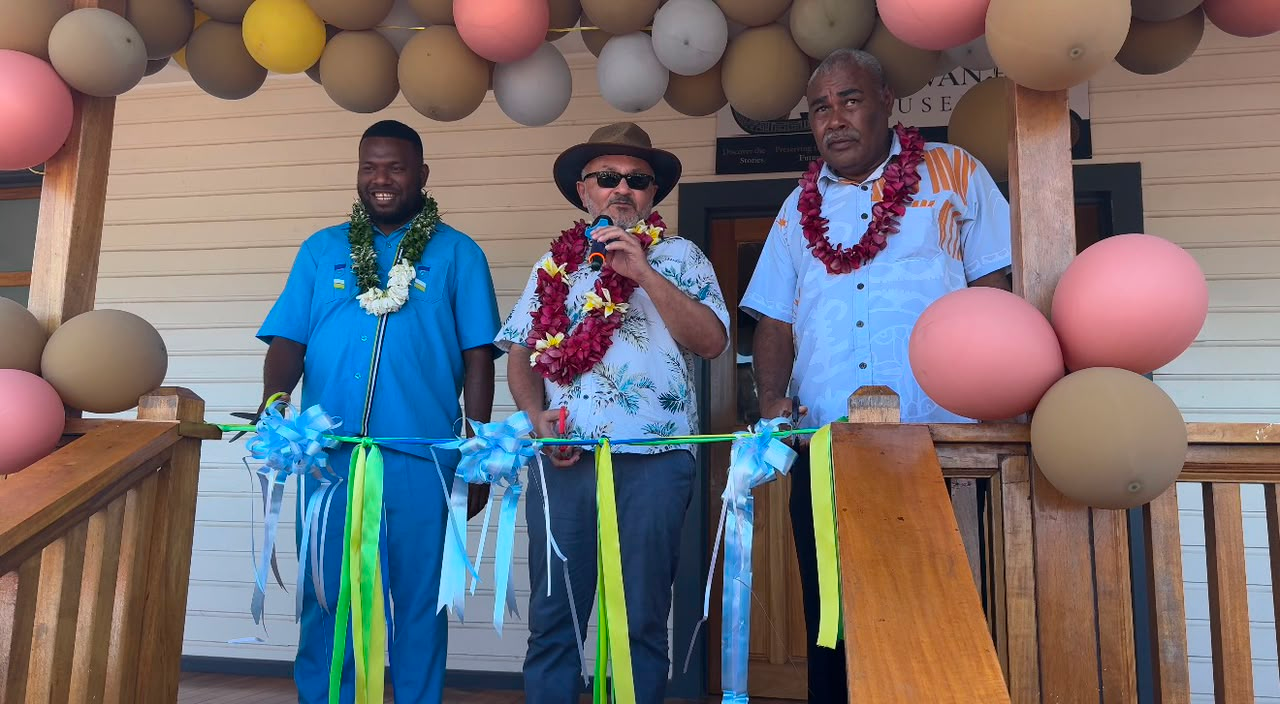
Premier Kenneth Sagupari made the call during the opening of the Nambawan Haus Museum in Tulagi this week.
“A nation that preserves its history strengthens its identity,” Sagupari said.
“A nation that understands its history makes wiser decisions,” he added.
“A nation that honours its heritage gives confidence to future generations.”
Sagupari said Nambawan Haus Museum will stand as a permanent home for the documentary heritage of Central Province and Solomon Islands – a place where the past is protected, the present is informed and the future is inspired.
Housed in the former official residence of the British Resident Commissioner, first built in 1898, Nambawan Haus occupies one of the country’s most historically significant buildings.

Tulagi served as the administrative capital of the British Solomon Islands Protectorate until World War II, when the destruction caused by the war led to the transfer of the colonial administration to Guadalcanal and the eventual establishment of Honiara as the nation’s capital.
The museum’s collections trace Solomon Islands’ history over centuries, covering traditional societies, the colonial era, the arrival of Christianity, the battles of World War II, and the country’s journey to independence in 1978.
One of its centrepieces is a traditional Binabina war canoe, crafted by Chief William Semu, who is believed to be the last living master of the art.
Sagupari said the canoe embodies “the true meaning of preserving and transferring traditional knowledge to the young generation.”
The museum’s interior was designed by Millicent Barty of Millicent Design and Kastom Keepers, who sourced replica British colonial artefacts from Australia to furnish the exhibition space.
The project was funded by the Ministry of Culture and Tourism, with additional support from local tourism operators and development partners.
Prime Minister Matthew Wale, diplomatic representatives from the United Kingdom, New Zealand, the United States, Japan and Australia, as well as traditional chiefs, church leaders and members of the public witnessed the opening ceremony.
You must be logged in to post a comment.