
by Ronald Toito’ona
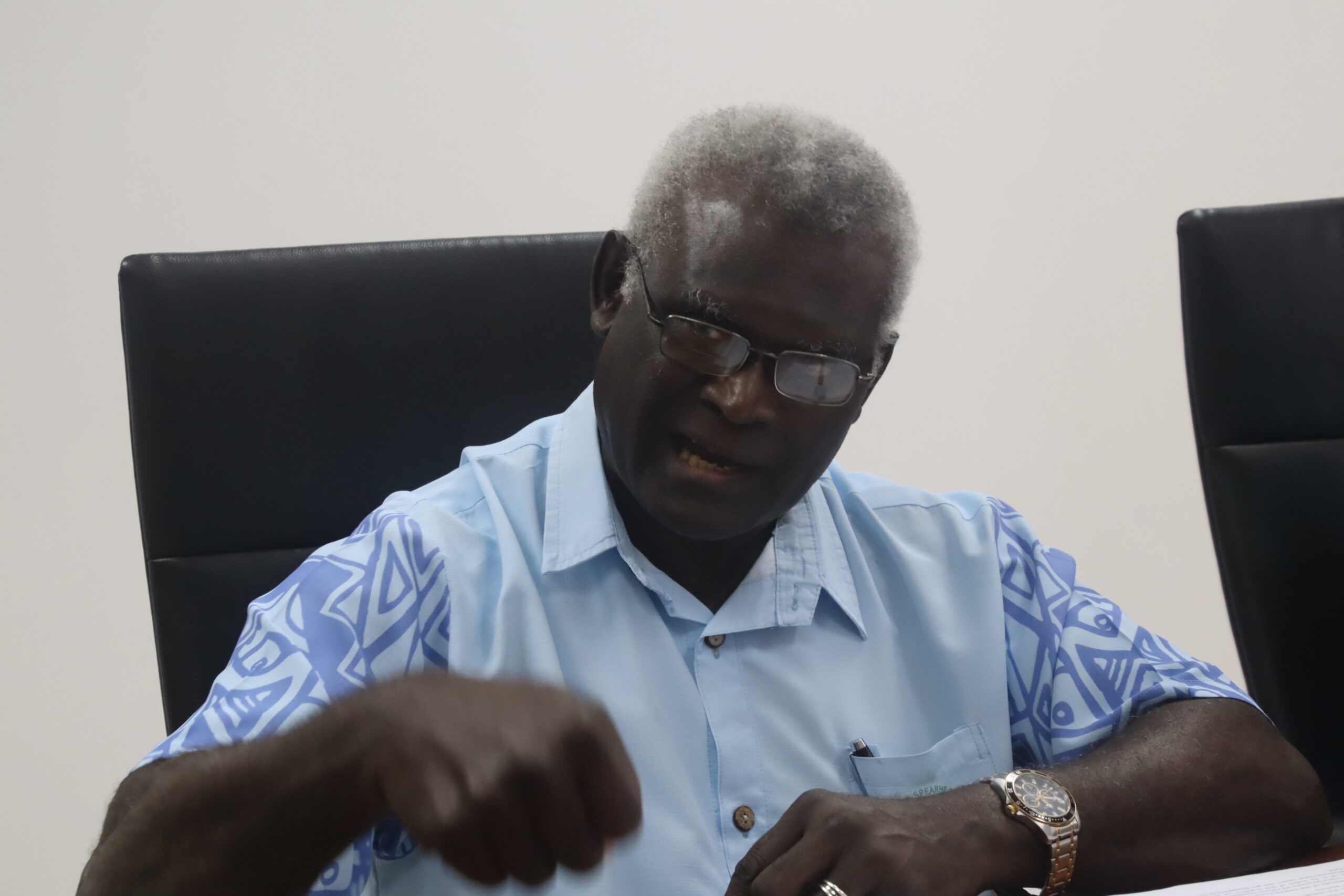
Former Prime Minister Manasseh Sogavare has dismissed speculation that his recent defection from the Government for National Unity and Transformation (GNUT) as finance minister was motivated by personal ambition to reclaim the country’s top political post.
Responding to a direct question during a press conference today, on whether he moved to the opposition with the aim of becoming Prime Minister again, Sogavare said such thinking was ‘a narrow view.’
“I have never, never, never in my life fought to become Prime Minister,” Sogavare said firmly.
“It was offered to me. So we have come here as a new coalition, and the new coalition too will decide on who will be our candidate for Prime Minister.
“We will leave that to the new group to decide,” Mr Sogavare said.
He added, he is 70-years-old, and might not be capable to take on the top job.
Sogavare’s remarks come amid heightened political maneuvering in Honiara, following the resignation of several high-profile ministers—including himself and former Infrastructure Minister Manasseh Maelanga—from the GNUT government earlier this week.
The group’s departure has reshaped the balance of power in Parliament and fueled speculation about leadership changes ahead of a possible no-confidence motion.
The east Choiseul MP has a long history as Prime Minister of the Solomon Islands.
Sogavare’s political career has been marked by multiple returns to the Prime Ministership—not through personal campaigns, but through shifting alliances and the endorsement of parliamentary majorities.
He has served as Prime Minister four times: first in 2000, again in 2006–2007, then from 2014–2017, and most recently from 2019 until April 2024. In each case, Sogavare rose to the role amid national crises or political upheavals, often emerging as a compromise or unity candidate when Parliament struggled to reach consensus.
His first term came in the aftermath of the ethnic tensions that rocked the Solomon Islands in the late 1990s, following the resignation of then-Prime Minister Bartholomew Ulufa’alu. Sogavare, then a relatively young MP, was seen as a stabilizing figure acceptable to rival factions.
In 2006, he returned to power after the sudden resignation of Snyder Rini amid riots in Honiara. His tenure again ended prematurely when he was ousted in a vote of no confidence in 2007.
His 2014 comeback followed a general election in which his Democratic Coalition for Change Government (DCCG) gained enough support to form government. Yet again, in 2017, he lost the top job due to internal disagreements—only to return in 2019 under a new coalition.
Each ascent was backed by political groups seeking leadership that could hold fragile alliances together. Rather than aggressively campaigning for the premiership, Sogavare has often found himself the default candidate of compromise and continuity.
In this current political tension, Sogavare appears to be positioning himself not as a power-seeker, but as part of a broader coalition seeking change from what he and others have described as ‘failed leadership’ under the current GNUT administration.
ENDS
