
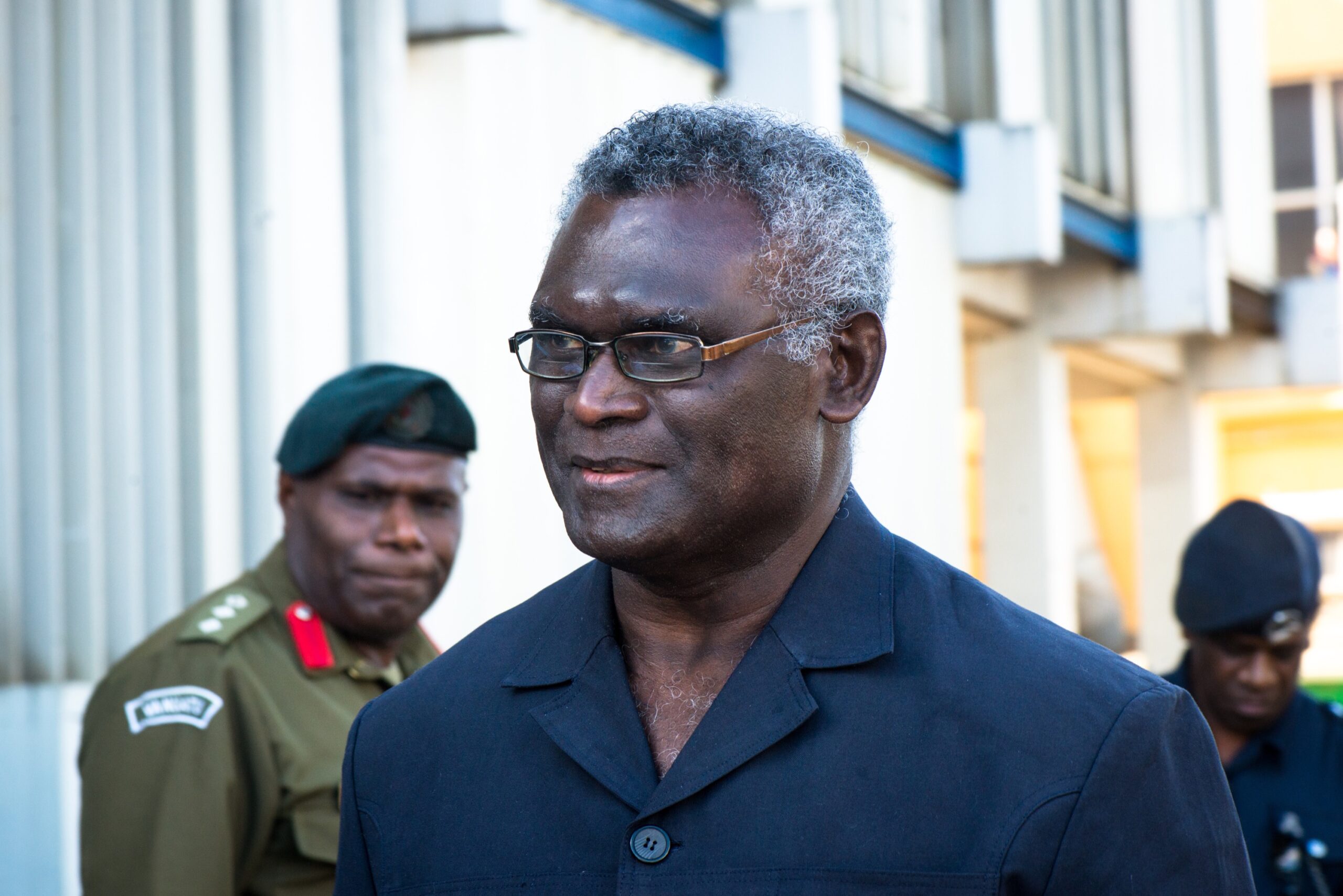
Opposition Leader Manasseh Sogavare has launched a scathing attack on the Government’s planned maritime security agreement with the United States, warning it could compromise Solomon Islands’ sovereignty.
His criticism comes a day before the “Agreement Concerning Counter Illicit Transnational Maritime Activity” is due to be signed in Honiara, following Prime Minister Matthew Wale’s visit to the United States last week.
Sogavare argued the proposed agreement would undermine Solomon Islands’ control over its territorial waters, likening it to handing part of the country’s sovereignty to the United States.
“This Government wants Solomon Islanders to believe this is simply a security partnership?” Sogavare asks.
“It is not,” he added.
“Agreements of this kind can give a foreign navy legal authority to act in our waters in exchange for a theoretical right Solomon Islands could never realistically exercise.
“That is not a partnership between sovereign equals.”
Representatives from both governments will sign the agreement tomorrow afternoon at the US Embassy in Honiara.
The proposed agreement, which Sogavare termed a Shiprider Agreement, would allow greater cooperation between Solomon Islands and the United States in addressing transnational maritime crimes, including illegal fishing, drug trafficking and other security threats at sea.
Solomon Islands is the latest Pacific country to consider such an arrangement, with 12 other Pacific nations – Cook Islands, Fiji, Federated States of Micronesia, Kiribati, Marshall Islands, Nauru, Palau, Papua New Guinea, Samoa, Tonga, Tuvalu and Vanuatu – already having signed shiprider agreements with the United States.
Sogavare, who as prime minister signed a secretive controversial security agreement with China in 2022, said Solomon Islands must carefully examine the legal implications of the agreement before committing to it, warning that similar arrangements in other countries had evolved beyond their original scope.
He cited agreements signed elsewhere in the Pacific, including Vanuatu’s 2016 arrangement, arguing that the United States template provides American vessels with the ability to board, search and pursue suspect vessels when local shipriders are unavailable.
He questioned whether the reciprocal rights offered under such agreements would provide meaningful benefits for smaller Pacific countries with limited maritime enforcement capacity.
“That is not reciprocity. It is a one-way transfer of authority dressed up as an equal partnership,” Sogavare said.
The Opposition Leader acknowledged that illegal fishing, drug trafficking and other maritime threats are genuine concerns, but said security cooperation must not come at the expense of national sovereignty.
“The question is not whether we need help, but what legal authority we are being asked to surrender in return,” he said.
Sogavare claimed Cabinet and Government Caucus have not endorsed the proposed agreement.
The Government has yet to respond to Sogavare’s comments.
Meanwhile, a Solomon Islands academic says the proposed agreement would assist Solomon Islands in several ways.
Dr Tarcisius Tara Kabutaulaka, an Associate Professor at the University of Hawai’i at Manoa, said it is worth noting that 12 Pacific Islands countries already have shiprider arrangements with the US Coast Guards.
“Such partnerships assist PICs with maritime security, protect and manage offshore marine/fisheries, address/mitigate IUU fishing, and address transnational crimes such as drug trafficking,” Kabutaulaka said.
“It also helps train our law enforcement personnel,” he added.
“Given our limited capacity, arrangements such as these are valuable.”