
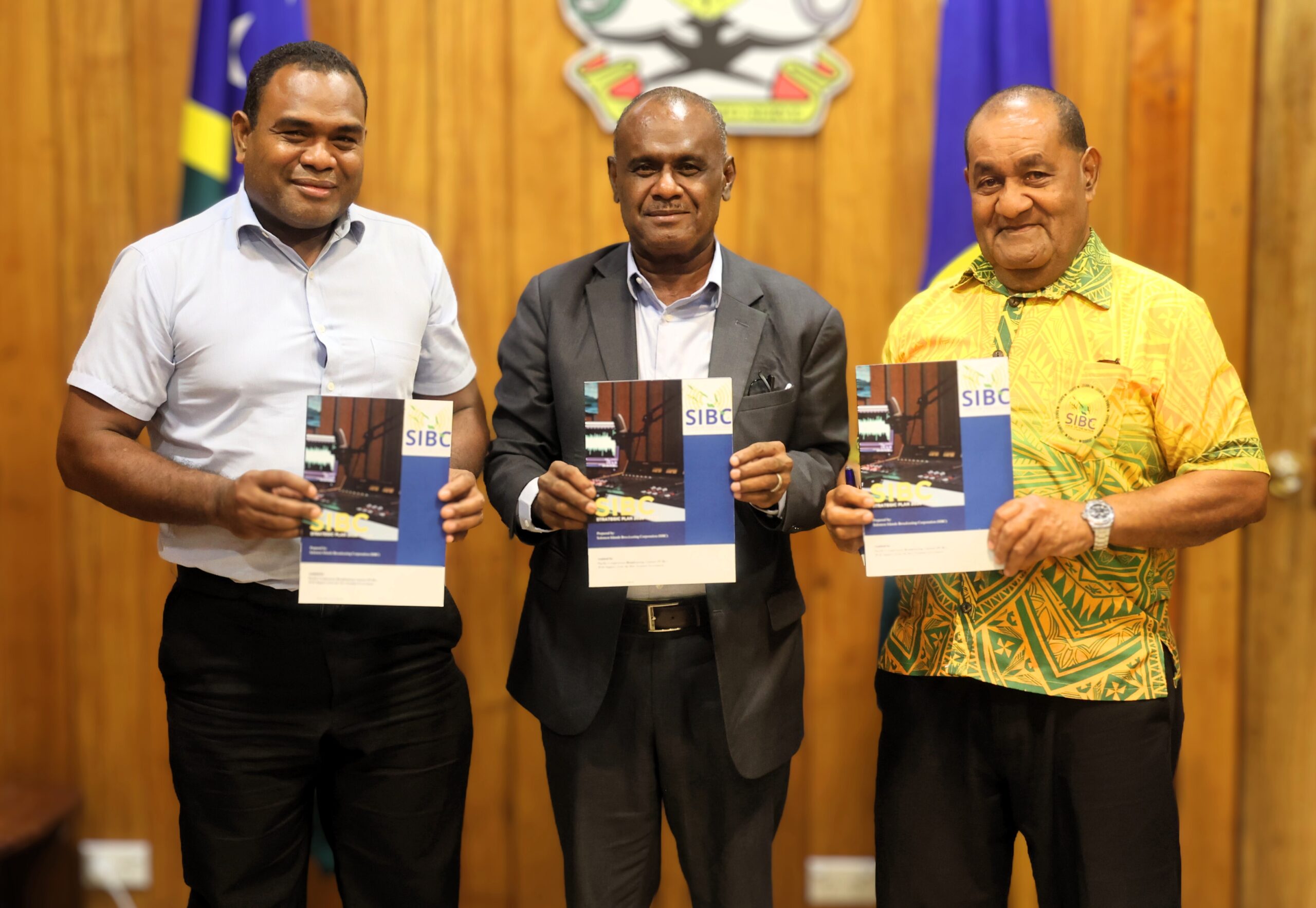
The Solomon Islands is moving to strengthen national radio coverage across its remote island communities as part of a broader effort to improve access to information and public communication services. The initiative is outlined in the Solomon Islands Broadcasting Corporation (SIBC) Strategic Plan 2026–2030, which was recently presented to Prime Minister Jeremiah Manele by the national broadcaster’s leadership.
SIBC Board Chairman Solomon Kalu and Chief Executive Officer Johnson Honimae met with the Prime Minister in Honiara on March 6th, to present the strategic roadmap and update him on the organisation’s operations and development priorities.
Since its removal as a State-Owned Enterprise (SOE) on June 27, 2022, the Solomon Islands Broadcasting Corporation (SIBC) has transitioned from a profit-oriented entity to a National Broadcaster operating directly under the Office of the Prime Minister and Cabinet (OPMC).
During the meeting, the SIBC leadership briefed Prime Minister Manele, as Minister responsible for SIBC, on the vision outlined in the Strategic Plan. Developed with support from the New Zealand Government, the Plan provides a roadmap for the organisation and its staff, outlining strategic priorities to strengthen SIBC’s service to the people of the Solomon Islands.
Key strategic areas discussed during the meeting included upgrades to broadcasting infrastructure, including work underway in Lata, in the far eastern Temotu Province, with support from the Prime Minister’s Office to improve radio coverage for communities in the province.
SIBC also highlighted the upgrade of its AM transmission system at Henderson as a priority project, noting that the 1035 AM medium wave band remains one of the most widely accessed platforms for listeners, particularly in areas such as Honiara, Guadalcanal, Malaita, and parts of the Central and Western provinces.
The current AM system operates at only about 50 % of its capacity, limiting reach and signal strength. Upgrading the system would allow the broadcaster to improve signal quality and coverage significantly, enabling more reliable access to news and information for a larger portion of the population.
The broadcaster also noted that shortwave transmission on 5020 kHz at Henderson remains an important channel for audiences in far-flung islands during morning and evening hours, reinforcing the ongoing need to maintain and strengthen national transmission capabilities. SIBC continues to explore partnerships and support to strengthen these critical broadcasting systems.
In Television, SIBC is also exploring collaboration with Telekom Television (TTV) to broadcast content through one of its channels, while discussions on partnership arrangements continue.
In addition, SIBC maintains working arrangements with Solomon Telekom Company Limited, including the use of its towers to transmit FM signals in Malaita and Western Province, helping expand access to broadcasting services across the country.
Meanwhile, Mr Manele welcomed the Strategic Plan and reaffirmed the Government’s commitment to strengthening the national broadcaster as a key institution for unity and stability in Solomon Islands.
“SIBC plays a central role in promoting unity and stability, which is one of the Government for National Unity and Transformation’s fundamental policy pillars, Unity and Stability. Hence, we see SIBC as an important institution for the Government,” Prime Minister Manele said.
CEO Johnson Honimae thanked the Prime Minister and the Solomon Islands Government for their continued support to the national broadcaster, including the annual SBD 5 million subvention grant.
He also acknowledged the Government’s decision to pay the grant in full rather than in tranches, noting that the support is vital in sustaining SIBC’s operations and services to communities across the country.
The courtesy visit reaffirmed the strong partnership between SIBC and the Government, and the broadcaster’s central role in informing, connecting, and serving Solomon Islanders across the archipelago.
[ENDS]