
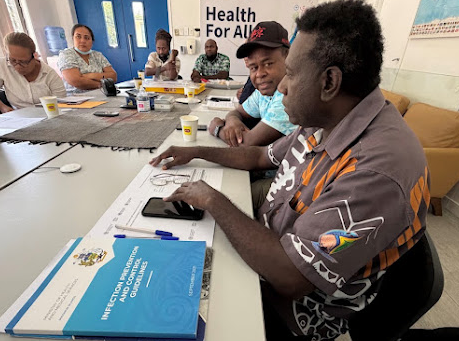
Solomon Islands has strengthened its efforts to combat drug-resistant infections after completing its latest national assessment on antimicrobial resistance (AMR), a growing global health threat.
The country recently submitted its annual report to the Tracking Antimicrobial Resistance Country Self-Assessment Survey (TrACSS), an international survey that measures how countries are responding to infections that no longer respond to medicines such as antibiotics.

The Solomon Islands has taken part in the survey every year since 2020, providing information from the health, agriculture, livestock, food and environmental sectors to help guide both national planning and global efforts to tackle the problem.
Across the Western Pacific, participation in the survey remains high. In 2025, 26 of the region’s 28 countries completed the assessment, reflecting a growing commitment to tackling antimicrobial resistance together.
Minister for Health and Medical Services, Morris Toiraena, said drug-resistant infections pose a serious threat to everyone.
“Drug-resistant infections threaten all of us,” Toiraena said.
“We are committed to protecting communities across the country and confronting this growing threat,” he added.
“Participating in TrACSS helps us make informed decisions and better prepare our national response.”
The World Health Organization (WHO) Representative to Solomon Islands, Dr Howard Sobel, said antimicrobial resistance is a silent but growing problem that makes common medicines less effective.
“When medicines such as antibiotics stop working, infections become harder to treat,” Sobel explained.
“By taking part in TrACSS, Solomon Islands is helping protect these life-saving medicines while strengthening cooperation across the health, agriculture, animal and environmental sectors,” he added.

The survey has gained greater international importance after the United Nations adopted a global declaration calling on countries to step up action against antimicrobial resistance.
The declaration identifies TrACSS as the main tool for monitoring countries’ progress and encourages at least 95 per cent of nations to submit annual reports.
Antimicrobial resistance occurs when bacteria and other germs change over time, making medicines such as antibiotics less effective.
As a result, infections become more difficult and expensive to treat.
Patients can spend longer in hospital, face more serious complications and, in some cases, die from infections that were once easily treated.
For the Solomon Islands, the challenge is even greater because health services have limited resources and many communities live in remote islands where access to healthcare is already difficult.
Health officials say tackling antimicrobial resistance is essential to protecting public health and ensuring medicines continue to work when they are needed most.
To address the problem, the Ministry of Health and Medical Services, together with other government agencies, has developed a National Multi-sectoral Antimicrobial Resistance Plan (2023-2026).
The plan focuses on:
1. Raising public awareness about the safe use of antibiotics;
2. Improving laboratory testing and disease monitoring;
3. Encouraging responsible use of antibiotics in people and animals;
4. Preventing the spread of infections; and
5. Strengthening cooperation between the health, agriculture, livestock and environmental sectors.
6. Information collected through the TrACSS survey helps the Government identify gaps in its response, target resources where they are needed most, strengthen cooperation between agencies and guide support from development partners.
Health authorities say continued participation in the survey will help Solomon Islands protect its health system, safeguard the effectiveness of antibiotics and improve the country’s ability to respond to future health challenges.

You must be logged in to post a comment.