
“When a Prime Minister is simultaneously the regulator, the tax collector, and a timber merchant, state policy inevitably aligns with cartel profit margins.” Sir Francis Billy Hilly.
Across the Pacific Islands, customary land ownership has long been seen as the ultimate constitutional shield for indigenous sovereignty.
But deep within the legislative framework of the Solomon Islands, an obscure legal mechanic is quietly severing people from their birthright, precisely eighty-two inches beneath the soil.
Addressing the National Parliament last week, Prime Minister Matthew Wale condemned the multi-generational mismanagement of natural resources, a legacy of exploitation that has hallowed out the nation and left behind a trail of environmental degradation and economic ruin.
“Sir, I have named the disease before, and I’ll name it again: Elite Capture. The quiet arrangement by which the wealth of this nation is harvested by a narrow few, while the ordinary families carry the cost. Every reform announced by His Excellency the Governor General, Sir, is directed against this evil that has plagued our nation for far too long.”

Wale continued: “In the forestry sector, for many years, the management of our forests has been the clearest proof of elite capture.”
The Prime Minister said that the systemic hollowing of our forests must not serve as a blueprint for the mining industry, asserting that his administration is actively refining the legislative gaps within the proposed Mineral Resources Bill 2025 to be tabled soon in Parliament.
The systemic exploitation resting on this anomaly recently burst into the open before the Bill & Legislation Committee (BLC).
Testifying on the Mineral Bill 2025 earlier, Philip Kanairara, a lawyer and Chairman of the Law Reform Commission, called for an immediate investigation into the state’s long-standing doctrine that indigenous land titles stop at a six-foot threshold.
Kanairara’s revelation was severe, there is no actual basis in English common law or Solomon Islands jurisprudence for this arbitrary boundary.
“In common law, there’s no such thing as below six feet,” Kanairara testified.
“But in the Solomon Islands, everyone talks about it. People own resources down to six feet deep, and anything below belongs to the state. I don’t know where that idea comes from.”
Under Section 2(1) of the Mines and Minerals Act 1990, all minerals are legally vested in the State and the people, a core provision that functions in reality to invalidate indigenous land claims below the six-foot threshold.
Customary sovereignty grants local ownership over the surface jurisdiction down to six feet deep, covering agricultural plots, sago reserves, ancestral graves, and topsoil.
“But anything below this six-foot threshold reverts to State ownership, creating an extraction loophole often exploited by corporate cartels” Kanairara said.
The political history of this loophole reveals an alarming pattern of shifting allegiances.
Last year, while serving as Opposition Leader, Wale aggressively interrogated the Ministry of Mines during a Public Accounts Committee hearing, demanding to know if they planned to strike the controversial clause from the Act to resolve decades of resource-owner grievances.
Yet, following his recent ascension to Prime Minister, Wale’s stance underwent a dramatic transformation.
When questioned by local media on the upcoming amendments to the Mineral Resources Bill, he defended the status quo.
“On the ‘below six feet clause’ we think it is good to keep it that way,” Wale asserted, citing the need for strategic, centralized control to manage intergenerational wealth.
The Human Toll of “Elite Capture”
From the floor of the National Parliament, Prime Minister Wale has repeatedly issued sharp condemnations of the systemic resource mismanagement and corruption that continue to plague the nation.
He described an era as “Stripped islands, a few enriched, and the landowning village left with stumps and silt,” pledging to phase out raw round log exports entirely by 2032.

Across the ridges of the Guadalcanal hinterland, the bauxite-rich pockets on Rennell, and the fragmented Nickel rich landscapes of the Western Solomons, the structural remnants of the logging era are being swallowed by invasive secondary growth.
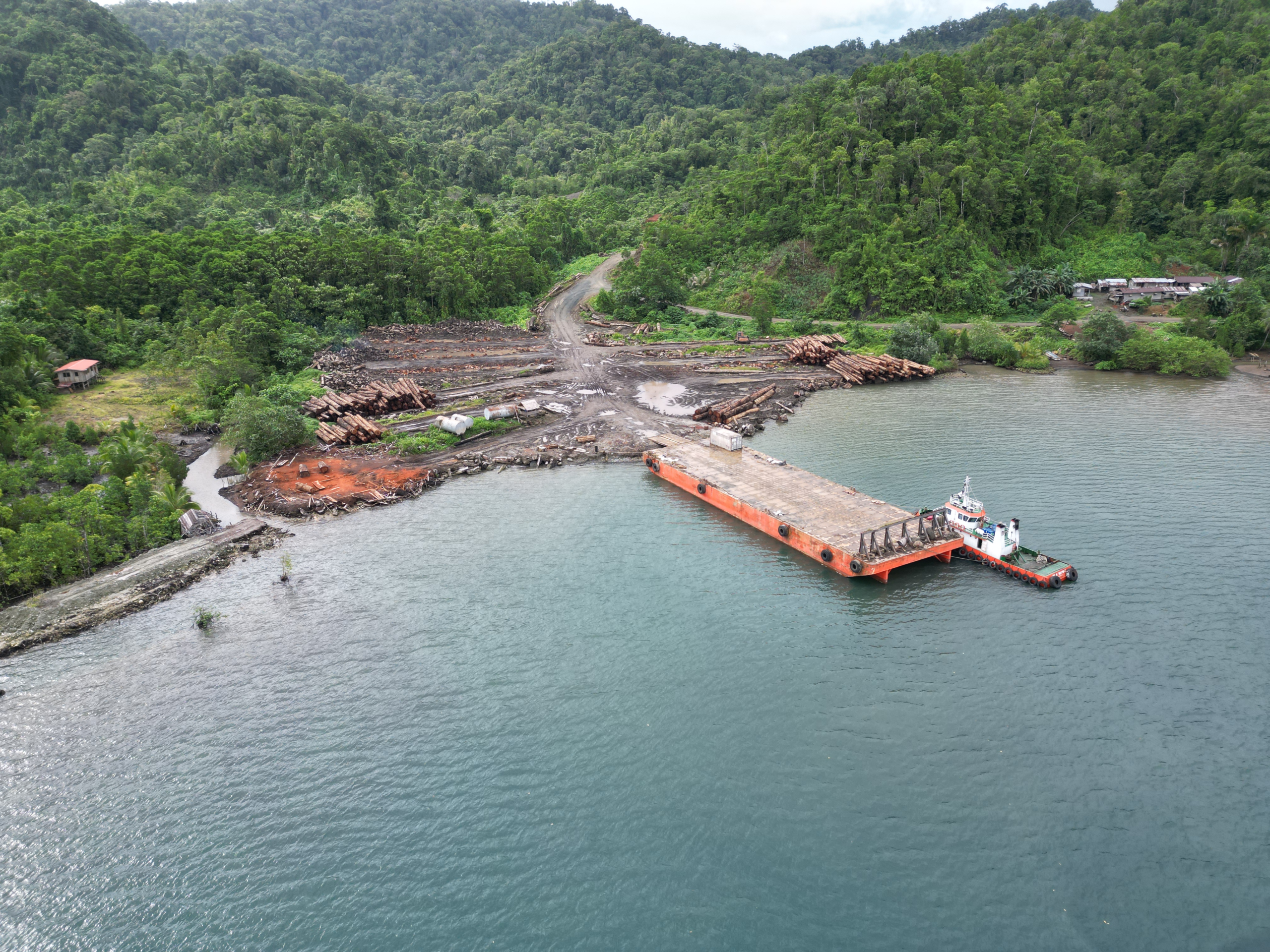
For four decades, overseas syndicates funneled billions in raw timber through the capital’s wharves, a systematic hollowing of indigenous wealth that left behind a legacy of ecological ruin and social displacement.
While resources vanished, a generation of dispossessed youth drifted toward the urban sprawl of Honiara, their ancestral birthright traded for the fleeting, hollow comforts of the city’s bars and night life.
Wale said: “The young graduate walking the streets of Honiara with a certificate, but no job-that is the standard against which the people will judge all of us.”
The social consequences of this wealth extraction are visible on the street corners of Honiara, or urban centers and even the logging/mining camps where displaced, idle youth face limited economic prospects.

In Rennell Island land tenure case, dispossessed landowner Jimmy Festus testified that logging and subsequent mining left him with nothing but bare rock.
“My land was logged, and later mined! The mining company left with our 33 shipments without paying up, and I never owned a business, nothing. I am still poor and worse off than before mining. All I have now is a bare rock!”
Rather than simple regulatory failure, critics argue this weak economic reality points to a calculated methodology of depletion and deception.
The late Sir Francis Billy Hilly, a former Prime Minister, told In-depth Solomons in 2024, explicitly described the structural collapse not as a symptom of institutional weakness, but as “textbook state capture.”
The Blueprint of Extraction
When the last chainsaws fell silent in the early 2000s, the resource owners of the interior thought the deprivation was over. They were wrong!
Today, new machinery is rolling up the old logging roads. In Isabel, Guadalcanal, Choiseul or Rennel Island. This time, they aren’t coming for the trees. Some maybe. But they are already exporting raw what lies beneath: bauxite, nickel, and gold.
On Rennell Island, shipping manifests reveal that thirty-three vessels heavily laden with raw bauxite have departed for international markets, leaving both the national treasury and customary owners uncompensated.
These syndicates are deploying the exact same legal and logistical playbook that decimated the forests.
The historical architecture of this system traces directly back to the political maneuvers of former Prime Minister Solomon Mamaloni.
Upon regaining power in 1981, Mamaloni dismantled the strict colonial-era regulatory buffer managed by the Forestry Department, which had protected customary landowners from foreign syndicates.

Under the populist banner of letting customary landholders decide their own fate, his government stripped the Commissioner of Forests of supervisory powers.
Sir Billy said: “In reality, removing state oversight did not empower villagers. It exposed rural communities to unscrupulous foreign logging cartels, primarily from Malaysia and Indonesia, who arrived with cash, legal teams, and promises that never materialized.
“Framing these regulatory checks as obstacles to indigenous economic freedom, Mamaloni’s administration systematically stripped the state of its oversight capacity.
“Between 1981 and 1983, foreign logging licenses increased fourfold.”
But Mamaloni did not stop at controlling the state.
He merged the state with the timber industry itself. Through his locally owned company, Somma Ltd, he became a timber operator, logging customary land in his home region of Makira.
Sir Billy once said: “When a Prime Minister is simultaneously the regulator, the tax collector, and a timber merchant, state policy inevitably aligns with cartel profit margins.”
Richie Pautanagata, President of the West Rennell Land Owners Association, observed that these commercial syndicates systematically exploited the divide between intricate legal frameworks and local educational disparities.
“In our case in Rennel, customary owners were only presented with mere two-page fragments of complex contracts.
“Crucial signature pages designed to permanently alienate ancestral lands were severed from the full context, keeping landowners blind to the mechanics of their own dispossession.
“They were paid $500 to sign up their land for logging and mining.”
Cash, Cartels, and Political Patronage
According to Peter Dauvergne’s 1997 working paper documents titled “Corporate Power In The Forests Of The Solomon Islands” published by the Australian National University, “By the mid-1990s, round logs generated over 50 percent of total export earnings and 30 percent of government revenue. The industry had achieved something more powerful than profit: they had achieved dependence.”
Mamaloni famously noted: “Solomon Islands is a country born but never conceived.”
“This revenue stream allowed the administration to construct an extensive system of political patronage. Bureaucrats who attempted to enforce environmental regulations or logging codes were systematically demoralized, bypassed, or dismissed.
“In 1992, the government formalized this patronage by introducing a discretionary fund for Members of Parliament.
“Funded directly by timber revenues, this cash pool allowed politicians to bypass development ministries and distribute extraction profits directly to secure constituency loyalty.”
The Coup That Broke Reform
In 1993, a reformist administration led by Sir Francis Billy Hilly attempted to break the cartels’ grip.

His government instituted a progressive tax that raised log export duties to 66 percent, drafted a National Forestry Action Plan, and set a strict deadline to phase out raw log exports by 1997 in favor of local wood processing.
According to Peter’s ANU paper, Hilly deployed international specialists to monitor timber traders and combat under-invoicing, which was draining an estimated SI$94 million annually through falsified export pricing.
“For eighteen months, the Australian-funded Timber Control Unit successfully restricted corporate price manipulation.
The corporate retaliation was swift.
Sir Billy told In-depth Solomons in 2024: “Logging executives intervened directly, visiting key officials with cash and promises of personal enrichment.
“In November 1994, my coalition fractured under corporate pressure, forcing me out from office. Solomon Mamaloni returned to power as foreign logging executives openly celebrated the transition.
“The subsequent policy rollback was complete.
“The log export tax was slashed, and the export ban was extended to 1999, giving corporations a clear window to maximize extraction.
“International advisers were dismissed, surveillance programs were shuttered, and the plantation inventory data disappeared.”
Findings from Peter Dauvergne’s (ANU) highlight the scale of the corruption: “the Malaysian logging firm Integrated Forest Industries paid zero export tax in 1995 after distributing SI$7 million directly to three government ministers and key officials.”
During Mamaloni’s final term, timber extraction soared to more than three times the sustainable yield, exceeding 325,000 cubic meters annually.
Concurrently, discretionary tax exemptions cost the public treasury an estimated SI$207.9 million.
“When national bankruptcy loomed in 1996, Mamaloni took personal control of the Finance Ministry, choosing default over structural reform.”
The resulting economic collapse and rural resentment laid the groundwork for the armed civil conflict known as “The Tensions” in 1998, Peter Dauvergne stated.
The Next Frontier
Today, the Solomon Islands continue to face the consequences of this institutional legacy.
Prime Minister Mathew Wale recently acknowledged the structural deficit.
“We should be close to 70 billion GDP… Government cash reserves that existed in 2014 have been squandered… some of the revenue that should have been collected has never been collected. Some of these are due to corruption.”
Yet, even as the current administration drafts new mineral resource legislation and revenue-sharing frameworks, intelligence from the provinces indicates that mining cartels are deploying the exact same playbook used during the timber boom.
Syndicates are appointing compliant “trustees” to bypass local consent, posting critical surface access agreements on obscure government bulletin boards, and securing lucrative concessions from political facilitators.

At the center of this strategy remains the ‘below six-foot doctrine’.
Sir Billy Hilly said: “Until customary land rights are legally recognized as three-dimensional, extending from the topsoil down to the earth’s core, the legislative framework ensures that the exploitation of the nation’s resources will continue uninterrupted.”
This story was produced with funding support from the Pacific Media Assistance Scheme PACMAS.

You must be logged in to post a comment.