
By Ednal Palmer
The handover of two new NAIAD vessels to the Royal Solomon Islands Police Force (RSIPF) has sent a strong warning to drug traffickers and organised criminal networks operating across the Pacific: maritime surveillance and enforcement capabilities in the Solomon Islands and Pacific are getting stronger.
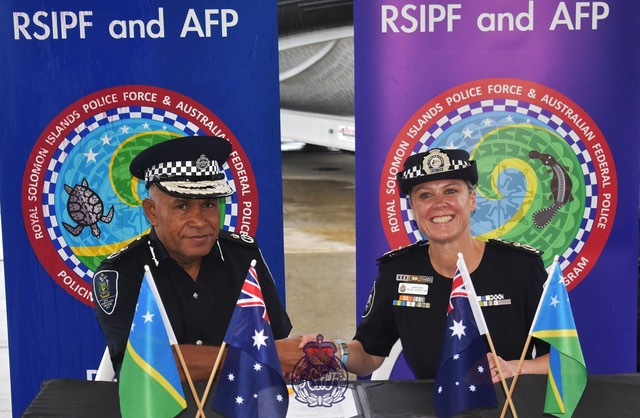
Australian Federal Police (AFP) Commissioner Krissy Barrett said the new vessels given to the Solomon Islands police are part of a broader effort to counter what she described as a “maritime illicit drug superhighway” running through the Pacific.
Speaking at the official handover ceremony at the RSIPF’s Aola Base in Honiara today, Barrett acknowledged that Australia’s demand for illicit drugs is contributing to the trafficking networks that increasingly threaten Pacific countries.
“Recently, I said publicly that the illicit commodities being trafficked to and through the Pacific is Australia’s shame,” Barrett said.
“Australia’s insatiable appetite for these illicit drugs is appalling, especially given our trusted friends and partners have become the collateral damage,” she added.
Barrett said Australia must take responsibility for the consequences of the illicit drug trade and support Pacific partners in protecting their waters and communities.

“With that in mind, a great partner knows when to step up and when to take its share of responsibility,” she said.
She said the decision to provide the two NAIAD vessels should send a clear message to criminal networks operating across the region.
“We want news of this investment to be heard loud and clear,” Barrett said.
“And it will, because we know illicit drug cartels and other organised criminals are always listening and watching.”
The message, she said, is that criminal organisations cannot undermine the security and sovereignty of Solomon Islands or the wider Pacific with impunity.
“They cannot undermine the security and sovereignty of the Solomon Islands and the wider Pacific,” Barrett said.
‘These Criminals Are Not Untouchable’
Barrett said the new vessels represent another practical tool for Pacific law enforcement agencies to fight organised crime and protect their maritime domains.
“These criminals are not untouchable. The Pacific Chiefs all have great resolve, skill and capability to target those who target us,” she said.
She said the enhanced maritime capability would enable the RSIPF to intercept and seize illicit drugs while increasing the risks and costs for criminal networks attempting to use Pacific waters as a trafficking route.
The objective, she said, is to demonstrate to international drug cartels that attempting to exploit Pacific waters will come with serious consequences.
“This is about how we design our own Pacific-led security and safety architecture,” Barrett said.
Her comments align with the Pacific Islands Forum Leaders’ vision of an Ocean of Peace, where Pacific countries take greater responsibility for the security and safety of the region.
Strengthening Solomon Islands’ Maritime capability
Barrett said the two vessels were designed with the RSIPF and the needs of Solomon Islands communities in mind.
“These vessels have been designed by the RSIPF for the people of the Solomon Islands. This has been a long time in the making. But it has been worth it,” she said.
She described the investment as evidence of the RSIPF’s commitment to protecting its citizens and contributing to a safer Pacific.
“This vision is your legacy for future generations and proves how we can work together on tangible outcomes for a peaceful and secure region,” Barrett said.
Solomon Islands Minister of Police, National Security and Correctional Service John Tuhaika Junir said strengthening the country’s national security architecture requires strong partnerships with international partners.
“As Solomon Islands continues to strengthen its national security architecture, partnerships such as this remain critically important,” Junir said.
“They enable us to respond to emerging challenges with greater preparedness and confidence, while strengthening our national institutions to remain professional, capable and responsive to the needs of our people.”
More Eyes on Solomon Islands’ Waters
The two NAIAD vessels are expected to significantly strengthen the RSIPF’s ability to conduct maritime policing, respond to emergencies and support communities across Solomon Islands’ vast island chain.
Their deployment will also allow the RSIPF’s Guardian-class vessels to focus more heavily on longer-range offshore operations.
For Solomon Islands, which has an extensive maritime domain and thousands of kilometres of coastline, the additional vessels provide an important boost to its ability to monitor and respond to activity at sea.
The handover also underscores the growing security and law-enforcement relationship between Solomon Islands and Australia.
Beyond drug interdiction, the new capability is expected to support maritime emergencies, community safety, policing operations and the broader protection of Solomon Islands’ sovereign waters.
But the warning from the AFP commissioner was unmistakable: the Pacific is no longer an easy operating environment for international criminal networks – and Solomon Islands is strengthening its ability to protect its waters.

You must be logged in to post a comment.