
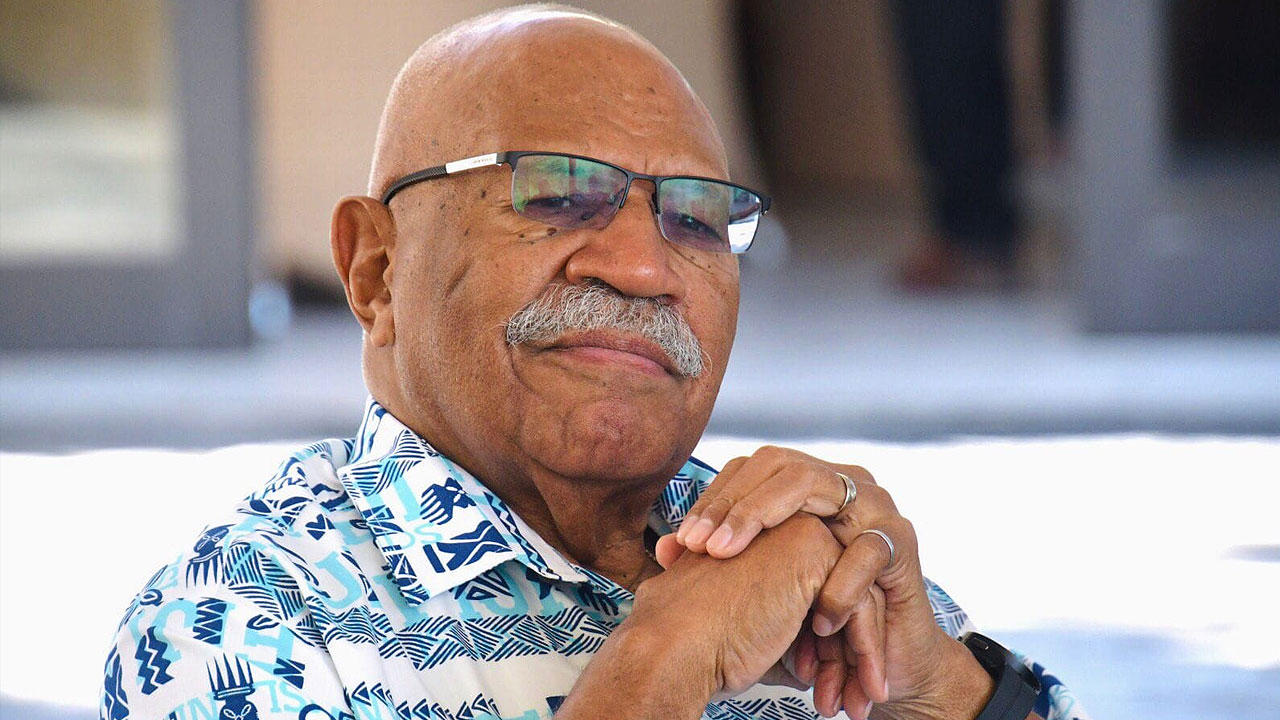
Fiji Prime Minister Sitiveni Rabuka has delivered a fierce, unapologetic message to global diplomats, declaring that the Pacific is done asking for the world’s “sympathy.”
Addressing the pre-COP31 summit gathering in Suva tonight, Rabuka dismantled the conventional framing of regional helplessness, warning global diplomats that the sinking coastlines of Oceania represent far more than an isolated tragedy, serving instead as a grim mirror reflecting humanity’s impending catastrophe.
“The ecological disasters striking small island states are not isolated Pacific risks, but shared human catastrophes that will eventually breach every continent on Earth,” the Fijian leader told regional and international delegates.
The evening began with the heavy solemnity of Fijian protocol, where foreign dignitaries were brought into a strict cultural contract through the presentation of the tabua (whale’s teeth) and the sevusevu (kava ceremony).
Rabuka used these sacred rites to lock the visiting leaders into the indigenous philosophy of the vanua, the absolute oneness of land, sea, and the people.
By participating, the international guests ceased to be mere onlookers and became part of the community, bound by a mutual duty of care.
Rabuka then brought the reality of this bond to life by pointing to the shores of Tuvalu, where the climate crisis is already a daily invasion rather than a distant policy debate.
“There, the climate crisis is not a forecast,” Rabuka told the leaders.
“It is the king tide at the door, the salt in the farmlands, and the hardest of questions: How long can we continue to stay?”
Refusing to let the international community view this tragedy through the lens of pity, Rabuka demanded that the world look at the Pacific as a bellwether rather than a victim.
“I’m not asking you to look to the Pacific with your sympathy,” Rabuka insisted.
“I’m asking you to look at us as a bellwether, indicating the scale of the challenges to come, frontline communities aware risks become visible first.
“Rising seas, a warming ocean, water that fails, food that does not come, crops that cannot be harvested or even planted; these are not Pacific risks. They are human risks. They are shared risks.”
He reminded the leaders that the Pacific Ocean covers one-third of the planet and acts as the engine room of the world’s weather.
When these waters warm and El Niño gathers strength, the consequences do not stop at local coral reefs.
“They trigger devastating droughts and floods across every continent, ultimately dictating the price of food on dinner tables in foreign cities where many have never even heard of Fiji.
“What begins in our waters arrives in yours,” Rabuka warned, dismantling any comfort of geographical distance.
In a powerful reclamation of traditional knowledge, Rabuka challenged the Western notion that indigenous ways of living are mere superstition, describing Pacific ancestors as rigorous readers of science who tracked the tides, skies, and birds to stay alive.
He said, today, that ancient system is screaming a warning.
“The Pacific Ocean is sounding the conch shell now, the bui now, and it is not sounding it for us alone.”
Opening the Talanoa dialogue in Suva, the Prime Minister framed the region’s vulnerability as frontline leadership.
He called on global powers to keep the 1.5°C target alive, ensure climate finance directly reaches affected communities, and grant the ocean a formal seat at negotiations.
The message to the world is clear: “The Pacific is sounding the conch shell not to beg for rescue, but to tell the rest of the world to save itself while there is still time.
