
by Transparency Solomon Islands
At the recent United Nations General Assembly (UNGA), Prime Minister Manele warned that “the alarming rate of pollution in the ocean is endangering marine life and the ocean’s health”.
With the Solomon Islands recently hosting the Pacific Islands Ocean Conference and the Prime Minister’s UNGA address emphasising international efforts to protect the ocean and the environment, one cannot help but ask, what about Choiseul?
The situation where Solomon Nickel Mining Company Limited’s (SNMCL) non-compliance of the Environmental Impact Assessment Report (EIAR) and Development Consent of the Siruka nickel mining tenement has seen East Choiseul ravaged by environmental consequences.
The Siruka River, once the main source of drinking and bathing water for the local village, has been polluted so severely it is no longer safe for human use. The once clear waters have turned murky brown from sediment and toxic contaminants flowing into waterways and the ocean without appropriate mitigation measures clearly required in the EIAR– rapidly decreasing the water quality for both freshwater and marine life.
Such pollution also threatens the livelihoods of seaweed farmers, who depend on clean waters for their crops, creating serious concerns for their long-term economic survival. And this is only part of the destruction caused by Siruka mining.
The ongoing environmental damage in East Choiseul due to unchecked mining raises a critical question. How can the government reconcile its stated commitment to ocean conservation with the reality of pollution and environmental degradation in one of its own provinces?
Earlier this year, Transparency Solomon Islands (TSI) released the report “Siruka Nickel Mine: Severe Environmental Impacts and Non-compliance with Conditions of the Development Consent”. The report detailed how the company owned by Mr. Johnny Sy has shown complete disregard for safeguards designed to minimise the long-term environmental impacts of mining.
Environment Impact Assessment
The EIAR sets out clear strategies to prevent environmental harm from mining in the Siruka tenement. The EIA report in the case of Siruka, was completed by Ecological Solutions Solomon Islands (ESSI), a respected organisation, led by Choiseul’s own people, with international recognition for its work on ecological issues in Solomon Islands. Their report set out the best approaches to mitigate and minimise the effects of mining activities while sustaining and managing the ecosystem of East Choiseul.
But on the ground, there is overwhelming evidence that little to none of these safeguards have been put in place. TSI’s 2025 report on the Siruka Nickel Mine shows the extent of the incriminating evidence obtained in the form of photographs and video footage.
Nickel is a pollutant that can accumulate in toxic levels in soil, water and food, and excessive nickel exposure can cause diseases in humans including cardiovascular and kidney diseases and various cancers. Yet in East Choiseul, nickel ore is being stockpiled and transported without covers, drainage, or spill controls, leaving communities and waterways exposed to dangerous runoff.
At both Kava and Nembe Ports, ore is loaded with no protection against spillage, creating a high risk of contamination (see image 1).

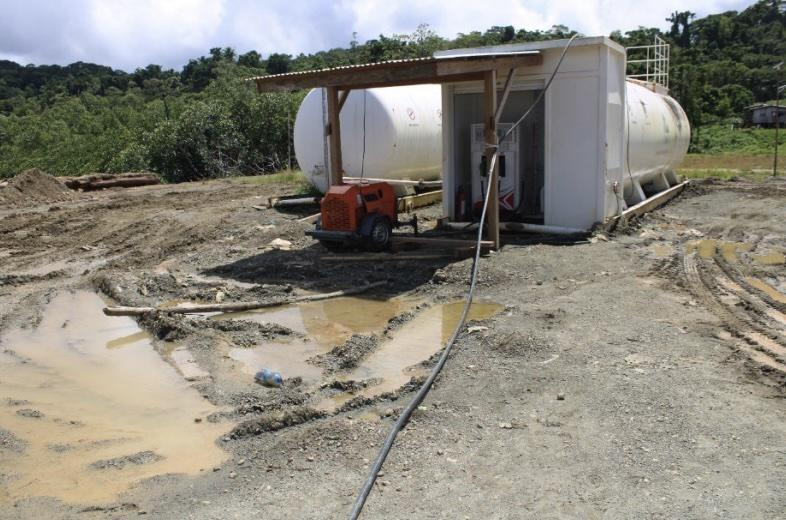
The report similarly found evidence that the company did not follow strategies to safely store hydrocarbons and other pollutants, with no spill kits, bunds, or basic safety measures to be seen on the site. This puts marine and freshwater environments at constant risk of devastating spills (Image 2 and 3).


The evidence is abundantly clear that the company is not in compliance with the EIAR and there have been limited attempts to implement these strategies recommended by the EIAR.
Government Inaction
There is overwhelming evidence at Siruka and in greater Choiseul of the non-compliance of Johnny Sy’s mining company. Yet, there has been limited action from the government.
The Ministry of Mines has remained silent, ignoring letters from communities and TSI calling for a stop notice. On the other hand, while the Ministry of Environment has acknowledged concerns, it claims the Ministry lacks funds to conduct an investigation. At most, the Ministry of Environment Director has issued a warning to the company, but it remains unclear whether this included a pollution abatement notice under the Environment Act 1998 – a notice that requires a person or entity to stop or correct a pollution-causing activity effective immediately.
This case exposes a deeper problem where Solomon Islands’ compliance and enforcement system is broken. When ministries fail to uphold the law in the face of clear violations, one must ask, who has the power to stop reckless companies that refuse to follow the rules?
If the ministries responsible do not have the power and capacity to conduct necessary measures, an independent body must be given the ability to do so. The Siruka mining case has demonstrated that mining companies cannot be trusted to comply with the conditions of its Development Consent without external supervision. It is inappropriate and inadequate to rely upon the mining company to self-monitor and self-report whether they themselves have been in breach of the conditions of the Development Consent. Therefore, TSI emphasises the imperative for there to be independent monitoring of all mining operations in Solomon Islands, both by the government and civil society organisations.
Moreover, TSI calls for the dangerous unchecked mining practices to be stopped immediately to protect vulnerable communities in Choiseul. The irreversible damage from the non-compliance of the mining company to the conditions of the Development Consent and the EIAR will affect communities in Choiseul for generations to come.
We cannot sit here complacently as we see the communities of Choiseul be exploited for profit. The government must impose appropriate penalties and restrictions on the mining company for their non-compliance with the EIAR and Development Consent. These restrictions must be meaningful and make a difference to the people and the natural ecosystems of Choiseul.
It is time for the government and the responsible ministries to take action and to put the interests of their people above those of foreign companies. The voices of Choiseul’s communities must be heard and their concerns taken seriously.

You must be logged in to post a comment.