
by Charley Piringi in Antalya, Turkiye
At just 35 years old, Millicent Barty should be daydreaming about buying her first home, climbing a career ladder, or building a quiet tomorrow.
Instead, her hands are bruised and raw from lifting jagged coral out of the crashing surf and hauling coconut trunks across disappearing plantations—working alongside villagers in Lilisiana to construct make-shift seawalls against an unrelenting ocean.
She is not planning for a comfortable retirement. She is fighting for survival, desperately trying to keep her ancestral homeland from being swallowed whole by the rising tides.
“I’m only 35 years old, at an age when many young people elsewhere are thinking about buying their first home, building careers, or planning their futures,” says Barty, founder of the Custom Keepers organisation, whose maternal roots lie deep in Malaita Province’s Langa Langa Lagoon, and Makira Province.
She said, “I’m wondering whether my ancestral home will even exist. Will my children know the places I grew up knowing? Where will our people go when there’s no more shoreline left to defend, and what does it mean to belong somewhere when that somewhere is slowly disappearing?”

Her anguish reflects the painful, daily reality of Lilisiana, a low-lying coastal community in the Solomon Islands where climate change is neither an abstract statistic nor a polite debate in an air-conditioned boardroom.
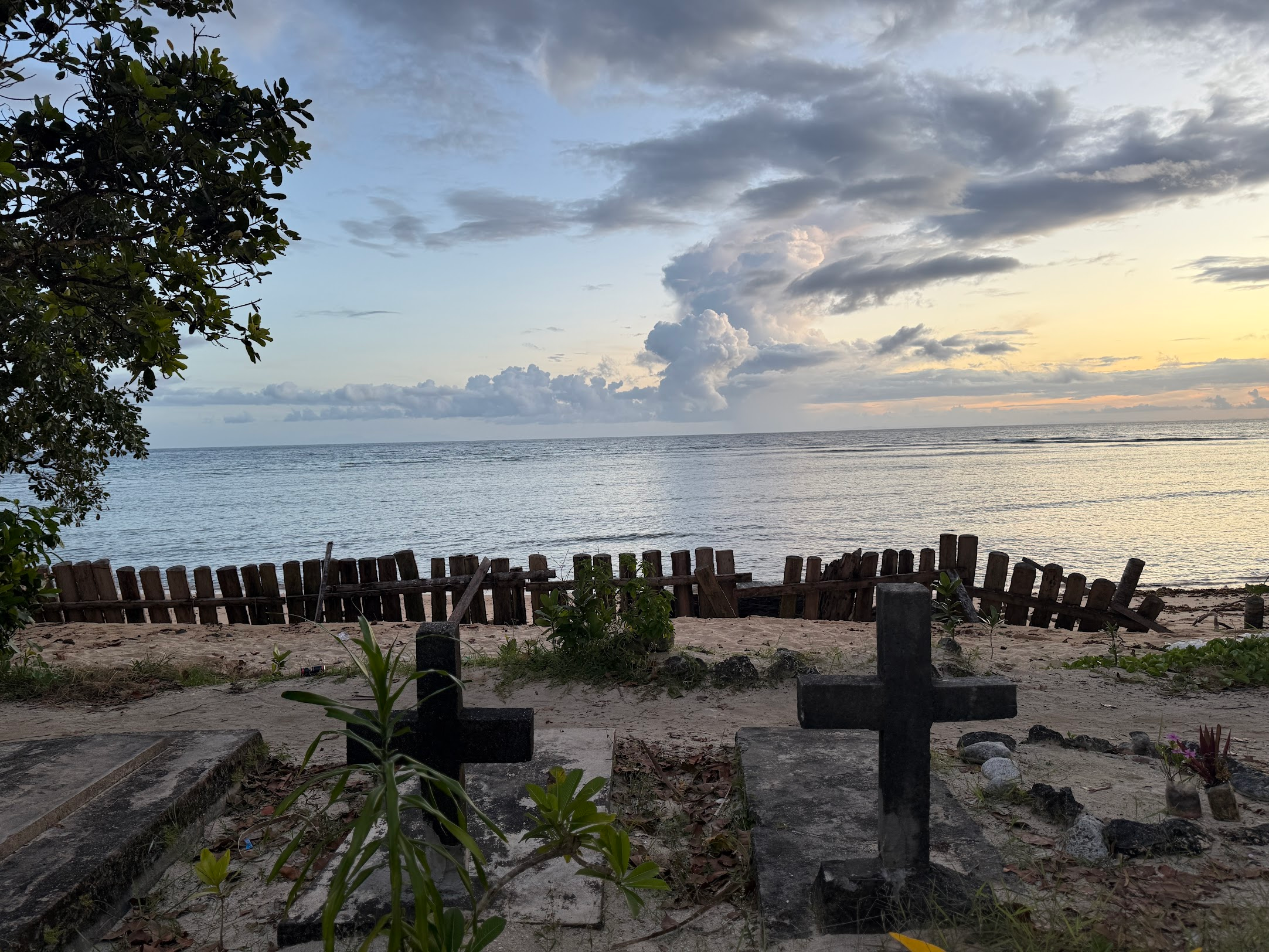
It is an immediate, ruthless thief. The rising tides have already poisoned their freshwater wells, smothered their Kakama swamp taro crops in salt, and torn open sacred burial grounds, carrying more than 200 ancestral graves into the dark abyss of the sea.
As December approaches, bringing dreadful king tides, and another punishing cyclone season, families elsewhere wrap holiday gifts and celebrations. But in Lilisiana, children, parents, and grandparents instead scramble to pile stones, timber, and coconut logs against the thundering waves.
“Imagine spending your life preparing for the next disaster while quietly wondering how many more your home can survive,” Bati says. “Our communities aren’t waiting to be saved; they are organizing, rebuilding, and drawing on generations of ancestral knowledge to protect what remains. But resilience shouldn’t mean being left to carry this burden alone. We contribute so little to creating this crisis, yet we’re being forced to contemplate losing everything”.
Ms Barty personally funded and built a traditional rock and coconut trunk seawall that temporarily defied engineering predictions of collapse. Yet as frontline islanders defend their shores with basic tools and empty pockets, billions of dollars promised by the international community remain trapped behind towering walls of bureaucratic paperworks.

“Communities like Lilisiana have received no direct funding from the International Loss and Damage Fund or any international climate funding that I’m aware of,” Bati notes, speaking plainly about the heartbreaking gap between grand climate summit rhetoric and village reality.
“When we as a community seek funding, we’re suddenly expected to produce engineering designs, technical assessments, financial projections, baseline data, and these lengthy proposals. We have elders who understand the tides, women who know exactly where the shoreline is weakening. Traditional knowledge must count as evidence.”
But thousands of miles away at the COP31 climate negotiations room in Antalya, Türkiye, global leaders echoed the very exasperation bleeding from the frontlines.
UN Secretary-General António Guterres delivered a stark warning to the summit: “We know the truth. Now we must act on it, because climate action is more than a fight over a number or a thermometer. We are in the fight for our lives and our children’s future.”
“And those who profit most from fossil fuels must help foot the bill for the damage they have caused. Polluters must pay.”

“Young people, scientists, indigenous peoples, civil society, small island developing states, you are the conscience of this struggle, and you have been standing up to some of the most powerful monarchs and special interests in our world today.”
Directly echoing Millicent Barty’s fear of a stolen future, Australian Prime Minister Anthony Albanese shared a message from another young Pacific voice clinging to her homeland.
“I met Melalusi Sokatea, a 13-year-old student who told us she dreams of becoming a doctor, but fears for her home,” Prime Minister Albanese told delegates, highlighting a heartbreaking plea that spans across the entire Pacific ocean.
“We all have one simple dream: to grow up safely here in Tuvalu, the place we call home,” Melalusi had shared. “We are not asking for pity. We are asking for help and partnership.”
“Please work together to protect small islands like ours,” she urged. “Help us build strong schools, strong homes, and strong water systems so students like me can learn, play, and grow up safely.”
For leaders like Solomon Islands Prime Minister Mathew Wale, the ongoing inaction following major international pledges feels like a deep moral betrayal.
“The fact that we’re more than a decade after the Paris Agreement, and still we’re talking about the same issues. Still, the pledges remain just that. Still, there is no finance for adaptation, relocation, and livelihoods, is an indictment on the world. Our humanity is being severely undermined by very powerful interests that continue to pollute almost at will, unrestrained.”
He added, “It’s justice we’re seeking, not charity, and yet finding it’s so difficult to find justice, even after the International Court of Justice made it very, very clear that countries have an obligation. Yet the major polluters are not serious, and are not sincere about those obligations. It’s a serious indictment of humanity.”
Adding her voice to the regional outcry, Fiji’s Minister for Information, Environment and Climate Change and Chair of the Pacific Small Island Developing States, Lynda Tabuya, demanded that world powers look directly at the human toll behind the negotiations.
“For Pacific families, climate change means saltwater in drinking wells, damaged crops, fewer fish and homes threatened by rising seas,” Tabuya insisted. “COP31 must deliver action that people can feel in their daily lives. Get climate finance to communities faster for secure water supplies, resilient homes and recovery after disasters. One Pacific. One voice. Real results for our people”.
Having recently participated in pre-COP discussions in Fiji, Ms Barty felt the painful disconnect between the diplomatic arena and the eroding shores back home.

“What struck me was how often we’re still having the same conversations. Like we know science now. We know who’s most vulnerable. We know what’s at stake. Yet, year after year, it just feels like we’re still negotiating how to respond while communities are already paying the price,” she reflected.
“I don’t question that there are people at COP genuinely fighting for change, but seriousness shouldn’t be measured by the number of declarations we make. It should be measured by what actually changes on the ground.”
Back on Lilisiana’s crumbling rim, Ms Barty said, empty global promises cannot shield them from the rising tide. Though resilient by ancestral tradition, the lagoon’s people cannot endure global neglect indefinitely.
“For Liliana, we’ve already lost our ancestral graves to sea level rise or coastal erosion. These are sacred spaces connecting us to our ancestors, our genealogy, and our identity. How do you put a price tag on that? How do you calculate the loss of a sacred space or the emotional burden of watching your ancestral home slowly disappear?” Ms Barty lamented.
“We don’t lack leadership, we don’t lack knowledge, and we certainly don’t lack the willingness to act,” Barty says quietly, staring out at the waves rolling relentlessly over her ancestors’ graves.
“What we lack is the financing to match the scale of what we’re facing—or slowly losing.”
This story was produced as part of the COP31 Climate Change Media Partnership, a journalism fellowship organized by Internews’ Earth Journalism Network and the Stanley Center for Peace and Security.
