
by Georgina Maka’a
in Kirakira
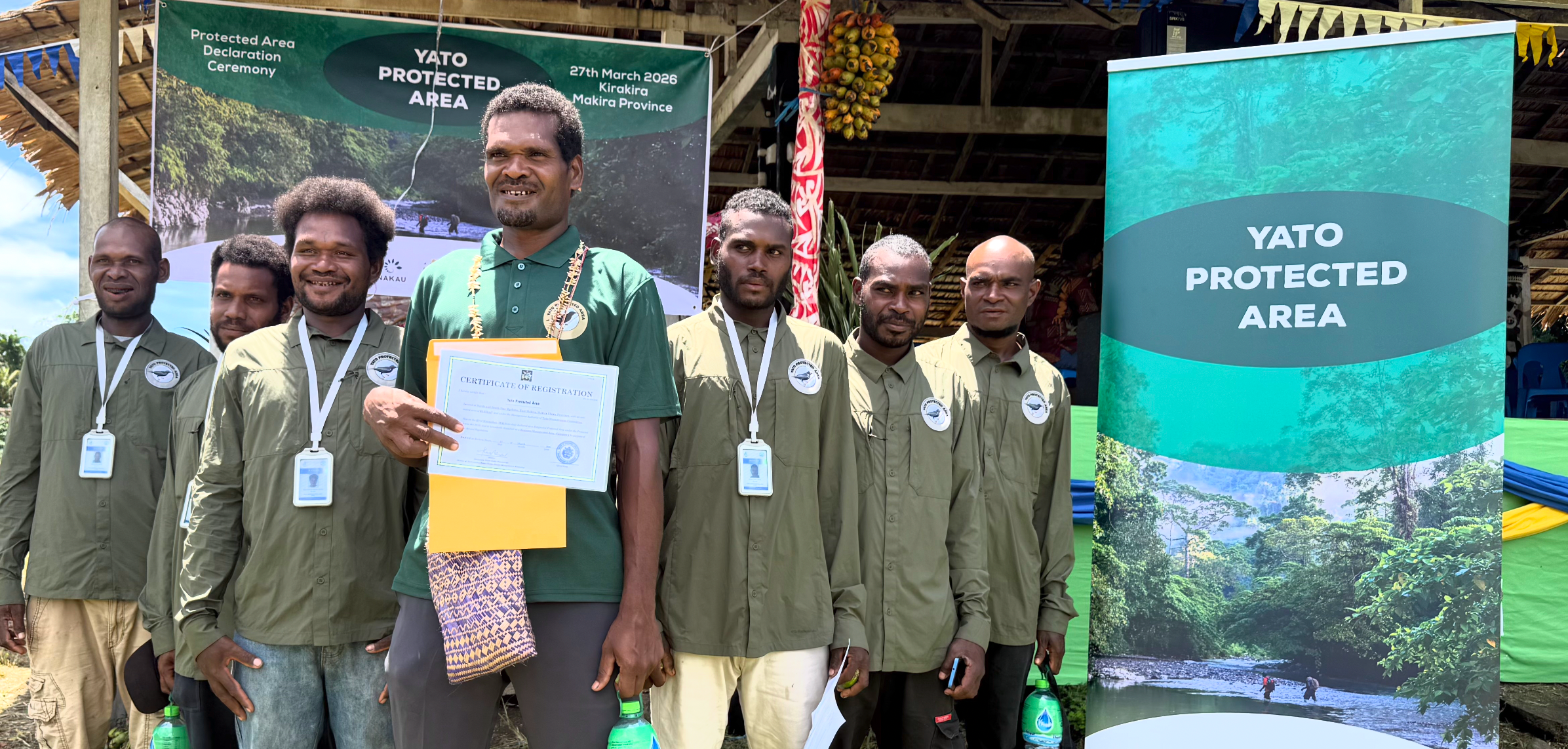
Yato Conservation Area in East Makira has been declared a “Protected Area” at a landmark event held at provincial capital Kirakira today.
This means no logging, mining or other destructive environmental activities will be allowed to take place on the declared area.
“Yato now stands as the largest terrestrial/forest protected area in Solomon Islands,” Karl Kuper, Deputy Secretary of the Ministry of Environment, Climate Change, Disaster Management and Meteorology (MECDM) said at today’s ceremony attended by hundreds of villagers and guests.
“This is no small achievement – it is a legacy. It reflects courage, vision, and a deep respect for the environment that sustains us,” Kuper added.
“Today is a day of pride. A day of unity. And a day of commitment to our land, our people, and our future.
“This moment marks another important milestone in the conservation journey of Solomon Islands.”

The Yato Conservation Area is owned by five communities from two tribes in Star Harbour.
The area spanned approximately 10,000 hectares of protected forest.
Kuper told the villagers that by choosing to protect their land, they are protecting biodiversity, culture, and future generations.
“You have achieved a major milestone. Your unity and determination have made this possible,” he added.
Provincial premier Stanley Siapu spoke with pride at today’s event.
Siapu commended the communities of Yato for their vision, determination, and commitment to making a bold decision more than a decade ago – choosing a sustainable, long-term pathway instead of relying on short-term earnings from the logging industry.
He added that the Provincial Government will play a central role in management oversight and coordination.
“All conservation initiatives must align with provincial ordinances, policies and development frameworks,” Siapu said.
“This is a matter of governance, legitimacy, and accountability,” the premier added.

He said his government welcomes the National Government’s initiative to develop a Carbon Trading Policy and a Protected Area Trust Fund to ensure the sustainability of legally declared protected areas.
The Yato project has been led by members of the Atawa and Amwea Tribes, representing the communities of Bagarai, Napuamarewa, Kereapena, Nasuahu, and Hariga.
The communities began exploring long-term economic alternatives to large-scale logging in 2016.
With support from researchers at the University of Rochester and conservation partners, the initiative has expanded over time and now includes contributions from the Critical Ecosystem Partnership Fund, the Makira Provincial Government, and other organizations working alongside communities.
Since 2022, two of these organizations – Live & Learn Solomon Islands and Nakau – have provided training and technical support through the Forest Value Enhancement Project (FoVEP), an initiative of the Millennium Challenge Corporation-funded (MCC) Solomon Islands Threshold Program (SITHP).
Their work has helped communities strengthen forest management systems, map boundaries, conduct forest inventories, and undertake land-use planning needed to access new economic opportunities such as performance-based forest finance.
[ENDS]

You must be logged in to post a comment.