𝘉𝘺 𝘢𝘯 𝘖𝘣𝘴𝘦𝘳𝘷𝘦𝘳
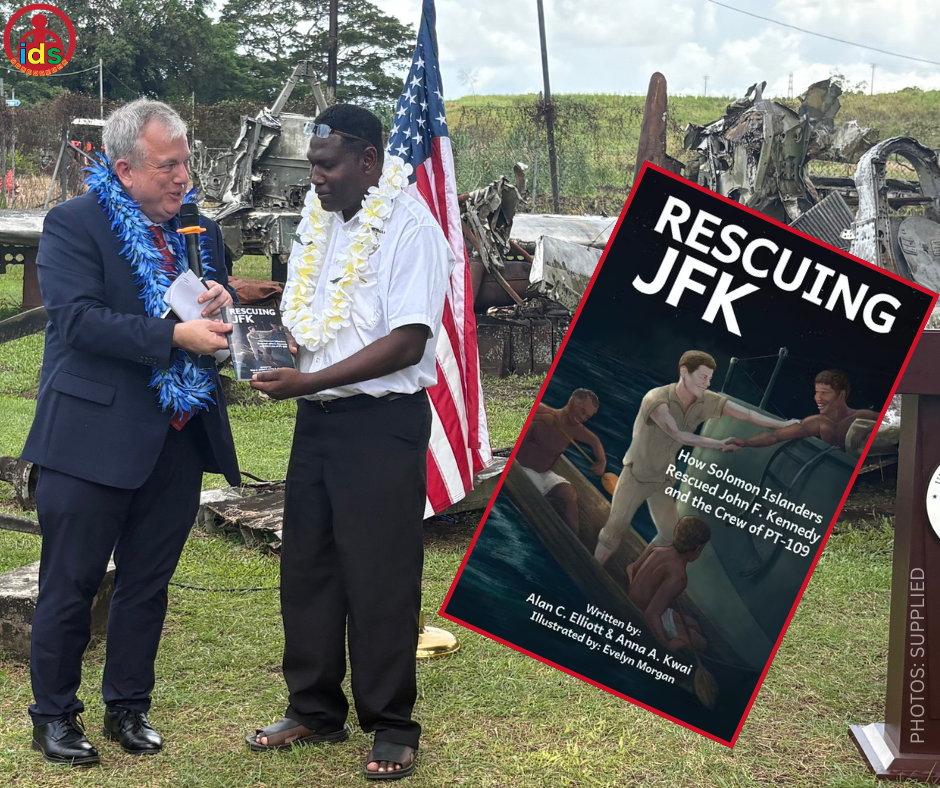
I recently read a social media post by the U.S. Embassy in Honiara highlighting an event in Solomon Islands, where the Deputy Assistant Secretary of State Matt Murray and Chargé d’Affaires Dan O’Hara officiated the launch of a book titled, “𝘙𝘦𝘴𝘤𝘶𝘪𝘯𝘨 𝘑𝘍𝘒: 𝘏𝘰𝘸 𝘚𝘰𝘭𝘰𝘮𝘰𝘯 𝘐𝘴𝘭𝘢𝘯𝘥𝘦𝘳𝘴 𝘙𝘦𝘴𝘤𝘶𝘦𝘥 𝘑𝘰𝘩𝘯 𝘍. 𝘒𝘦𝘯𝘯𝘦𝘥𝘺 𝘢𝘯𝘥 𝘵𝘩𝘦 𝘊𝘳𝘦𝘸 𝘰𝘧 𝘵𝘩𝘦 𝘗𝘛-109”, along with its subsequent distribution to schools. The post featured them presenting a copy to the Betikama Adventist College Library.
This book is important because the role of Solomon Islanders in rescuing John F. Kennedy illustrates human-centered ties between the United States and Solomon Islands. It highlights a shared historical moment that is emotionally resonant and relatively accessible compared to more technical areas such as trade, security, or aid frameworks. Additionally, Solomon Islands schools need books, making this a generous diplomatic gesture by U.S. officials.
However, the event also reflects a broader framing of U.S.–Pacific Islands relationship that I find problematic—namely, the tendency of U.S. officials to rely heavily on World War II (WWII) to define the relationships. This framing risks flattening complex regional experiences, as WWII was not experienced uniformly across the Pacific.
I have previously argued in other forums that the U.S. reliance on WWII as a diplomatic frame is problematic for both the U.S. and Pacific Island nations.
There are two main reasons why the U.S. appears to rely heavily on this narrative. First, WWII was the last major war in which the U.S. achieved decisive victory, defeating Imperial Japan in the Pacific. The victory culminated in the atomic bombing of Hiroshima and Nagasaki that resulted in Japanese surrender and ended the war. Since then, the outcomes of subsequent conflicts—such as Bay of Pigs invasion in Cuba (1961), the Vietnam War (1964-1975), the Iraq War (2003-2011), and the intervention in Somalia (1993)—have been more ambiguous or regarded as unsuccessful. Meanwhile, conflicts such as the Korean War (1950-1953) and the war in Afghanistan (2001-2021) remain contested in terms of who ultimately won.
As a result, the U.S. may have developed a habit—perhaps an obsession—of invoking its WWII successes in the Pacific to sustain a narrative of military and moral triumph. This narrative is familiar, positive, and deeply embedded in U.S. political and diplomatic discourse. Alternatively, it may serve to divert attention from the more controversial or less successful engagements—the story of the empire’s victory must be kept alive to distract from its other more ominous engagements.
Second, the U.S. often frames WWII through a narrative of liberation: that it freed the Pacific Islands from Japanese imperial rule, thereby establishing a foundation for enduring friendship and gratitude. While this interpretation may hold true in certain contexts—such as Guåhan/Guam, where Japanese occupation was particularly harsh—it does not reflect the diversity of experiences across the region. For example, in his book, “𝘚𝘢𝘯𝘢: 𝘈𝘯 𝘢𝘶𝘵𝘰𝘣𝘪𝘰𝘨𝘳𝘢𝘱𝘩𝘺 𝘰𝘧 𝘔𝘪𝘤𝘩𝘢𝘦𝘭 𝘚𝘰𝘮𝘢𝘳𝘦”, the Papua New Guinea leader recounts relatively positive interactions with Japanese soldiers, illustrating a more complex historical reality.
Moreover, the liberation narrative becomes less convincing when considering how WWII facilitated and strengthened U.S. colonization, militarization, and strategic control of the Pacific Islands. Following WWII, the U.S. took possession of the northern Pacific—present day Palau, Federated States of Micronesia, Marshall Islands, and the Commonwealth of the Northern Mariana Islands—expanded its military presence in Guåhan/Guam and Hawai’i, established bases such as Kwajalein in the Marshall Islands, and conducted nuclear weapons testing in the region. Rather than simply liberating the Pacific, these actions contributed to ongoing militarization and external control, dynamics that continue to shape the region today, particularly amid growing geopolitical competition with China.
In addition, the legacy of WWII continues to have tangible and harmful effects in some Pacific Islands countries. Unexploded ordnances (UXO) left behind from the war continue to cause injury, death, and environmental damage. In Solomon Islands, for example, communities still face risks from UXO, and the process of clearing these remnants is both dangerous and costly.
For these reasons, I find it troubling when U.S. officials repeatedly invoke WWII as the primary frame for engagement with the Pacific Islands.
Given the United State’s current global image challenges, it is understandable that officials may seek positive historical narratives on which to build relationships; an attempt to use small positive stories to build category 5 diplomatic hurricanes. WWII offers a readily available story of cooperation and success. However, overreliance on this narrative risks turning it into an overused diplomatic tripe.
To be clear, the issue is not that WWII should never be referenced. Rather, when it becomes the primary lens through which relationships are framed, it can appear outdated or selective—especially in a region where lived experiences often diverge from that narrative. Most Pacific Islanders today do not associate WWII with positive memories, but rather with its enduring consequences, including wreckage and UXO. For most of most young Pacific Islanders, WWII is a very distant past.
Focusing too heavily on WWII can also sideline pressing contemporary issues in the Pacific, such as climate vulnerability, economic development, fuel shortages, drug trafficking, sovereignty concerns, and the long-term impacts of militarization. These are the priorities for many Pacific Islands communities today, and do not fit neatly into a WWII framework.
The relationship between the U.S. and Pacific Island countries remains important. Moving forward, it would be beneficial for policymakers in Washington D.C., to adopt a more nuanced and forward-looking approach to framing these relationships.
[ENDS]