
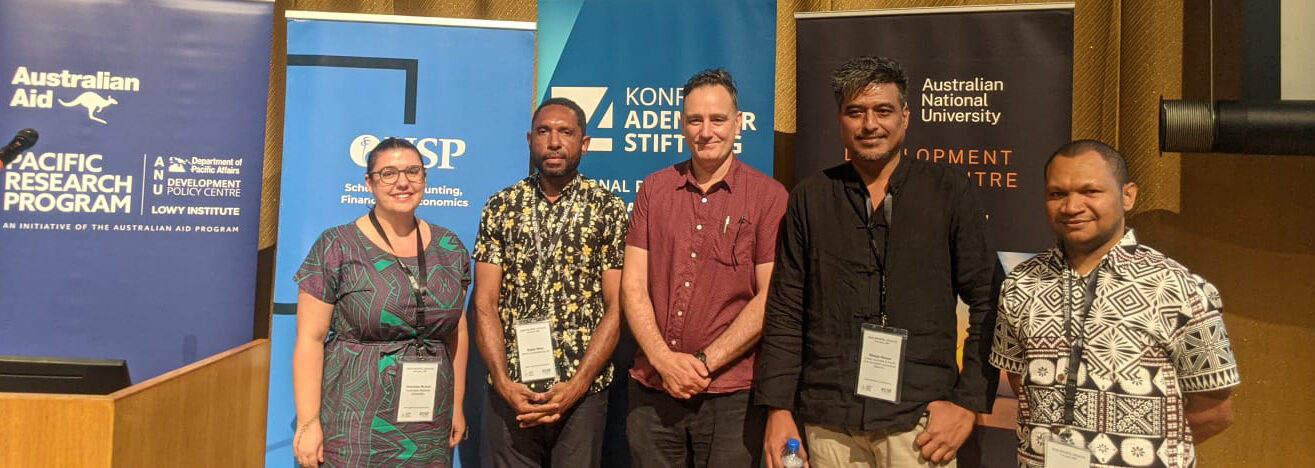

By Grant Walton and team*
At the 2025 Pacific Update, hosted at the University of the South Pacific in Suva, Fiji, at the start of June, three public panels on corruption, anti-corruption and integrity systems set the stage for a smaller gathering of scholars, policymakers and practitioners.
On the second day of the conference, this group came together to confront the region’s corruption challenges, identify gaps in current research and sketch out a possible pathway for future scholarship.
This blog captures their discussion and outlines emerging directions for anti-corruption research in the Pacific.
The tone amongst the participants was mixed. Some voiced deep pessimism, warning that corruption was becoming more entrenched and, as a “wicked problem”, resistant to simple solutions.
There was a sense that longstanding approaches to reduce corruption had failed to live up to their promise of achieving more responsive and accountable governance.
Others pointed to signs of hope, noting stronger leadership and regional cooperation. In particular, they highlighted the Teieniwa Vision, endorsed by the Pacific Islands Forum, as a distinctly Pacific-led call to action on corruption.
Momentum is also visible at the national level, with more Pacific countries establishing anti-corruption agencies, drafting integrity strategies and launching initiatives.
Research suggests there are real opportunities to strengthen responses, particularly through:
- increasing education
- targeting anti-corruption messages
- building political will
- increasing international pressure
- strengthening accountability ecosystems
- supporting independent investigative journalism
- countering collective action problems through coalitions of motivated leaders
- improving cooperation to respond to the security risks associated with corruption
- combating money laundering
- addressing faltering prosecution rates, and
- understanding the economic benefits and corruption risks of citizenship-by-investment schemes.
The group discussed some of the priorities for anti-corruption research and noted that, while there was an increasing amount of research undertaken on corruption in the Pacific, there are still critical gaps in our understanding of how to build effective responses.
Some of the ways these could be addressed included:
- examining how regulatory frameworks support action at local, national and regional scales
- analysing the risks posed by mobile money and informal transfers
- investigating corruption threats linked to infrastructure
- further scrutinising the use of constituency development funds (building on work already done in Solomon Islands and Papua New Guinea)
- understanding the frequent failure of anti-corruption institutions to prosecute perpetrators
- probing corruption risks tied to climate finance and adaptation, and
- researching the potential for civil society and churches to help fight corruption, as well as their potential to contribute to it.
Participants also called for more focus on success stories. For example, improved fisheries governance through the Parties to the Nauru Agreement demonstrates that progress is possible.
More research on such “islands of integrity” could illuminate strategies that work. And identifying positive outliers where social accountability has led to improved service delivery could shed light on strategies that could be expanded and scaled.
Having said this, the group also noted the diversity of the nature of corruption and the formal and informal systems available to combat it.
Every country is different and requires a tailored approach. In line with this, some suggested that more research into Pacific definitions was needed (though it was noted that some research had covered this — see here and here), and that it was “time to walk away from traditional (that is, Western) definitions of corruption”.
Participants also spoke about the significant challenges associated with researching corruption. Some spoke about the threats they have faced in writing about corruption in the region, particularly from political elites but also from some members of the public.
The group discussed the different value “insiders” — those from the communities in which they are studying — and “outsiders” — those who are not — bring to the study of corruption.
There was concern that foreigners could misunderstand the political, economic and cultural complexities of the contexts in which they undertake their research.
At the same time, there was a view that the dangers associated with researching corruption were more acutely felt by those who lived and worked within the countries they studied.
One noted that it can be difficult to gain access to elites once researchers have written about them.
This underlines the importance of locally led corruption research, as well as the challenges it can bring.
It was noted that in some places, fear about corruption had brought about unwieldy rules and regulations that can slow and hamper development. Some were concerned about the auditing requirements of donors, suggesting that while these sometimes overbearing requirements might help reduce corruption, smaller grassroots organisations are less likely to have the infrastructure and personnel to address them.
This can squeeze out smaller organisations and networks that are better able to represent local communities and marginalised groups.
In conclusion, while scholarship on corruption in the Pacific is growing, the discussion underscored that much remains to be done to understand both the nature of the risks posed by this “wicked problem”, and to improve responses to it.
* This article appeared first on Devpolicy Blog (devpolicy.org), from the Development Policy Centre at The Australian National University. It is co-authored by Grant Walton, Henrietta McNeil-Stowers, Teddy Winn, Lisa Denney, Michael Kabuni and Filimoni Rokonadravu. Grant Walton is an associate professor at the Development Policy Centre and the author of Anti-Corruption and its Discontents: Local, National and International Perspectives on Corruption in Papua New Guinea.

You must be logged in to post a comment.