
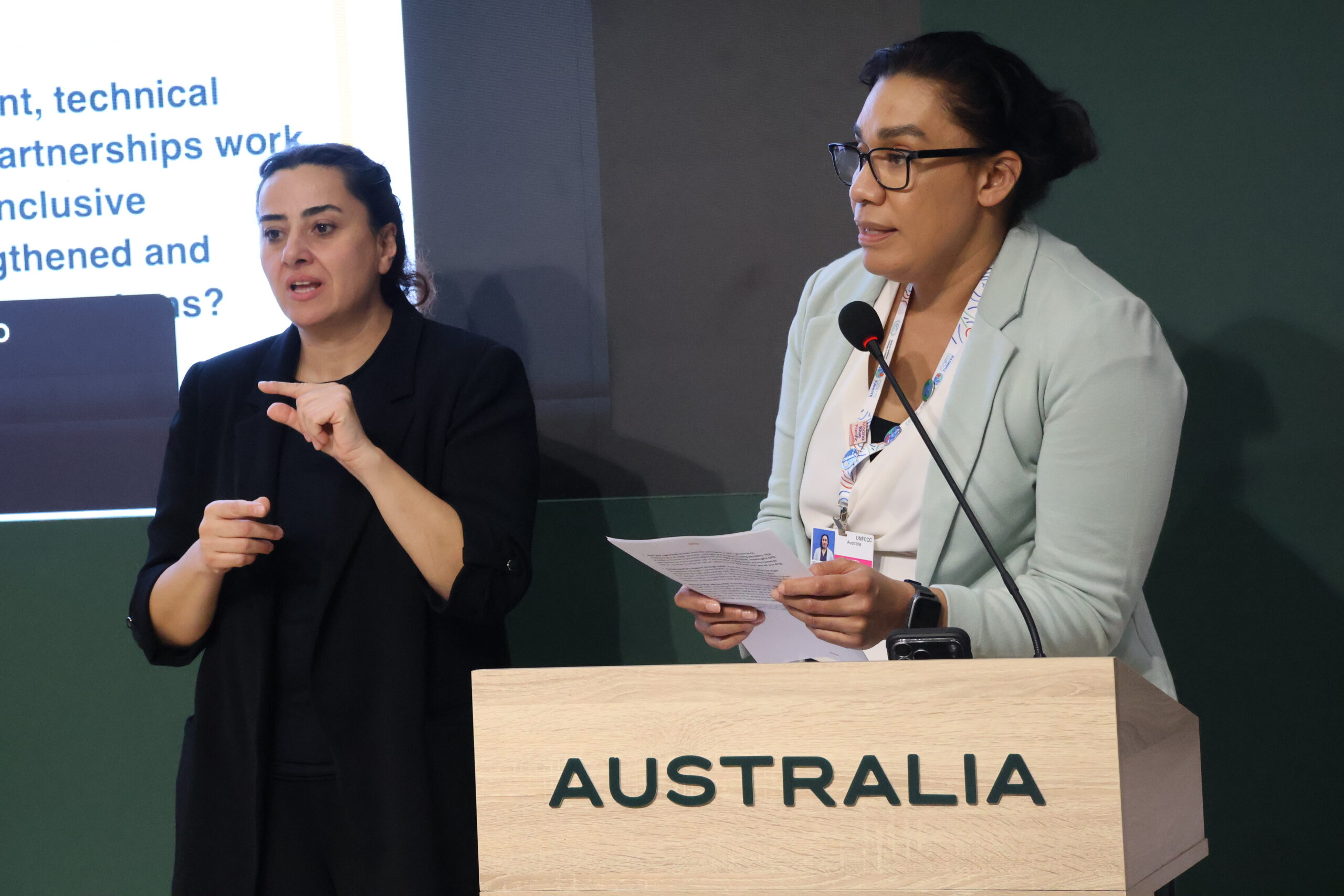
by Charley Piringi in Antalya, Turkiye
Pacific leaders are championing disability-inclusive climate action as the UN Global Disability Fund (GDF) launches its first climate cohort, securing dedicated support for organizations representing persons with disabilities across the region.
Announced at a COP31 side event in the Australian Pavilion in Antalya, organizations from Fiji and Papua New Guinea, have become the first Pacific recipients of the fund, which is supported by the Australian Government.
Under the initiative, Australia is funding grants of up to USD 450,000 for each 24-month, two-phase program. Crucially, at least 10% of each budget must go directly to Organizations of Persons with Disabilities (OPDs).

Emi Tagi, DFAT’s Climate Branch Director, said Australia’s commitment to partnering with the Pacific Disability Forum and the International Disability Alliance.
“Australia recognizes that climate action must be disability equitable and rights based,” Tagi stated. “I very much look forward to the launch of GDF’s first climate cohort and hearing about the grantees’ plans to take forward this important work.”
This landmark initiative aims to connect local Pacific expertise with predictable, accessible funding, ensuring people with disabilities lead and shape climate responses across the region.
Speaking at the launch, Ruth Cross-Kwansing, Kiribati’s Minister for Women, Youth, Sports and Social Affairs and PIF Champion for Gender Equality and Social Inclusion, urged global leaders to secure dedicated budget lines for inclusion.
“Find the budget line for people with disabilities in your next climate project,” she urged. “If there is no line, there is no inclusion, whatever the proposal says.”

“The risk comes from exclusion rather than from impairment,” Cross-Kwansing noted, calling on funders to channel resources directly into existing Pacific disability benefit systems so support reaches local communities faster.
“Labeling it without budgeting is tokenism,” Cross-Kwansing warned, urging leaders to turn commitments into law, clear budgets, and lasting representation. “Nothing about us without us.”
While major climate finance historically failed to provide flexible funding for marginalized groups, these new regional partnerships aim to close the gap and ensure no one is left behind.
This story was produced as part of the COP31 Climate Change Media Partnership, a journalism fellowship organized by Internews’ Earth Journalism Network and the Stanley Center for Peace and Security.
