Clean Energy Powers Next-Generation Infrastructure in Solomon Islands
Australia is expanding its support for climate-resilient infrastructure across the Pacific, with Foreign Minister Penny Wong recently announcing more than SBD$3 billion (AUD$550 million) in new grant financing focused on renewable energy and resilience.
While those investments are still being rolled out, Australian-backed projects in the Solomon Islands are already demonstrating how clean energy can support public infrastructure.
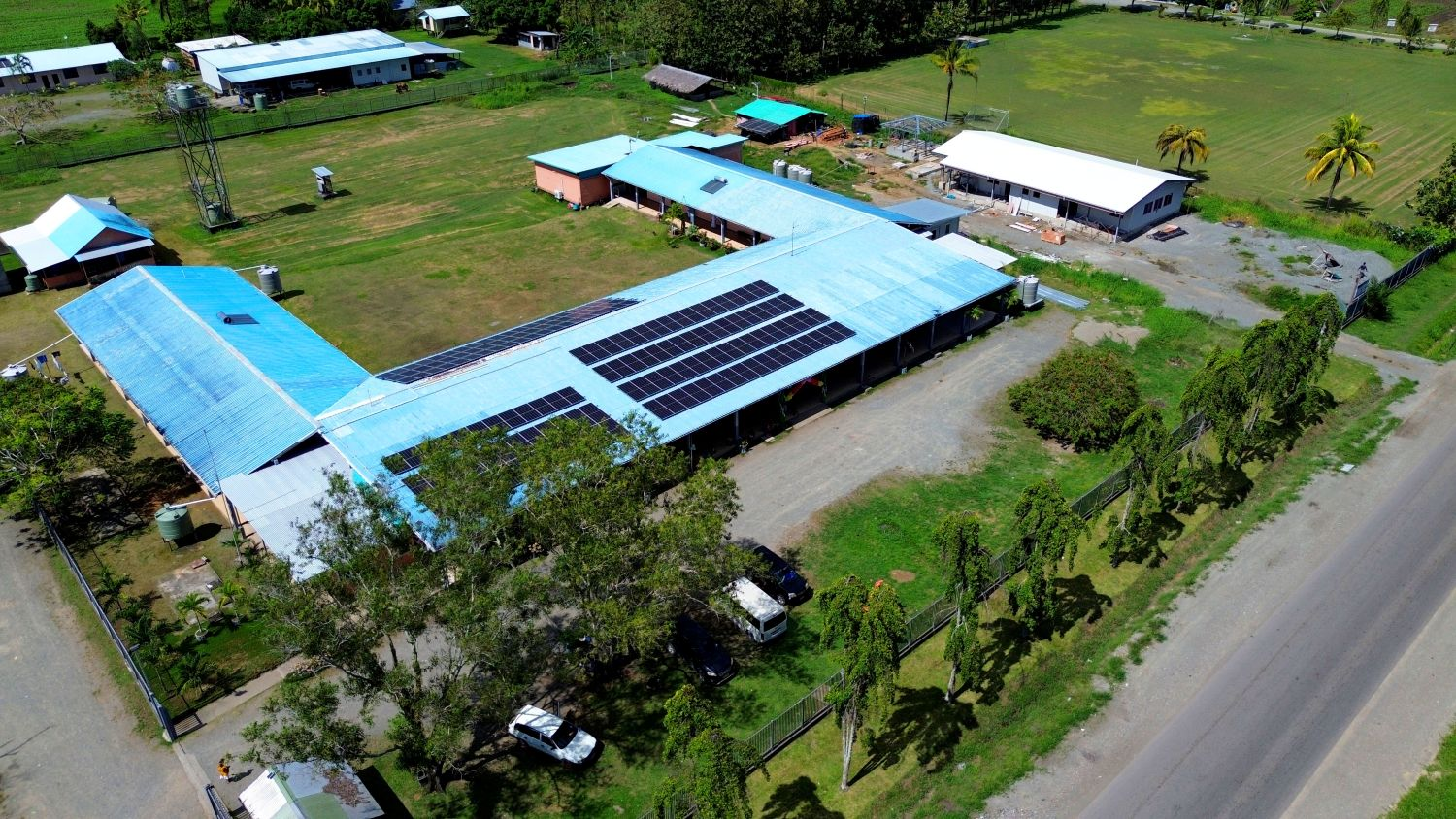
Building shading and cross-ventilation will keep Naha Birthing and Urban Health Centre cool, while 350 solar panels installed on the roof will power it’s daytime energy needs.
At the soon-to-open Naha Birthing and Urban Health Centre in the capital, Honiara, around 350 solar panels will supply the facility’s daytime electricity needs. Solar-powered systems have also been installed at public markets in Buala, Malu’u, and Seghe, providing safer and more accessible spaces for vendors and overnight users.
The solar system at Buala Market generates about 29 kilowatts of power, with battery storage capable of maintaining essential lighting for up to a week during prolonged cloudy or rainy conditions. Such installations aim to reduce reliance on diesel generation while improving service reliability.
The solar and battery system at Buala Market will support clean, renewable power to essential services event during extended periods of rain.
Australia’s High Commissioner to Solomon Islands, Jeff Roach, said the two countries share a commitment to lowering emissions and supporting climate goals under the Paris Agreement. He noted that renewable energy sources — including solar, wind, and hydropower — can also reduce operating costs for public infrastructure.
“Green power not only makes climate sense, it lowers operating costs and reduces exposure to global fuel price volatility,” Mr Roach said. “This allows governments to spend less on energy and more on essential services.”
Work is also progressing on the Tina River Hydropower Development, the Solomon Islands’ first large-scale hydropower project, which is expected to provide more reliable electricity to Honiara. Australia is funding the construction of 22 kilometres of transmission lines linking the facility to the city’s grid, along with access roads and project offices, as part of its largest climate-financing investment in the Pacific in partnership with international development banks.
Australia is working with local suppliers to ensure Solomon Islands has the workforce to install and maintain solar power systems.
Beyond power generation, climate-smart design principles are being applied to infrastructure development. At the Naha health facility, planners incorporated shading, cross-ventilation, and landscaped spaces to reduce heat retention and lower energy use compared to conventional buildings.
Australia has also supported the installation of a solar–battery–diesel hybrid system at Good Samaritan Hospital in Guadalcanal Province. Serving more than 60,000 people, the system has so far operated without relying on diesel, improving energy security while cutting costs.
Regional initiatives are also underway. The AUD 75 million Renew Pacific programme is supporting off-grid renewable energy projects across the Solomon Islands and other Pacific nations, while working with local suppliers to build technical skills for installation and maintenance.
Taken together, these projects reflect a broader push toward sustainable infrastructure aimed at reducing emissions, improving energy reliability, and supporting long-term development across Pacific island communities.




You must be logged in to post a comment.