
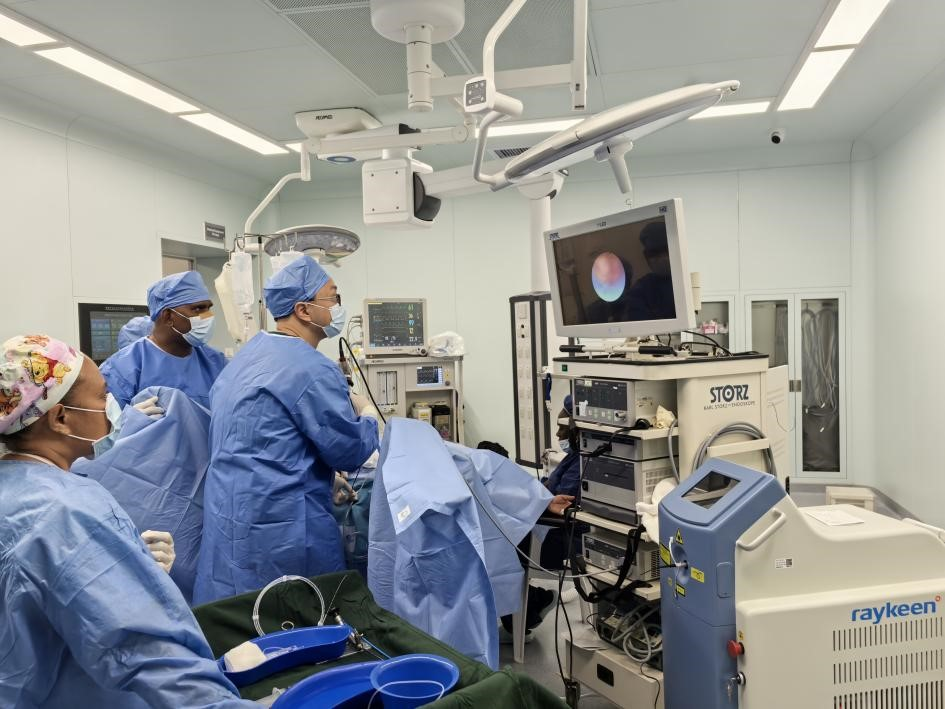
With technical support from China, Solomon Islands has successfully performed its first holmium laser minimally invasive kidney stone lithotripsy, marking a major milestone in the country’s urological care and bilateral health cooperation.
On 22 January 2026, the 4th China Medical Team, working alongside the urology team at the National Referral Hospital (NRH), completed the country’s first flexible ureteroscopic holmium laser lithotripsy on a patient with right kidney stones.
The breakthrough procedure represents a significant advancement in the diagnosis and treatment of urinary tract stones in Solomon Islands and ushers China–Solomon Islands urological cooperation into a new phase.
Addressing a Longstanding Clinical Challenge
Kidney stones are a common and serious health issue in Solomon Islands.
Limited medical resources and delayed diagnosis have meant that many patients present with advanced disease, including large or impacted stones, hydronephrosis, and impaired kidney function.
For decades, treatment has relied largely on open surgery, which carries higher risks, longer recovery times, and greater physical and financial burdens for patients.
The introduction of minimally invasive alternatives has therefore been a long-standing clinical priority.
China-Backed Project Enables Technology Transfer
This gap has been systematically addressed through the China–Solomon Islands Urology Minimally Invasive Surgery Center Project, initiated by China’s National Health Commission.
The project has provided comprehensive support, including equipment donations, technology transfer, and specialist training.
Key equipment such as holmium laser lithotripsy systems and laser fibers has been installed, enabling Solomon Islands to adopt modern minimally invasive techniques.
Prior cooperation has already enabled successful treatment of bladder and ureteral stones, building strong local expertise and teamwork.
Precision Surgery With Minimal Trauma
The landmark kidney stone procedure was jointly planned by Dr. Chen Xulong of the China Medical Team and Dr. Augustine Melly of the NRH urology department following detailed preoperative assessment.
Using a flexible ureteroscope inserted through the body’s natural urinary tract, surgeons reached the kidney without any external incision.
The stone was precisely fragmented with a holmium laser and removed using a negative-pressure suction system, highlighting the key advantages of minimally invasive surgery—high precision, minimal trauma, and faster recovery.
Rapid Recovery and Systemic Impact
The patient recovered smoothly, experienced no significant postoperative discomfort, and returned quickly to normal daily activities.
The success demonstrates the safety and effectiveness of minimally invasive surgery in reducing risks and accelerating rehabilitation.
With this achievement, Solomon Islands is transitioning from a system heavily dependent on open surgery toward minimally invasive management of urinary stone disease, reserving traditional methods for only the most complex cases.
Building Local Capacity and Sustainable Care
Reflecting on the milestone, Dr. Augustine Melly said the opportunity to study in China and receive hands-on mentorship had transformed local medical capacity.
“Today, I am able to independently relieve my fellow citizens of suffering that once seemed unavoidable. China–Solomon Islands medical cooperation has not only raised our clinical skills but also brought renewed hope to patients.”
Zhao Xueke, leader of the 4th China Medical Team, said the procedure marks a shift from isolated technical breakthroughs to systematic capacity building.
Looking ahead, the team will continue to use the Urology Minimally Invasive Surgery Center as a platform to expand training, standardise procedures, and ensure more patients can access advanced, high-quality care locally, without the need for overseas treatment—deepening China–Solomon Islands health cooperation and contributing to a shared vision of global health for all.
