
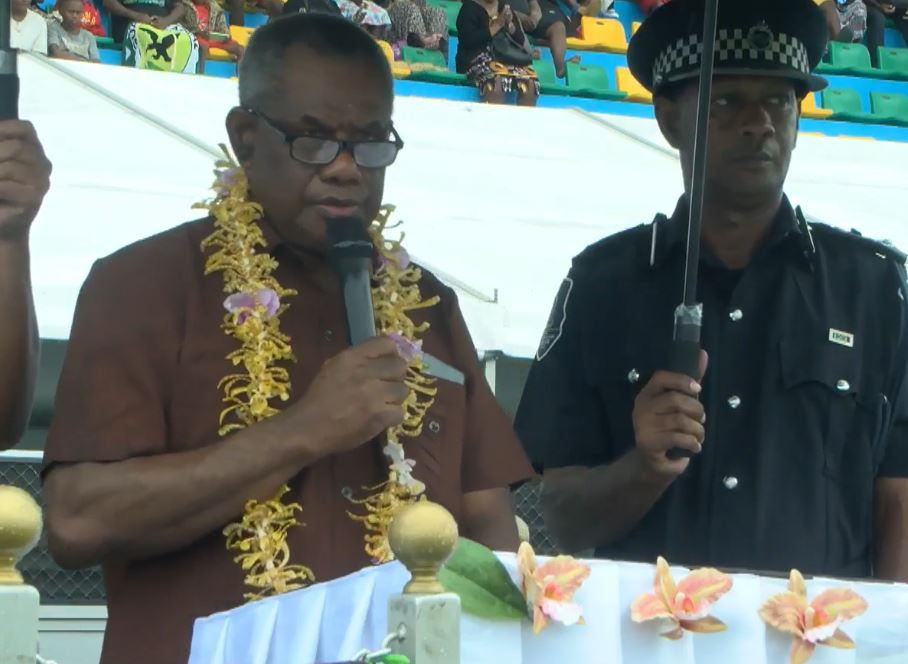
Guadalcanal Province has renewed its push to become a state under a future federal system of government, with Premier Willie Atu announcing the province’s ambition to achieve statehood by 2028.
Speaking at the province’s 42nd Second Appointed Day celebration in Honiara today, Atu said Guadalcanal’s aspiration for statehood remained stronger than ever and called on national leaders to support the constitutional reforms needed to make it possible.
“Statehood for Guadalcanal Province is not negotiable and our desire for this is now far greater than ever before since 1988 and 1998,” Atu stated.
“We are proposing 2028 for Guadalcanal Province to become the State of Guadalcanal,” he added.
Guadalcanal, with a population of 154,022 people, staged a four-day celebration at the grounds of Panatina Village, east Honiara, that culminated in the official event today.
Atu said the province had already established a state office and completed a report outlining its readiness for statehood under the proposed federal system.
The report, he said, would be submitted to the Constitution Reform Unit for consideration.
Guadalcanal’s push for greater autonomy comes as the country continues discussions on constitutional reform and the proposed transition from the current unitary system to a federal system of government.
Atu said the province’s renewed campaign was based on its economic contribution, population growth and the need for greater control over resources and service delivery.
He cited national data showing Guadalcanal contributes about 31 percent of Solomon Islands’ gross domestic product (GDP), but receives only around 10 percent in return.
“Despite having one of the largest average household incomes, Guadalcanal is ranked as the second poorest province in Solomon Islands,” he said, highlighting what he described as inequality between urban areas around Honiara and rural communities.
The premier also used the anniversary celebration to highlight what he described as major improvements in the province’s financial management and governance.
He said Guadalcanal Province had become debt-free from all officially recorded debts and had achieved its first qualified audit opinion for the 2022–2023 financial year since becoming a province in 1984.
Atu said the province had recorded increased revenue collections and budget surpluses over the past three years, allowing it to establish a reserve fund with a commercial bank.
He also announced that the province had invested $1 million in Central Bank Treasury Bonds in the 2025–2026 financial year, earning an estimated annual interest of $20,000.
The premier said the investment reflected the province’s intention to create sustainable sources of revenue beyond government grants and donor support.
Major Infrastructure Investments
Atu also highlighted several major development projects funded through the Provincial Capacity Development Fund (PCDF), including $35 million allocated for 36 projects in the 2026–2027 budget.
He said the projects would support education, health, climate resilience, community development and economic opportunities across Guadalcanal.
The province has also invested $11.8 million in 12 bridges and two footpaths, while undertaking surveys for future road connections between Au and Marau, and Lambi and Variana.
Atu pointed out that improving road connectivity was critical to helping rural communities transport agricultural produce to markets in Honiara.
The province has also committed $8.6 million towards the development of a new provincial station at Makaruka, which he said would become a future administrative and economic centre.
The Premier used the anniversary theme, “Empowering Guadalcanal for National Unity and Prosperity,” to call for stronger decentralisation of powers, fairer resource sharing and improved provincial capacity.
He said true empowerment of provinces required the transfer of administrative functions and legislative authority closer to communities.
“Provincial governments are better positioned to deliver responsibilities and promote national unity and prosperity going forward,” he said.
Atu also called on the national government to ensure provincial audits were completed annually, saying transparency and accountability were critical for good governance.
Demand For Greater Services
The Premier renewed calls for Guadalcanal to have its own provincial hospital, arguing that population growth and pressure on the National Referral Hospital required additional health facilities.
He said Guadalcanal’s population was growing at about 3.2 percent annually, creating increasing demand for health, education and infrastructure services.
He also called for the reopening of provincial airstrips, including Marau, Aola and Babanakira, to support tourism and economic growth.
Education And Economic Future
Atu said the province had prioritised education by clearing outstanding debts owed to Solomon Islands National University and investing about $12 million towards implementing the Education Act.
He said education was central to building the province’s future workforce and supporting its long-term development goals.
“Guadalcanal’s vision was to become a financially self-reliant model province by 2030 through revenue from government transfers, taxation and investments.
“We would continue working with the national government, investors, donors and communities to achieve sustainable development,” he stated.
