
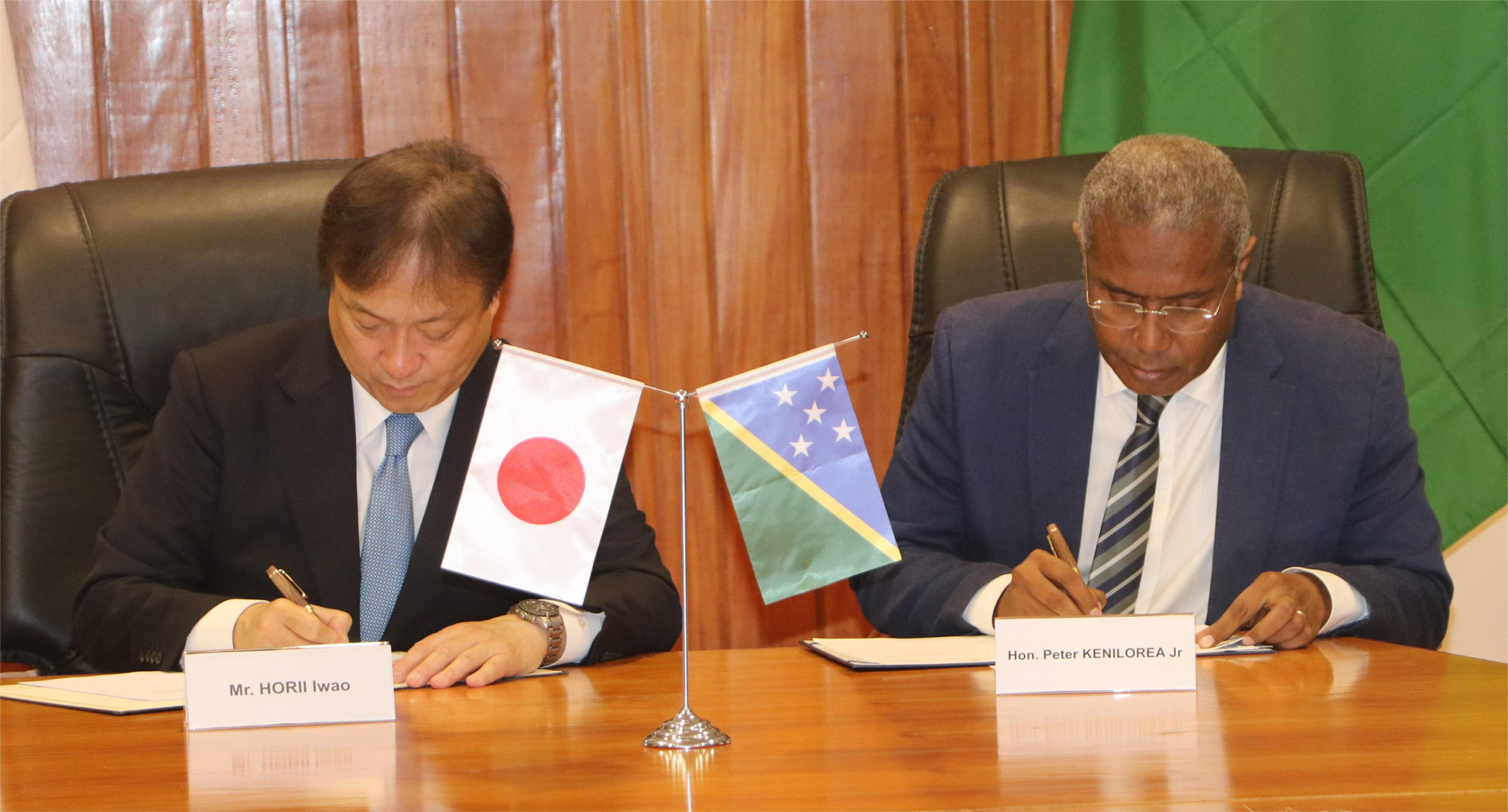
Solomon Islands and Japan today signed two grant agreements worth 294 million Japanese Yen (SBD14,633,217.75) to strengthen the country’s public service and improve malaria diagnosis.
Acting Minister for Foreign Affairs and External Trade, Peter Kenilorea Jr, and Japan’s State Minister for Foreign Affairs, Iwao Horii, exchanged diplomatic notes during a signing ceremony in Honiara.
The first agreement provides 126 million Japanese Yen (about SBD6.2 million) for the Project for Human Resource Development Scholarship (JDS).
Minister Kenilorea said the scholarship programme will enable Solomon Islands public servants to pursue Master’s degrees in Japan, helping build the skills needed to strengthen the country’s public sector.
“By supporting postgraduate study in Japan, this programme builds the knowledge, leadership and technical expertise our public service needs to meet our country’s evolving development challenges,” he said.
Horii said the project is designed to develop future policy-makers within the Solomon Islands public service while strengthening ties between the two countries.
“Through this project, we hope to build multi-layered people-to-people relationships and networks between Japan and Solomon Islands,” he said.
The scholarship programme has already enabled a number of Solomon Islands officials to study at Japanese universities.
Under the second agreement, Japan will provide 168 million Japanese Yen to the Ministry of Health and Medical Services to procure modern equipment for malaria diagnosis.
Minister Kenilorea said malaria remains a major public health challenge, particularly in remote and rural communities where cases have been increasing.
“Modern diagnostic equipment will improve the accuracy and speed of case detection, enabling health workers to provide timely treatment and strengthening disease surveillance nationwide,” he said.
Horii said the assistance comes in response to the recent surge in malaria cases.
“We strongly hope that this programme will enable the early detection and treatment of malaria, thereby reducing the risk of severe illness and death,” he said.
Both ministers reaffirmed the strong relationship between Solomon Islands and Japan, which has spanned more than four decades since diplomatic relations were established in 1978.
“Today’s signing reaffirms the enduring partnership between Japan and Solomon Islands, and our shared commitment to the well-being of the people of Solomon Islands,” Minister Kenilorea said.
Horii also noted that Japan will host the 11th Pacific Islands Leaders Meeting (PALM 11) in Yokohama next northern summer.
“We look forward to further strengthening our ties with Pacific Island countries, including Solomon Islands, through discussions on common issues such as climate change and the environment,” he said.
Minister Kenilorea acknowledged the Government of Japan, the Ministry of Foreign Affairs of Japan and the Japan International Cooperation Agency (JICA) for their support in making the two agreements possible.
Japan is one of Solomon Islands’ long-standing partners that has funded many critical infrastructure projects across the country.
Among them are the Honiara Highway Road Project, Honiara Central Market, the Honiara International Airport terminal, Gizo Hospital in Western Province, Auki Market and Wharf, and the soon-to-be-completed Kilufi’i Hospital in Malaita.
