
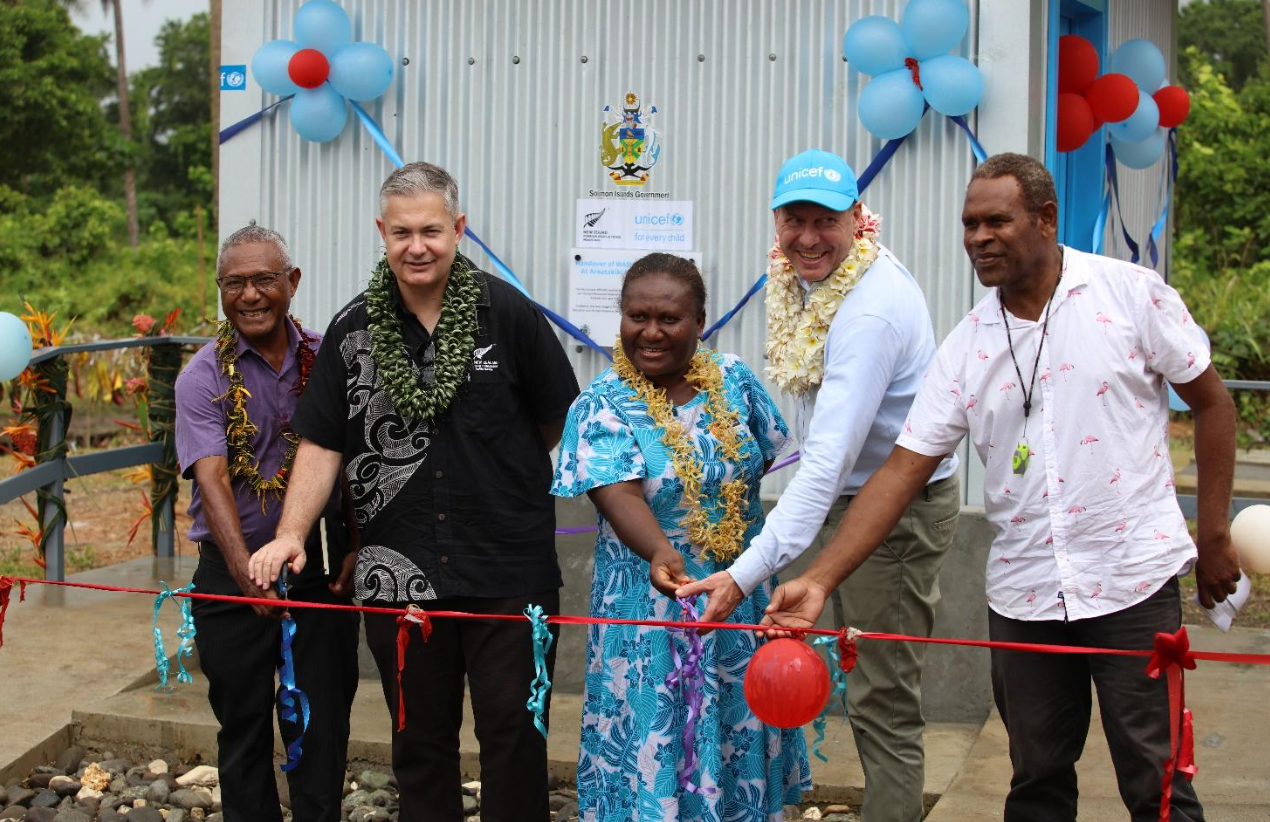
On 25 November 2025, students at Aretakiki Primary School in Central Guadalcanal celebrated a milestone with the opening of new clean water, safe toilets, and hygiene facilities – bringing dignity, health and opportunity to every child.
The Government of New Zealand and UNICEF, in collaboration with the Solomon Islands Ministry of Education and Human Resources Development (MEHRD), officially handed over two newly constructed Water, Sanitation and Hygiene (WASH) facilities to Aretakiki SDA Primary School in Guadalcanal Province.
Launched in 2021 through a partnership between UNICEF, MEHRD and the New Zealand Ministry of Foreign Affairs and Trade (MFAT), this initiative seeks to strengthen access to safe water and sanitation at Schools in Solomon Islands.
Through the WASH in Schools Programme, students at Aretakiki SDA Primary Schools have access to safe drinking water, girls and boys toilets, a girl’s shower to promote girl’s health, handwashing facilities and a water storage system.
“Before these new facilities, we were using open pit toilets, which were very unhygienic. Now, with the new facilities in place, we are very happy because they help create a healthier, safer school environment and promote lifelong good hygiene and wellbeing for our students,” said Don Mauria, the chairman of Aretakiki school board.
Mr Mauria thanked the New Zealand Government, UNICEF and MEHRD for this partnership.
The Solomon Islands Government and its partners are making important strides in bringing clean water, safe toilets, and hygiene facilities to more schools and clinics across the country. Yet challenges remain – more than half of all educational facilities still do not have reliable access to these essential services, highlighting the ongoing need for investment and collaboration.
A 2024 WASH in Schools survey conducted by MEHRD and UNICEF shows that just over two-fifths of schools (41%) provide a basic level of water service, while nearly half (47%) provide a limited service and 12% provide no service. Nationally, basic sanitation coverage is low, nearly half (49%) provide a limited sanitation service, and 45% of schools have no sanitation facilities at all.
Permanent Secretary Dr Franco Rodie highlighted that good health is essential for quality education. Water, sanitation, and hygiene facilities are more than physical structures — they represent safety, dignity, respect and opportunity. These facilities support students learning without disruption or health risks, and they provide an important foundation for understanding and practicing good hygiene.
Dr Rodie also thanked the New Zealand Government for the funding support, and UNICEF for the coordination and implementation of the project.
This project forms part of the Government of New Zealand’s financial support for WASH in Schools in Solomon Islands, totalling NZ$2,927,831 between 2021 and 2026.
His Excellency Jonathan Curr, New Zealand High Commissioner to the Solomon Islands, emphasised that “When children have safe toilets and clean water at school, they can focus on learning and thriving. That’s why New Zealand is proud to support efforts to deliver WASH facilities to schools in Solomon Islands. I wish the students of Areatakiki Primary School many happy and healthy years ahead.”
Supported by the New Zealand High Commission and led by MEHRD, UNICEF is building WASH facilities in 20 schools across Honiara and Guadalcanal Province. Through the programme, over 5,000 students and 250 teachers will benefit from access to improved water, sanitation and hygiene services.
Benjamin Grubb of UNICEF emphasized the project’s far-reaching impact.
“This initiative is about more than just new facilities – it’s about giving every child the chance to learn, grow, and thrive in a safe and healthy environment. When children no longer have to worry about access to clean water or safe toilets, they can focus on what truly matters: their education and their dreams for the future.”
This project highlights the collaborative efforts of the Government of the Solomon Islands, the New Zealand Ministry of Foreign Affairs and Trade, UNICEF and local communities to enhance access to education for schoolchildren, promote good hygiene practices and improve educational outcomes.
