
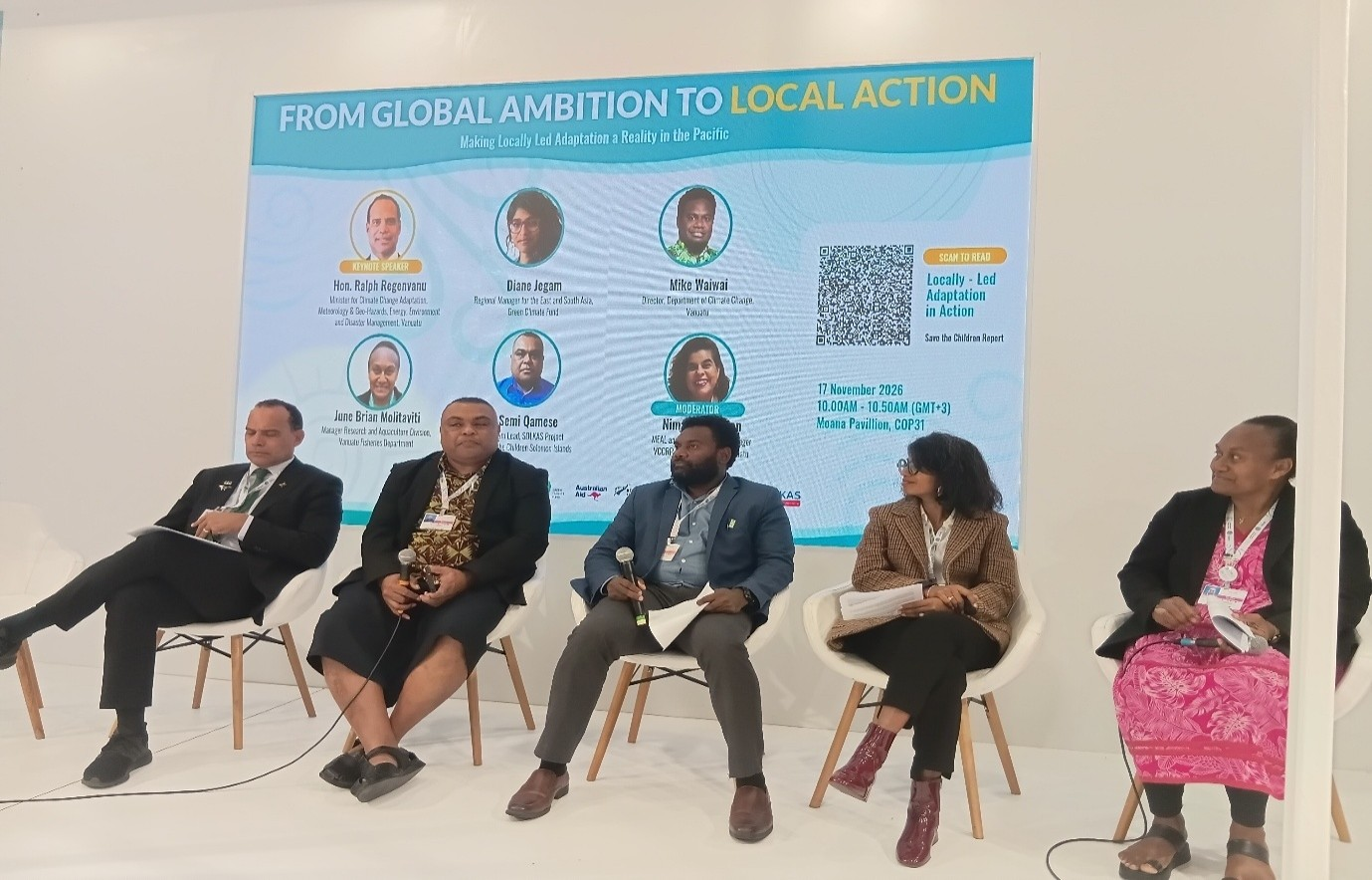
At this week’s global climate summit in Antalya, Pacific leaders highlighted that locally led adaptation has moved from a goal to a concrete reality.
Through initiatives such as the Vanuatu Community-based Climate Resilience Project (VCCRP) and the Solomon Islands Knowledge-Action-
The message headlined the high-level side event From Global Ambition to Local Action: Making Locally Led Adaptation a Reality in the Pacific at the Moana Blue Pacific Pavilion on Saturday 16 November. It built on a pre-COP31 side event hosted by the Government of Vanuatu in Fiji, and was complemented by a Solomon Islands-led dialogue, Financing the Frontlines: From Pacific Communities to Climate Action—Unlocking Locally Led Pathways for Delivering Climate Finance Where It Matters Most.
Delivering the keynote in Antalya, Vanuatu’s Minister for Climate Change Adaptation, Meteorology and Geo-Hazards, Energy, Environment and Disaster Management, Ralph Regenvanu, said communities were confronting threats to food and water security, livelihoods, infrastructure and natural resources, and that the era of mere consultation had to end.

Global ambition, he said, must be matched by local delivery.
In Vanuatu, VCCRP is supporting climate-resilient agriculture, fisheries, natural resource management, disaster risk reduction and stronger local institutions.
In Solomon Islands, SOLKAS—led by Team Lead Semi Qamese of Save the Children Solomon Islands with Climate Change Advisor Joseph Mutsigwa—works through Community Resilience Assessments (CRAs) and Community Adaptation Plans (CAPs).
These enable communities to identify risks and prioritize practical fixes such as climate-smart agriculture, water security, rainwater harvesting, renewable energy, school connectivity and community-based disaster risk management, with investment extended to schools, essential services and provincial institutions.
Ralph RegenvanuMinister for Climate Change and Adaptation,
Meteorology and Geo-Hazards,Energy Environment and
Disaster Management
PC: Renie Anderson Pacific Programmes
Both projects showed adaptation succeeding by combining traditional knowledge, community priorities, scientific climate information and institutional support—shaped island by island rather than copied from one place to the next, speakers said.
Much of the talk was about money. Delegates said small island developing states face geographical isolation, high implementation costs, limited institutional capacity and logistical challenges.
They called for more flexible and predictable finance, for communities to hold real decision-making power throughout the process, and for financing architecture built around Pacific realities.
Diane Jegam, Regional Manager for East and South Asia at the Green Climate Fund, said partnerships were essential to translating ambition into tangible results.
Solomon Islands Minister for Environment, Climate Change, Disaster Management and Meteorology, Honourable Wayne Kituru Ghemu, who opened the Financing the Frontlines dialogue, said lasting impact depended on investment in climate-resilient schools, youth engagement, child-sensitive adaptation and mechanisms for young people to participate meaningfully in decision-making.
Qamese used the same forum to promote the SOLKAS Youth Incubators Model, urging delegates to put children and young people at the centre of climate finance by turning youth ideas into enterprises and livelihoods.
Contributions also came from Justine Audrain, Global Lead for the Local Facility at the United Nations Capital Development Fund; Karlos Lee Moresi, Team Leader and Programme Adviser for Climate Finance and Resilience at the Pacific Islands Forum Secretariat; Fred Siho Patison, Ambassador and Special Advisor for Climate Change Diplomacy and Environmental Affairs; and officers from the Office of the Prime Minister of Solomon Islands.
The Moana Pavilion panel brought together Minister Ralph Regenvanu; Mike Waiwai, Director of the Vanuatu Department of Climate Change; June Brian Molitaviti, Manager of the Research and Aquaculture Division in the Vanuatu Fisheries Department; Semi Qamese, SOLKAS Team Lead; and Diane Jegam of the Green Climate Fund, moderated by Nimarta Khuman, Monitoring, Evaluation, Accountability and Learning and Programme Quality Manager for VCCRP with Save the Children Vanuatu.
As negotiations continued, Vanuatu and Solomon Islands concluded that the knowledge and solutions already exist in Pacific villages, and that what is now needed is sustained climate finance, stronger institutional support and meaningful partnerships—to move from demonstrating what works to scaling it, so no Pacific island community is left behind.
