
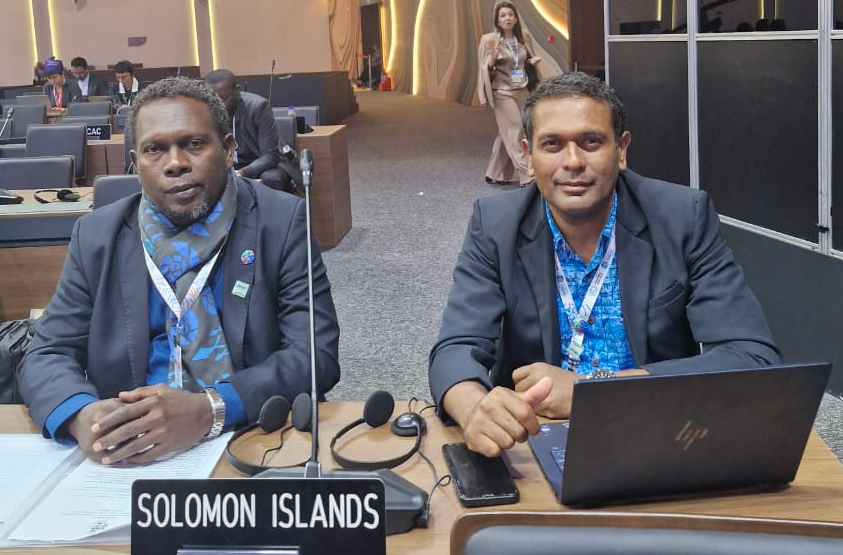
by Georgina Maka’a in ANTALYA, Türkiye
For Solomon Islands, a transition cannot be considered just simply because it is fast or technically achievable.
That was the message from Minister of Environment, Climate Change, Meteorology and Natural Disasters Management Wayne Ghemu at Monday’s Fourth Annual High-Level Ministerial Roundtable on Just Transition, where he shared his country’s reflections on what a genuinely fair shift to clean energy requires.
Solomon Islands aligned itself with statements delivered by Samoa on behalf of AOSIS and Vanuatu on behalf of the Pacific Small Island Developing States.
Ghemu said Solomon Islands views the UAE Just Transition Work Programme as crucial in guiding parties toward equitable and inclusive transition pathways to achieve the goals of the Paris Agreement, stating that the dialogues and annual ministerial roundtables offer valuable opportunities to exchange experiences, share lessons, and learn from countries at different stages of their transition.
As a least developed country and a small island developing state, Solomon Islands continues to face significant barriers to transition.
While the country has made positive strides in establishing the necessary domestic policy frameworks, Ghemu said translating these into practical implementation remains challenging.
Drawing on Solomon Islands’ experience implementing renewable energy and electrification projects, he stressed the need for carefully planned transition pathways.
Much of the country’s existing infrastructure, skills, and institutional capacity has been built around fossil fuels, he said, while transitioning to cleaner energy and building resilience involves substantial upfront costs.
“To ensure no one is left behind, those pathways must fully consider their social, economic, and international dimensions,” Ghemu stated.
Ghemu also welcomed the establishment of the Just Transition Mechanism under Decision 2/CMA.7 at COP30, saying its mandate to enhance international cooperation, technical assistance, capacity-building, and knowledge-sharing and to enable equitable and inclusive transitions provides an important opportunity to strengthen support for developing countries.
The mechanism, he said, must be implementation-focused and operationalized equitably, taking into account the specific vulnerabilities and limited resource base of countries such as Solomon Islands. It should facilitate international cooperation and mobilize concrete support, including environmentally sound technologies, technical assistance, and capacity-building to address existing vulnerabilities and strengthen resilience.
The minister said the design and operationalization of the Mechanism must advance at COP31 and be closely aligned with the review of the work program. It should also strengthen linkages with relevant UNFCCC processes, including the Global Stocktake, NDCs, and National Adaptation Plans.
Its institutional arrangements and governance, he added, must remain firmly grounded within the UNFCCC process.
Ghemu explained that its functions should recognize the special circumstances of SIDS, support pathways consistent with the 1.5°C goal, and facilitate access to the necessary means of implementation while upholding the principles of a just transition.
