
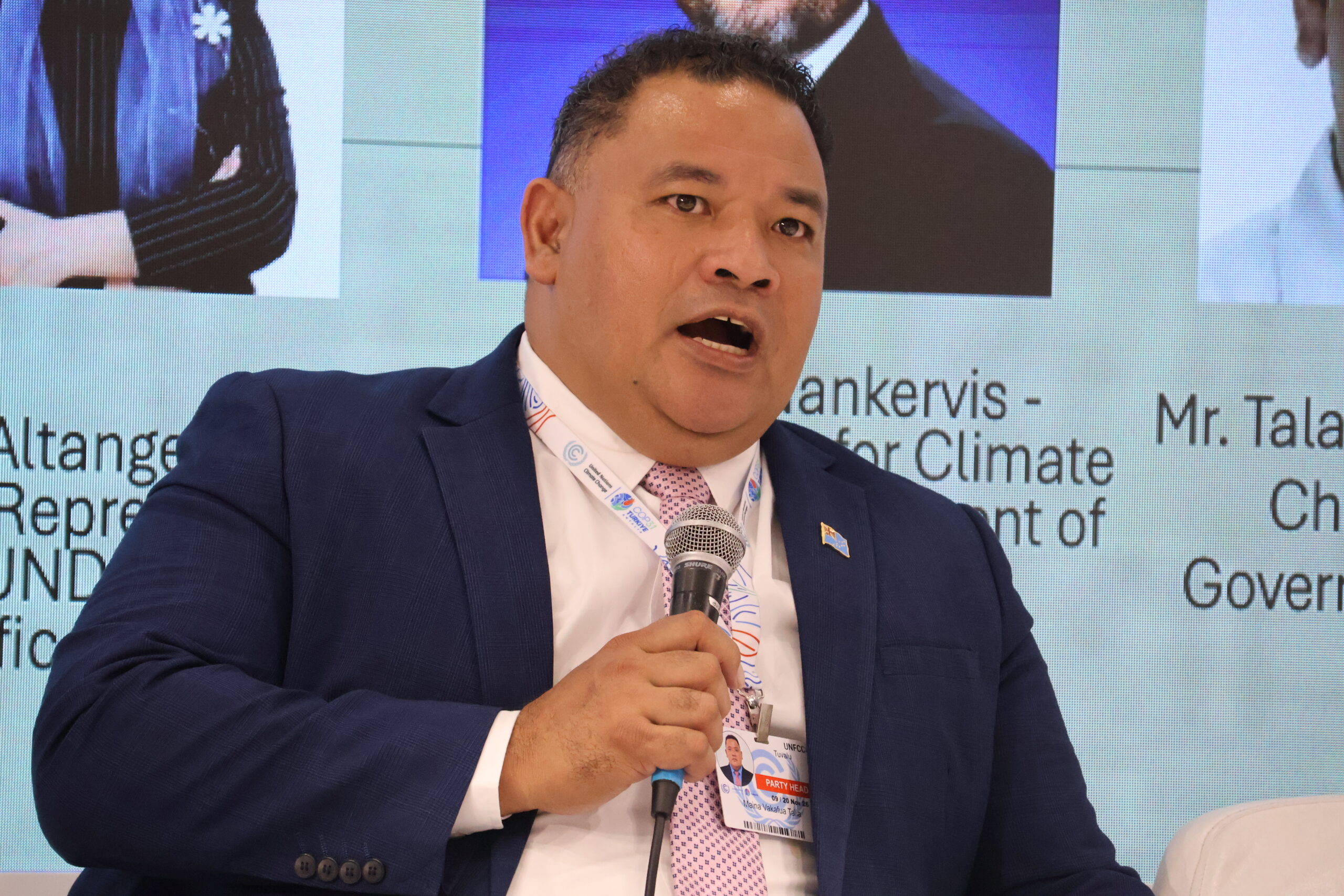
by Charley Piringi in Antalya, Turkiye
Tuvalu demanded major polluters honor their Paris Agreement legal obligations by providing direct grants, rather than loans, to frontline Pacific nations.
Speaking to In-Depth Solomons, Dr. Maina Talia, Tuvalu’s Minister for Climate Change and Environment, condemned financial proposals that force vulnerable countries into debt to survive a crisis created by others.
“We shouldn’t be borrowing money to buy our way out of this issue. The polluters pay principle must be enforced,” Dr. Talia urged. “They pollute, they pay… Why do we have to borrow to buy our way out of something where our contribution is almost zero?”
The Pacific Islands account for negligible amounts of global greenhouse gas emissions, yet faces an immediate threat from rising seas and extreme weather.
Standing no more than three meters above sea level with no rivers or mountains, the low-lying atoll nation relies entirely on rainfall and is currently braving intense El Niño weather patterns.
Dr. Talia dismissed arguments from developed nations citing domestic politics and military spending to justify withholding climate finance, warning that global leaders are prioritizing market stability over human survival.
“If we are to treat climate change as a threat to national security, then maybe other countries will stop diverting money,” he said. “We really need to tell the rich countries that this race for survival is not about saving the economies. It’s about doing the right thing. It’s about justice for Pacific Islands and small Island states. It’s about survival of people.”
The Minister’s call highlights ongoing friction between island states and international finance institutions, which continue to deploy debt-based instruments across the region.
Responding to challenges faced by small island states with limited fiscal space and administrative capacity, the World Bank Group highlighted specialized mechanisms designed to ease access to development capital.
World Bank Global Director for Climate James Fergasson explained that vulnerable island nations receive dedicated access under the International Development Association (IDA).
“Small island states have a specific window, small country allocation in our IDA window to make sure that they are accessing that lowest cost of capital,” Fergasson said.
Acknowledging that small states struggle to engage with multiple lending agencies while facing severe cyclones and economic shocks, the Bank is implementing mutual reliance arrangements, such as joint operations with the Asian Development Bank, so governments face a single counterpart.
The World Bank is expanding disaster risk toolkits, including climate-resilient debt clauses that allow nations to pause debt service payments during major natural disasters, alongside contingent lines of credit.
Despite these low-cost capital options and flexible terms, Pacific leaders like Dr. Talia maintain that frontline island nations fighting for their survival should not be burdened with debt for a crisis they did not create.
This story was produced as part of the COP31 Climate Change Media Partnership, a journalism fellowship organized by Internews’ Earth Journalism Network and the Stanley Center for Peace and Security.
